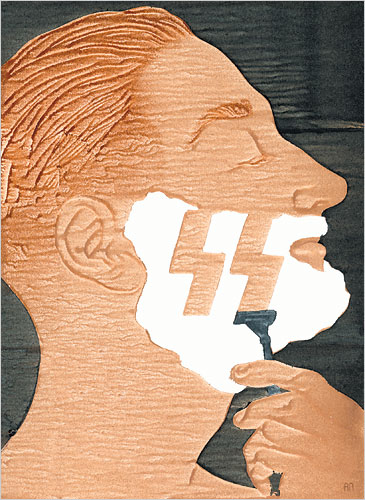
and a cloud of dust onto us

Nearby, another group was being brought up: my gaze met that of a beautiful young woman, almost naked but very elegant, calm, her eyes full of an immense sadness. I moved away. When I came back she was still alive, half turned onto her back, a bullet had come out beneath her breast and she was gasping, petrified, her pretty lips trembled and seemed to want to form a word, she stared at me with her large surprised incredulous eyes, the eyes of a wounded bird, and that look stuck into me, split open my stomach and let a flood of sawdust pour out, I was a rag doll and didn’t feel anything, and at the same time I wanted with all my heart to bend over and brush the dirt and sweat off her forehead, caress her cheek and tell her that it was going to be all right, that everything would be fine, but instead I convulsively shot a bullet into her head, which after all came down to the same thing, for her in any case if not for me, since at the thought of this senseless human waste I was filled with an immense, boundless rage, I kept shooting at her and her head exploded like a fruit, then my arm detached itself from me and went off all by itself down the ravine, shooting left and right, I ran after it, waving at it to wait with my other arm, but it didn’t want to, it mocked me and shot at the wounded all by itself, without me; finally, out of breath, I stopped and started to cry. Now, I thought, it’s over, my arm will never come back, but to my great surprise it was there again, in its place, solidly attached to my shoulder, and Häfner was coming up to me and saying, “That’s enough, Obersturmführer. I’ll take over for you.”

— Jonathan Littell, The Kindly Ones

What it’s like to edit at Hustler

When Eric Althoff answered a Craigslist ad for a copy editor for a publication with adult content, he had no idea that he’d soon work for one of the most famous (or infamous) magazines in America: Hustler.

But that’s exactly what Althoff did for four years, editing copy for the pornographic magazine and doing some reporting for it as well. He met porn stars, rock stars and publisher Larry Flynt. Althoff shared his experiences at a session at the ACES conference titled “Even Porn Needs Style.”

In some ways, Althoff said, working at Hustler was like working at any other magazine, dealing with page layouts and production deadlines. Larry Flynt Publications had what he called a “conservative corporate environment.”

The content of Hustler, of course, is hardly conservative. The copy that Althoff worked with contained what he called “the saucy language and colorful terms” of porn that also popped up often during the session.

“Images of a salacious nature have always included words,” he said. Those words may appear in headlines, captions and story text. That’s why, he said, porn needs editing like anything else.

Hustler’s stylebook is similar to others, Althoff said, offering guidance to writers and editors at the magazine on word choice for its readers. Among those at Hustler:

— blow job vs. blowjob
— porno vs. porn
— phone-sex vs. phone sex
— girl next door vs. girl-next-door
— cover babe vs. coverbabe

In each of these examples, Hustler prefers the latter usage. On occasion, the magazine would update its stylebook. For example, it now uses “hos” rather than “ho’s.”

Indeed, Hustler will bend its style rules on occasion. Althoff said that the magazine prefers “come” as a verb and “cum” as a noun in references to ejaculation. But on the magazine’s cover, it would allow “cum” in either situation to get the attention of potential buyers. “‘Cum’ is going to jump out at consumers,” he said.

Althoff stressed the need for porn editors who edit such content to keep a distance between their professional work and their personal lives. He did that, he said, but after four years, he had had enough of Hustler for personal and professional reasons.

Althoff went into consulting work for a Web company and then to Brides magazine. He’s now freelancing and said that potential employers always ask about his Hustler experience.

Regardless of the type of content, Althoff said, it’s important for editors to keep in mind how language evolves. “The English language is very elastic,” Althoff said. “Change it if you need to.”

— Contributed by Andy Bechtel
nola.copydesk

Of Beards and Weirdness

In England in the sixties and seventies I was often out and about leading the literary life, and I met a surprising number of my heroes without really seeking to. The real surprise, each time, was that they were all in character. One night in Hull I was performing a cabaret act in the student bar and it turned out that the dour adult figure sitting at the back was Philip Larkin. Later on he told me that he was so deaf he hadn’t heard a word, and I was too dense to ask him why, in that case, he had come. In London I saw a lot of Kingsley Amis and he was almost never not irascible. He could talk enchantingly for hours about abuses to the language but if he caught you abusing it he would always give you what for on the spot. Robert Lowell was in London for a while and I had several opportunities for observing just what a handful he could be. I thought he was a nitwit, but strictly in the sense that he was normally something else, and turned dippy only when the wind changed.

William Empson was well-known to have been wildly eccentric from the beginning. It would have been a tough reputation to live up to at a first meeting, but when I finally did bump into him in Cambridge one night he effortlessly soared off the scale of weirdness into a realm I had not previously encountered. He was giving a reading in the Cambridge Union and I—still a graduate student, so it was a great honor—was one of the support readers. A few lines into his first poem he started explaining it, and his explanation became so abstruse that he shifted from side to side. He was on the point of walking in circles when I offered to help. As I remember things now, I would read a stanza of the poem and then he would start explaining again. It all took forever and gave the audience plenty of opportunity to study his beard, which was at that time in a phase when it all occurred below the level of the chin, as if he had stuck his head through a rug. We support readers were cut down to about five minutes each but he was very kind about a poem of mine, and started explaining it to me.

Since I thought the world of his work, I took this as a high compliment. But he wasn’t yet through with his largesse. From a side pocket of his jacket he produced a crumpled plastic sack which had obviously been in there for some time. The contents were well crushed, but with typical precision he identified them. “Would you like a crisp?” I took a few fragments and chewed. They tasted very old, like flakes from the wall of an ancient Egyptian tomb. I was beginning to get the idea that the verbal titans might not necessarily be models of sanity. Later on this perception came in handy for the vital and continuing task of not setting unreal standards of normality for yourself when you are engaged in an activity quite so strange as pushing words together into patterns and expecting people to listen to them.

I have never met the greatest of my heroes, Richard Wilbur. Everything I have ever read about him contributes to the picture of a man who can start his career staring German Panzer divisions in the face and yet still achieve work that is a miracle for its clean, sane poise. Once, in London, not long after I arrived there, he gave a reading at the American embassy and he was so preppy, so perfectly Phi Beta Kappa, that he glowed like an icon. As I write this he is getting old but in his latest photographs he still looks like a film star: one of the sane film stars, like James Stewart. Yet knowing what I know about all my other heroes, I won’t be surprised to hear that when they clean out his attic they will find it full of plastic bath toys.

There again, Empson’s principal advantage had been that there was nothing to discover. Quite early in his adult life he had established it as standard practice that he would make sexual advances to people of either gender as long as they never washed, for example. Nothing came as a surprise except, on the night I met him, one thing: the batty, hair-framed face was fully concentrated on you as if you yourself were one of the scientific phenomena in one of his marvelous poems. If you were still at the stage of doubting your own identity, it could be unsettling to meet someone who seemed not to doubt it at all. He was really tremendously interested in what I thought of the crisps, so I chewed my mouthful with a show of connoisseurship, thinking: Try to say something interesting, this guy is a genius.

— Clive James
poetryfoundation

In the company of devils

“It was yesterday, five hours later than now,
That the twelve hundred and sixty-sixth year fell

Since the road here was ruined. I’m sending a crew
Out of my company in that direction
To see if sinners are taking the air. You go

With them, for they’ll not harm you in any fashion.
Come, Alichino and Calcabrina,” he cried,
“And you, Cagnazzo; and to be the captain

Of all ten, Barbariccia. And in the squad,
Take Libicocco and Draghignazzo too,
And Ciriatto with his tusky head,

And also Graffiacane and Farfarello,
And crazy Rubicante. Seach all around
The pools of boiling tar. And see these two

Get safely over to where the dens are spanned
By the next bridge, whose arc is undestroyed.”
“O me! O master, what do I see,” I groaned;

“We need no escort if you know the road —
And as for me, I want none. If you are cautious,
As is your custom, then how can you avoid

Seeing them grind their teeth and with ferocious
Brows threaten to do us harm?” And he returned,
“I tell you, have no fear: it is the wretches

Who boil here that they menace — so let them grind
As fiercely as they like, and scowl their worst.”
And then the company of devils turned,

Wheeling along the left-hand bank. But first
Each signaled their leader with the same grimace:
Baring their teeth, through which the tongue was pressed;

And the leader made a trumpet of his ass.

— The Inferno of Dante
tr. Robert Pinsky

ed elli avea del cul fatto trombetta.

Every Riven Thing

God goes, belonging to every riven thing he’s made
sing his being simply by being
the thing it is:
stone and tree and sky,
man who sees and sings and wonders why

God goes. Belonging, to every riven thing he’s made,
means a storm of peace.
Think of the atoms inside the stone.
Think of the man who sits alone
trying to will himself into the stillness where

God goes belonging. To every riven thing he’s made
there is given one shade
shaped exactly to the thing itself:
under the tree a darker tree;
under the man the only man to see

God goes belonging to every riven thing. He’s made
the things that bring him near,
made the mind that makes him go.
A part of what man knows,
apart from what man knows,

God goes belonging to every riven thing he’s made.

— Christian Wiman

These Poems, She Said

These poems, these poems,
these poems, she said, are poems
with no love in them. These are the poems of a man
who would leave his wife and child because
they made noise in his study. These are the poems
of a man who would murder his mother to claim
the inheritance. These are the poems of a man
like Plato, she said, meaning something I did not
comprehend but which nevertheless
offended me. These are the poems of a man
who would rather sleep with himself than with women,
she said. These are the poems of a man
with eyes like a drawknife, with hands like a pickpocket’s
hands, woven of water and logic
and hunger, with no strand of love in them. These
poems are as heartless as birdsong, as unmeant
as elm leaves, which if they love love only
the wide blue sky and the air and the idea
of elm leaves. Self-love is an ending, she said,
and not a beginning. Love means love
of the thing sung, not of the song or the singing.
These poems, she said….
                                       You are, he said,
beautiful.
                That is not love, she said rightly.
— Robert Bringhurst

By the Book: David Sedaris Interview

What book is on your night stand now?

I was a judge for this year’s Scholastic Art and Writing Awards, so until very recently I was reading essays written by clever high school students. Now I’ve started Shalom Auslander’s “Hope: A Tragedy.” His last book, “Foreskin’s Lament,” really made me laugh.

When and where do you like to read?

Throughout my 20s and early 30s — my two-books-per-week years — I did most of my reading at the International House of Pancakes. I haven’t been to one in ages, but at the time, if you went at an off-peak hour, they’d give you a gallon-sized pot of coffee and let you sit there as long as you liked. Now, though, with everyone hollering into their cellphones, it’s much harder to read in public, so I tend to do it at home, most often while reclining.

What was the last truly great book you read?

I’ve read a lot of books that I loved recently. “Nothing to Envy: Ordinary Lives in North Korea,” by a woman named Barbara Demick, was a real eye-opener. In terms of “great,” as in “This person seems to have reinvented the English language,” I’d say Wells Tower’s “Everything Ravaged, Everything Burned.” What an exciting story collection it is, unlike anything I’ve ever come across.

Do you consider yourself a fiction or a nonfiction person? What’s your favorite literary genre? Any guilty pleasures?

I like nonfiction books about people with wretched lives. The worse off the subjects, the more inclined I am to read about them. When it comes to fictional characters, I’m much less picky. Happy, confused, bitter: if I like the writing I’ll take all comers. I guess my guilty pleasure would be listening to the British audio versions of the “Harry Potter” books. They’re read by the great Stephen Fry, and I play them over and over, like an 8-year-old.

What book had the greatest impact on you? What book made you want to write?

I remember being floored by the first Raymond Carver collection I read: “What We Talk About When We Talk About Love.” His short, simple sentences and -familiar-seeming characters made writing look, if not exactly easy, then at least possible. That book got me to work harder, but more important it opened the door to other contemporary short story writers like Tobias Wolff and Alice Munro.

If you could require the president to read one book, what would it be?

I would want him to read “Is There No Place on Earth for Me?,” Susan Sheehan’s great nonfiction book about a young schizophrenic woman. It really conveys the grinding wheel of mental illness.

What are your reading habits? Paper or electronic? Do you take notes? Do you snack while you read?

I sometimes read books on my iPad. It’s great for traveling, but paper versions are easier to mark up, and I like the feeling of accomplishment I get when measuring the number of pages I’ve just finished — “Three-quarters of an inch!” I like listening to books as well, as that way you can iron at the same time. Notewise, whenever I read a passage that moves me, I transcribe it in my diary, hoping my fingers might learn what excellence feels like.

What is your ideal reading experience? Do you prefer a book that makes you laugh or makes you cry? One that teaches you something or one that distracts you?

Yes, all the above.

What were your favorite books as a child? Do you have a favorite character or hero from one of those books? Is there one book you wish all children would read?

There was a series of biographies with orange covers in my elementary school library, and I must have read every one of them. Most of the subjects were presidents or founding fathers, but there were a few heroes thrown in as well: Daniel Boone, Davy Crockett. I loved reading about their early years, back when they were chopping firewood and doing their homework by candlelight, never suspecting that one day they would be famous. I wish all children would read “Is There No Place on Earth for Me?” That way they’d have something to talk about when they meet the president.

Disappointing, overrated, just not good: What book did you feel as if you were supposed to like, and didn’t? Do you remember the last book you put down without finishing?

Boy, did I have a hard time with “Moby-Dick.” I read it for an assignment 10 years ago and realized after the first few pages that without some sort of a reward system I was never going to make any progress. I told myself that I couldn’t bathe, shave, brush my teeth or change my clothes until I had finished it. In the end, I stunk much more than the book did.

What’s the funniest book you’ve ever read?

The staff of The Onion put out an atlas that gives me a stomachache every time I read it. I can just open it randomly, and any line I come upon makes me laugh. For funny stories it’s Jincy Willett, Sam Lipsyte, Flannery O’Connor and George Saunders. Oh, and I love Paul Rudnick in The New Yorker.

What’s the one book you wish someone else would write?

I’d love to read a concise, non-hysterical biography of Michael Jackson. I just want to know everything about him.

If you could meet any writer, dead or alive, who would it be? What would you want to know? Have you ever written to an author?

I’m horrible at meeting people I admire, but if I could go back in time, I’d love to collect kindling or iron a few shirts for Flannery O’Connor. After I’d finished, she’d offer to pay me, and I’d say, awe-struck, my voice high and quivering, that it was on me.

If somebody walked in on you writing one of your books, what would they see? What does your work space look like?

When stuck, I tend to get up from my desk and clean, so if someone walked in they’d most likely find me washing my windows, or dusting the radiator I’d just dusted half an hour earlier.

Do you remember the last book that someone personally recommended you read and that you enjoyed? Who recommended you read it, and what persuaded you to pick it up?

My sister Amy and I have similar tastes in nonfiction, and on her recommendation I recently read and enjoyed “Tiger, Tiger,” by Margaux Fragoso.

What do you plan to read next?

I’m looking forward to the new Michael Chabon book. I loved “The Yiddish Policemen’s Union.”

— via nytimes