As dear old Kilvert notes, nothing is more tiresome than being told what to admire, and having things pointed at with a stick.
— David Mitchell, Cloud Atlas

As dear old Kilvert notes, nothing is more tiresome than being told what to admire, and having things pointed at with a stick.
— David Mitchell, Cloud Atlas
It is not every day that we are needed.
— Samuel Beckett
What thoughts I have of you tonight, Walt Whitman, for
I walked down the sidestreets under the trees with a headache
self-conscious looking at the full moon.
In my hungry fatigue, and shopping for images, I went
into the neon fruit supermarket, dreaming of your enumerations!
What peaches and what penumbras! Whole families
shopping at night! Aisles full of husbands! Wives in the
avocados, babies in the tomatoes!–and you, Garcia Lorca, what
were you doing down by the watermelons?
I saw you, Walt Whitman, childless, lonely old grubber,
poking among the meats in the refrigerator and eyeing the grocery
boys.
I heard you asking questions of each: Who killed the
pork chops? What price bananas? Are you my Angel?
I wandered in and out of the brilliant stacks of cans
following you, and followed in my imagination by the store
detective.
We strode down the open corridors together in our
solitary fancy tasting artichokes, possessing every frozen
delicacy, and never passing the cashier.
Where are we going, Walt Whitman? The doors close in
an hour. Which way does your beard point tonight?
(I touch your book and dream of our odyssey in the
supermarket and feel absurd.)
Will we walk all night through solitary streets? The
trees add shade to shade, lights out in the houses, we’ll both be
lonely.
Will we stroll dreaming of the lost America of love
past blue automobiles in driveways, home to our silent cottage?
Ah, dear father, graybeard, lonely old courage-teacher,
what America did you have when Charon quit poling his ferry and
you got out on a smoking bank and stood watching the boat
disappear on the black waters of Lethe?
— Allen Ginsberg
Berkeley, 1955
I do not agree with Plato, but if anything could make me do so, it would be Aristotle’s arguments against him.
— Bertrand Russell, A History of Western Philosophy
I know what happens
I read the book
I believe I just got the goodbye look
— Donald Fagen
By John Kaag
chronicle
“The unexamined life is not worth living.” What Socrates failed to tell us is that the examined one isn’t a whole lot better.
So he wasn’t the wisest of all men. Or if he was, he was a patronizing jerk. When I grew up, I thought to myself, I wouldn’t be a patronizing jerk. I’d tell people straightforwardly, without irony or obfuscation, what a pathetic ruse life was. I’d tell them that living was a euphemism for dying slowly, that life was an incurable disease that was ultimately fatal. So what if I was only 12?
This is what happens when your older brother, home from university, leaves his copy of Plato’s Apology on the back of the toilet. He goes on to become the doctor that he’s supposed to. And you become a philosophy professor.
I’m sure that I wasn’t alone in my understanding of life’s meaninglessness, but I remember being surprised that more kids didn’t seem affected by it. Maybe they, like Socrates, just didn’t want to talk about it. Did they not experience the monotony of class and lunch, class and lunch, day after day? Did they not experience recess as a sadistic lie? Sadistic because it was either too painful or too short (you pick), and a lie because it was meant to provide some respite from the monotony. If they did, they weren’t saying.
I sort of hoped that was the case. I hoped that my classmates silently worried about the bus crashing, or about getting hit by it, or about the monosodium glutamate in their ham sandwich, or about the pig that went into making the ham.
I did.
Bedtime involved an extended ritual that had to be performed with extreme care—a type of penance for the pig and everything else I felt guilty about. Exactly six—not five or seven—trips to the bathroom had to be made. Three ice cubes had to be placed into one glass of water, which was placed on one white washcloth on the right bedside table. One set of eyeglasses had to be set on that table and pointed toward the door. And that door had to be propped open exactly two inches (the width of my 12-year-old hand). That measurement had to be checked at least twice, although one was allowed to check more often, depending on what he had eaten for lunch.
I hoped that this ritual would somehow keep my universe intact. That hope, on most nights, let me get some sleep.
Let me be clear: I had a very pleasant childhood. My anxiety did not have any particular cause, which amounts to saying that it was true anxiety. Sure, my father drank too much (I am not divulging any secret here) and was generally negligent (again, not a secret), but he left when I was 3. So let’s not blame him. That would be too easy. Even at 12, I knew that no discrete situation could warrant the fear and trembling of my bedtime ritual.
My mother, like any good mother (she was great, by the way), was worried. Indeed, she worried about me almost as much as I did. She worried that my monkey mind and nighttime prowling would leave me tired the next day, and that if I was tired, I wouldn’t be able to make friends, and that if I didn’t make friends, I’d get depressed, and that if I got depressed, I’d lose interest in school, and that if I lost interest in school, I’d never get a job, and that if I didn’t get a job, then I couldn’t have a family, and that if I didn’t have a family, I’d be miserable.
At least her worries were reasonable.
And so she was terrified when I announced—at the age of 15—that I was going into philosophy. She knew me well enough to take me seriously, and philosophy well enough to know that it would not ease my mind. As usual, she was right.
Graduate school taught me two things. First, it taught me that I had been justified in feeling bad about that pig. (Thanks, Peter Singer.) Ham sandwiches would henceforth be placed on a long list of things that merited guilt and penance. Second, it taught me that I could do nothing about the suffering of the world; one could neither adequately atone for one’s existence nor make a meaningful attempt to escape it.
Unless you consider Camus, of course.
“There is but one truly serious philosophical question, and that is suicide. Judging whether life is or is not worth living amounts to answering the fundamental question of philosophy.” If the answer to that question seems obvious to you, you’re lucky: You’re not a philosopher. Camus postulates only two possible answers, neither of which is much fun. He takes as a given that we live in a world that is completely indifferent to our human purposes.
For a long time, I was inclined to answer Camus in the negative: Life in a meaningless world was not worth living. But I realized that such a conviction would have pesky consequences. Answering in the affirmative was no walk in the park, either. It meant that you affirmed that life was an incurable disease, but that you had decided, resolutely and freely, to suffer through it.
Resolutely and freely. As a rule, philosophers are not dauntless. They talk a big game but are generally too worried about screwing up to actually do much of anything. Deciding to act resolutely and freely, therefore, is probably the least philosophical thing I’ve ever done. No, that isn’t quite true. Acting resolutely and freely is the least philosophical thing I’ve ever done.
So I stopped eating ham sandwiches. Maybe becoming a vegetarian doesn’t seem that significant to you, but it turns out that a little resolve can go a long way.
It also turns out that ham sandwiches come in many forms—living in an unhappy marriage; the desperate attempts to meet the expectations of friends, family, and colleagues; the impossibility of meeting your own. Of course, sometimes a ham sandwich is just a ham sandwich.
In any event, I stopped eating all of them.
When anxiety leaves you, or you decide to leave it, it’s very much like losing a certain kind of old friend—one whom you have come to hate. You still remember it in vivid detail, how it humiliated you, how it kept you up at night, how it wasted your time. But now it is gone. And suddenly you’re well rested, and you have lots of time.
My mother was right. She told me long ago that if I got enough sleep, I could make friends, and if I had friends, I wouldn’t be so depressed, and if I wasn’t so depressed, I’d do better in school, and if I did better in school, I’d get a good job, and if I had a good job, I could have a happy family, and if I had a happy family, I wouldn’t be miserable.
But here’s the thing about not being miserable.
Life is still a pathetic ruse: either too painful or too short. You pick.
Luminous beings are we, not this crude matter.
— Yoda
When any of these pantomimic gentlemen, who are so clever that they can imitate anything, comes to us, and makes a proposal to exhibit himself and his poetry, we will fall down and worship him as a sweet and holy and wonderful being; but we must also inform him that in our State such as he are not permitted to exist; the law will not allow them. And so when we have anointed him with myrrh, and set a garland of wool upon his head, we shall send him away to another city.
— Plato, Republic
via Bertrand Russell,
A History of Western Philosophy
By John Banville
ft
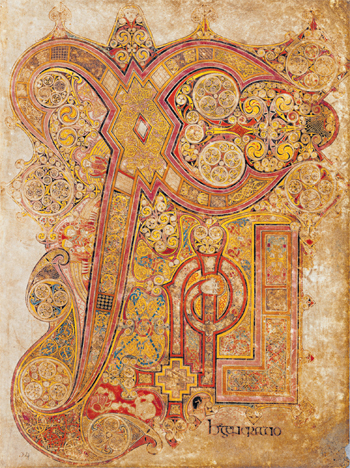
The story of the Book of Kells, of the mystery surrounding its provenance and the anonymity of the master scribes and artists who executed it, is a splendid romance. Few emblems of medieval European civilisation have caught the imagination of the international public to the same degree. Every year tens of thousands of visitors to Dublin file through the Long Room of Trinity College to view its intricately decorated pages. The artistry, colour, exuberance and wit that went into the making of this illuminated version of the four Gospels, described in the 11th-century Annals of Ulster as “primh-mind iarthair domain”, “the most precious object of the western world”, are an enduring source of awe and admiration. Here is a spark of brilliant light shining for us out of the Dark Ages.
The “Book of Kells” is probably a misnomer. Certainly the book was kept at Kells, a pleasant town in County Meath some 40 miles northwest of Dublin, from the beginning of the 11th century until it was sent to Dublin in the early 1650s for safe-keeping. It is not known for sure, however, where it originated. The best scholarly guess is that it was composed, or at least that its composition was begun, by Columban monks on the small, fertile island of Iona, off Mull on the west coast of Scotland, around the year 800.
The book, or codex, the more precise term for a manuscript volume, was from the start closely linked with the name of Columcille. The Annals of Ulster, for instance, refer to it specifically as “the great Gospel of Colum Cille”. This saint – Columcille translates as the “Dove of the Church” – is a potent figure in medieval Insular history, that is, the history of Ireland and Britain. He is Christian Ireland’s St George, but without the great-sword, and the pious counterpart, for generations of Irish schoolchildren, of the legendary warrior-hero Cuchulainn.
Columcille, or Columba, as he was known to the Latin-speaking world, was born in 521 or 522 into the aristocratic family of the O’Neills of Tír Connaill, roughly present-day Donegal. At the beginning of the 560s he travelled with 12 companions, in echo of Christ and his apostles, on a mission to Scotland to convert the Picts. In 563 he settled on Iona and founded a settlement there, which was to endure for centuries. Members of the community would go on to set up other monastic houses, including one on the great rock of Lindisfarne in Northumberland, established by the Ionan monk Aidan in 635.
At the close of the 8th century the tranquil life of Iona was violently disrupted by the arrival of the Viking longships. Raids were recorded in 795; in 802, when the settlement was “burned by the heathens”, as the Ulster annalists put it; and in 806, when 68 inhabitants were slaughtered. The following year a part of the monastic community transferred to Kells, where there was a royal hill-fort owned by the southern branch of Columcille’s family. The annals speak of Kells at this time as the “noue ciuitatis” of the Columban monks. The word “ciuitatis” means place of refuge, the circumference of which, according to one historical source, could be measured by an angel with a reed in his hand – it must have been a small fort indeed – which possibly accounts for the depiction in the Book of Kells of a number of angels holding what are probably reeds.
This last is one of many fascinating conjectures put forward by Bernard Meehan in The Book of Kells, a sumptuous – it is the only word for it – volume containing more than 80 pages from the manuscript reproduced full-size and in full, ravishing colour, as well as five comprehensive chapters on the historical background, the elements of the book, the manner of decoration, the work of the scribes and artists involved, and the physical features of the book.
Meehan, head of research collections and keeper of manuscripts at Trinity College, is surely the world’s foremost contemporary authority on the Book of Kells, which he has lived with and worked on throughout his professional career. His new book is a triumph of scholarly investigation and interpretation. Although he maintains an appropriately sober tone throughout, it is clear that he finds this marvellous artefact – indeed, this work of art – as fascinating and compellingly mysterious today as he did when he first set himself to unravelling its secrets some 30 years ago.
One of the endearing features of this version of the Gospels is that it is not particularly accurate. “While the scripts of the Book of Kells have a unique verve and beauty,” Meehan writes, “its text is erratic, with many errors resulting from eyeskip (where the scribe’s eye has jumped from a word to its next appearance, omitting the intervening text or letter).” This calls down a rare but stern professorial rebuke: “There is considerable carelessness in transcription.” Reading this, one’s deplorably feckless imagination wanders back through the smoke of the centuries to that frail little isle afloat in the wild Atlantic, where in a stone beehive hut a lonely scribe, hunched with quill in hand over his sheet of vellum, halts suddenly as he spots a mistranscription, claps a hand to his brow and utters whatever might have been the monastic equivalent of “Oh, shit!”

Those poor scribes – there were four of them, “prosaically termed A, B, C and D”, as Meehan sympathetically remarks – had their work cut out for them. The Book of Kells was made from 180 calf skins – an indication, by the way, of the comparative wealth of the monastic community, for in those days cows were money – and of the complete work, 680 pages remain, some folios as well as the original binding having been lost or destroyed. The scribes, employing broad quill pens held at right angles to the page, wrote with surprising speed, at an estimated rate of about 180 words per hour; the illustrator-artists, of course, would have worked much more slowly.
An elegant playfulness is evident throughout, with contingencies often being turned into occasions of bravura inventiveness. Meehan points out that to achieve an evenly justified right-hand margin, sometimes the final letter or letters of a word had to be inscribed below the remainder, and offers the example from the bottom of the verso of folio 276, where the final t of the word dixit is placed below the rest of the word, forming a flamboyant cross with the second stroke of the x. Elsewhere, too, necessity offered opportunity. The major illustrated pages would have taken very much longer to execute than script pages, and in order not to delay the process of transcription, the reverse sides would have been left blank to be filled in later with text. “Having to guess how much space to leave on these occasions,” Meehan writes, “the scribes normally erred on the conservative side, knowing that space could be filled with decoration if necessary.” Send in the artists.

The Irish have a weakness for puns, and this is as evident in the Book of Kells as it is in Finnegans Wake, although in the former the puns are for the most part visual, for no monk would think to tamper with the Gospel texts. A delightful example of visual punning occurs on the recto of folio 63. Meehan cites another scholar, George Henderson, identifying an insect on this page as a fly, “consistent with its place in the text, at Matthew 12.24, where the Pharisees say, ‘This man casteth not out devils but by Beelzebub, the prince of the devils’, for the name ‘Beelzebub’ is glossed in the list of Hebrew names in the Book of Kells as meaning ‘having flies’ or ‘Lord of flies’.”

Matters of doctrinal dispute, too, give rise to the occasional sly squib. The early Irish Church had its differences with Rome, for example on the thorny question of the dating of Easter, which led to a “great dispute” and a resulting Irish hostility towards St Peter, the founder of the Roman Church. According to the Venerable Bede, the Columbans had been persuaded in the early 700s to adopt the Roman method for fixing the date for Easter, but as Meehan points out, evidence in the Book of Kells points to a lingering resentment among the scribes and artists of Iona. Thus on the recto of folio 180, a line of text referring to Peter’s denial of Christ incorporates the figure of a hare, an animal known for its timidity.

An even more ingenious leporine dig is spotted by Meehan, with equal ingenuity, on the verso of folio 87. “The hare here, forming the S of Simile, gazes back overleaf to folio 87r, where Peter expresses doubt about following Jesus. It is precisely on the other side of the leaf from the pet of petrus, suggesting a deliberate association, to Peter’s disadvantage, between the words petrus and Simile and the animal, Peter being ‘like to’ a hare.” We should look with indulgence upon these harmless sallies. After all, as James Joyce pointed out, the Church of Rome was built on a pun, when Christ chose Peter (Petrus) as the rock (petra) of its foundation.
The Book of Kells is endlessly fascinating, boundlessly inspiring. “For many in Ireland,” Meehan remarks, “it symbolizes the power of learning, the impact of Christianity on the life of the country, and the spirit of artistic imagination.” So it is for many in the world at large, also. You do not have to be a Christian to appreciate the book’s beauty and power, expressing as it does our love of the natural world and at the same time the pathos of our yearning towards transcendence. In the beginning was the word, declares the Gospel of St John, and thereafter, we might add, came the transcribers of that word.
how the hell do you do this?
change the colors shapes and size
I’m clueless
not one thing I recognize
so foolish
every now’s a big surprise
help me to get through this
stay with me until I die
there’s nothing else I wanna try
— Built to Spill, “Reasons”
By Scott Van Wynsberghe
nationalpost

Its name sounds like the title of a Robert Ludlum thriller, and it has bamboozled generations of spies. An emperor reputedly once owned it, the Jesuits later acquired it and Yale University now has the infuriating thing. For those in the know, all that is needed is to roll one’s eyes and mutter about the Voynich Manuscript, which was discovered (or, technically, rediscovered) a century ago this year.
Wisely, Yale University’s Beinecke Rare Book and Manuscript Library decided to be open about so controversial an item, and the entire manuscript has been [external] posted online for scrutiny. There, one finds an object that initially does not seem to merit the fuss.
Physically, the manuscript is not large and has been measured (at a laboratory hired by the Beinecke Library) at just 23.5 x 16.2 cm, or just over 9” x 6”. Nor is it very lengthy. It once had no more than 116 leaves (or folios), each numbered on only one side, but 14 of them vanished as much as centuries ago, so just 102 remain. Counting both sides of each leaf, that makes 204 “pages,” although purists can be fussy on that point. (For the record, the Beinecke Library follows the convention whereby the leaf or folio on the right side of an open book is referred to as “recto,” while the reverse of that same leaf is “verso.” Thus, instead of references like “page 9,” one instead gets “folio 9 recto.”)
Once the technical minutia is out of the way, however, amazement follows. The manuscript is handwritten in a tidy, curvy format that cannot be read by anyone. When the individual characters of the writing are transliterated into a format of Roman letters adopted by Voynich buffs for the sake of convenience, the text provides such extreme nonsense as: “yteedy qotal dol shedy qokedar chcthey otordoror qokal otedy qokedy qokedy dal qokedy qokedy skam.”
The writing is accompanied by hundreds of illustrations, which one would expect to provide some guidance, but the opposite is the case. The pictures include perplexing charts of the cosmos, lots of unidentified plants and images of naked women either bathing or interacting with a bizarre network of tubes. (And the tubes are not even phallic: Sometimes, the women are inside them.)
For such a dreadful conundrum, the world has one man to thank — rare-book dealer Wilfrid Voynich. A former student agitator in flight from imperial Russia, Voynich transplanted himself first to the U.K. and then (as of 1914) to the United States, all the while building a reputation as a connoisseur of ancient scribblings. At some point in 1912 — nobody seems to know precisely when — he found the manuscript that bears his name.
Up to his death in 1930, Voynich was so evasive about the details of his discovery that one might reasonably wonder if he himself created the manuscript. However, the document was radiocarbon tested at the University of Arizona in 2009, yielding an origin point in the early 1400s. As well, the correspondence of a renowned scholar of the 1600s, the Jesuit Athanasius Kircher, has revealed a handful of apparent references to the manuscript. One of his contacts, the Prague-based physician Johannes Marcus Marci, evidently sent the manuscript to him for interpretation in the mid-1660s.
So the manuscript is not a modern fraud, but its provenance still remains very sketchy. In a 1930 letter written by Voynich’s wife Ethel — and not opened until her own death in 1960 — it was somewhat clarified that Voynich found the manuscript, thanks to a Jesuit priest named Joseph Strickland, at Frascati, near Rome. Voynich buffs have taken that to mean the Jesuit centre at the Villa Mondragone, near Frascati, where Strickland worked. In any case, Ethel revealed that Fr. Strickland swore Voynich to secrecy, implying that the transaction was somehow dicey.
How the manuscript got to Frascati is murky but must have had something to do with the Jesuit Kircher and his presumed receipt of it from Dr. Marci. In turn, Kircher was told by Marci that the latter had obtained it through the will of a late friend, George Baresch (also known by the Latin handle of “Barschius”). As well, Marci had heard a claim that the manuscript was once owned by Holy Roman Emperor Rudolf II (who reigned from 1576-1611), and ultraviolet examination of folio 1 recto has indeed revealed the faded signature of Rudolf’s chief botanist and alchemist, Jacobj à Tepenece.
Prior to Rudolf, however, there are at least 150 years of utter mystery. The very earliest theories about the manuscript centred on the English philosopher-monk Roger Bacon, who lived in the 1200s, but his era is ruled out by the radiocarbon test. In a 2011 article for the Skeptical Inquirer magazine, Voynich researcher Klaus Schmeh listed (and scoffed at) other candidates who have been proposed over the years, including artist Leonardo da Vinci, an Italian architect of the 1400s named Antonio Averlino and even an underground group of Cathar heretics. An English occultist, John Dee, has often come up, but online Voynich authority Philip Neal strongly discounts him.
Schmeh has wondered if the actual perpetrator may simply have been some unknown mentally ill person, but that looks impossible. Although all Voynich researchers may not agree, there has been a strong argument since the 1970s that the handwriting of the manuscript indicates at least two authors, not one. As well, linguist and computer expert Gordon Rugg has pointed out that the manuscript does not statistically conform to the known patterns of insane ravings, whatever its actual contents.
With the manuscript’s origin hopelessly obscure, Voynich enthusiasts have had no other choice but to try to crack the text. That daunting task has been made a little less grim by such online resources as the Beinecke Library (to which the manuscript was donated in 1969 by rare-book dealer H.P. Kraus, who bought it after Ethel Voynich’s death). Today, anyone can pretend to be a Voynich pundit. For much of its earlier history, however, the Voynich field was the preserve of a small circle of devotees — many of whom came from the shadows.
According to an historian of cryptology, David Kahn, Voynich consulted various authorities about his puzzling manuscript, and, in 1917, he approached MI-8, the U.S. military’s codebreaking unit during the First World War. The unit’s commander, Herbert O. Yardley, took a look at the manuscript, but it was a subordinate, John M. Manly, who became obsessed with it. When a possibly unhinged scholar named William R. Newbold began claiming in 1921 that he had solved the manuscript, Manly would lead the charge that discredited him. (Amusingly, Voynich was torn between the two men: The New York Timeslater revealed that both Manly and Newbold’s widow figured in Voynich’s will.)
Other significant intelligence personnel who joined the Voynich field in the decades to come were William F. Friedman (a legendary U.S. codebreaker of the Second World War), John H. Tiltman (a British contemporary of Friedman, also acclaimed), Prescott Currier (a U.S. Navy specialist), Yale University professor Robert S. Brumbaugh (previously a cipher sleuth for the U.S. Army) and Mary D’Imperio (whose highly regarded 1978 book on the manuscript can be consulted at the website of the National Security Agency).
Despite their skills, not one of the above was able to read the manuscript, leading to the growing suspicion that the text does not involve any encryption, because that would have been broken by now. And it may not even involve any actual language, either: In 2004, the aforementioned Gordon Rugg declared that the text was just gibberish — an ancient hoax possibly assembled through a non-functional version of a Renaissance coding technique called the “Cardan grille.” Rugg could not, however, explain why anyone in the Renaissance would do such a thing, nor did he address the amazing effort that went into the hundreds of illustrations. After a century of study, the Voynich Manuscript still mocks us.
And when it’s later
Open up your window just in case
You’re a radar
Built to scan the deeps of outer space
And if you recognize
Subtle patterns in the sky
Don’t take it as a sign
Unless it eases your mind
— Built to Spill

By David P. Barash
chronicle
Critics claim that evolutionary biology is, at best, guesswork. The reality is otherwise. Evolutionists have nailed down how an enormous number of previously unexplained phenomena—in anatomy, physiology, embryology, behavior—have evolved. There are still mysteries, however, and one of the most prominent is the origins of homosexuality.
The mystery is simple enough. Its solution, however, has thus far eluded our best scientific minds.
First the mystery.
The sine qua non for any trait to have evolved is for it to correlate positively with reproductive success, or, more precisely, with success in projecting genes relevant to that trait into the future. So, if homosexuality is in any sense a product of evolution—and it clearly is, for reasons to be explained—then genetic factors associated with same-sex preference must enjoy some sort of reproductive advantage. The problem should be obvious: If homosexuals reproduce less than heterosexuals—and they do—then why has natural selection not operated against it?
The paradox of homosexuality is especially pronounced for individuals whose homosexual preference is exclusive; that is, who have no inclination toward heterosexuality. But the mystery persists even for those who are bisexual, since it is mathematically provable that even a tiny difference in reproductive outcome can drive substantial evolutionary change.
J.B.S. Haldane, one of the giants of evolutionary theory, imagined two alternative genes, one initially found in 99.9 percent of a population and the other in just 0.1 percent. He then calculated that if the rare gene had merely a 1-percent advantage (it produced 101 descendants each generation to the abundant gene’s 100), in just 4,000 generations—a mere instant in evolutionary terms—the situation would be reversed, with the formerly rare gene occurring in 99.9 percent of the population’s genetic pool. Such is the power of compound interest, acting via natural selection.
For our purposes, the implication is significant: Anything that diminishes, even slightly, the reproductive performance of any gene should (in evolutionary terms) be vigorously selected against. And homosexuality certainly seems like one of those things. Gay men, for example, have children at about 20 percent of the rate of heterosexual men. I haven’t seen reliable data for lesbians, but it seems likely that a similar pattern exists. And it seems more than likely that someone who is bisexual would have a lower reproductive output than someone whose romantic time and effort were devoted exclusively to the opposite sex.
Nor can we solve the mystery by arguing that homosexuality is a “learned” behavior. That ship has sailed, and the consensus among scientists is that same-sex preference is rooted in our biology. Some of the evidence comes from the widespread distribution of homosexuality among animals in the wild. Moreover, witness its high and persistent cross-cultural existence in Homo sapiens.
In the early 1990s, a geneticist at the National Institutes of Health led a study that reported the existence of a specific allele, Xq28, located on the X chromosome, that predicted gay-versus-straight sexual orientation in men. Subsequent research has been confusing, showing that the situation is at least considerably more complicated than had been hoped by some (notably, most gay-rights advocates) and feared by others (who insist that sexual orientation is entirely a “lifestyle choice”).
Some studies have failed to confirm any role for Xq28 in gay behavior, while others have been supportive of the original research. It is also increasingly clear that whatever its impact on male homosexuality, this particular gene does not relate to lesbianism. Moreover, other research strongly suggests that there are regions on autosomal (nonsex) chromosomes, too, that influence sexual orientation in people.
So a reasonable summary is that, when it comes to male homosexuality, there is almost certainly a direct influence, although probably not strict control, by one or more alleles. Ditto for female homosexuality, although the genetic mechanism(s), and almost certainly the relevant genes themselves, differ between the sexes.
Beyond the suggestive but inconclusive search for DNA specific to sexual orientation, other genetic evidence has emerged. A welter of data on siblings and twins show that the role of genes in homosexual orientation is complicated and far from fully understood—but real. Among noteworthy findings: The concordance of homosexuality for adopted (hence genetically unrelated) siblings is lower than that for biological siblings, which in turn is lower than that for fraternal (nonidentical) twins, which is lower than that for identical twins.
Gay-lesbian differences in those outcomes further support the idea that the genetic influence upon homosexuality differs somewhat, somehow, between women and men. Other studies confirm that the tendency to be lesbian or gay has a substantial chance of being inherited.
Consider, too, that across cultures, the proportion of the population that is homosexual is roughly the same. We are left with an undeniable evolutionary puzzle: What maintains the underlying genetic propensity for homosexuality, whatever its specific manifestations? Unlike most mystery stories, in which the case is typically solved at the finish, this one has no ending: We simply do not know.
Here are some promising possibilities.
Kin selection. Scientists speculate that altruism may be maintained if the genes producing it help a genetic relative and hence give an advantage to those altruistic genes. The same could be true of homosexuality. Insofar as homosexuals have been freed from investing time and energy in their own reproduction, perhaps they are able to help their relatives rear offspring, to the ultimate evolutionary benefit of any homosexuality-promoting genes present in those children.
Unfortunately, available evidence does not show that homosexuals spend an especially large amount of time helping their relatives, or even interacting with them. Not so fast, however: Those results are based on surveys; they reveal opinions and attitudes rather than actual behavior. Moreover, they involve modern industrialized societies, which presumably are not especially representative of humanity’s ancestral situations.
Some recent research has focused on male homosexuals among a more traditional population on Samoa. Known as fa’afafine, these men do not reproduce, are fully accepted into Samoan society in general and into their kin-based families in particular, and lavish attention upon their nieces and nephews—with whom they share, on average, 25 percent of their genes.
Social prestige. Since there is some anthropological evidence that in preindustrial societies homosexual men are more than randomly likely to become priests or shamans, perhaps the additional social prestige conveyed to their heterosexual relatives might give a reproductive boost to those relatives, and thereby to any shared genes carrying a predisposition toward homosexuality. An appealing idea, but once again, sadly lacking in empirical support.
Group selection. Although the great majority of biologists maintain that natural selection occurs at the level of individuals and their genes rather than groups, it is at least possible that human beings are an exception; that groups containing homosexuals might have done better than groups composed entirely of straights. It has recently been argued, most cogently by the anthropologist Sarah B. Hrdy, that for much of human evolutionary history, child-rearing was not the province of parents (especially mothers) alone. Rather, our ancestors engaged in a great deal of “allomothering,” whereby nonparents—other genetic relatives in particular—pitched in. It makes sense that such a system would have been derived by Homo sapiens, of all primate species the one whose infants are born the most helpless and require the largest investment of effort. If sufficient numbers of those assistants had been gay, their groups may have benefited disproportionately.
Alternatively, if some human ancestors with a same-sex preference reproduced less (or even not at all), that, in itself, could have freed up resources for their straight relatives, without necessarily requiring that the former were especially collaborative. Other group-level models have also been proposed, focusing on social interaction rather than resource exploitation: Homosexuality might correlate with greater sociality and social cooperation; similarly, it might deter violent competition for females.
Balanced polymorphisms. Perhaps a genetic predisposition for homosexuality, even if a fitness liability, somehow conveys a compensating benefit when combined with one or more other genes, as with the famous case of sickle-cell disease, in which the gene causing the disease also helped prevent malaria in regions where it was epidemic. Although no precise candidate genes have been identified for homosexuality, the possibility cannot be excluded.
Sexually antagonistic selection. What if one or more genes that predispose toward homosexuality (and with it, reduced reproductive output) in one sex actually work in the opposite manner in the other sex? I prefer the phrase “sexuallycomplementary selection”: A fitness detriment when genes exist in one sex—say, gay males—could be more than compensated for by a fitness enhancement when they exist in another sex.
One study has found that female relatives of gay men have more children than do those of straight men. This suggests that genes for homosexuality, although disadvantageous for gay men and their male relatives, could have a reproductive benefit among straight women.
To my knowledge, however, there is as yet no evidence for a reciprocal influence, whereby the male relatives of female homosexuals have a higher reproductive fitness than do male relatives of heterosexual women. And perhaps there never will be, given the accumulating evidence that female homosexuality and male homosexuality may be genetically underwritten in different ways.
A nonadaptive byproduct. Homosexual behavior might be neither adaptive nor maladaptive, but simply nonadaptive. That is, it might not have been selected for but persists instead as a byproduct of traits that presumably have been directly favored, such as yearning to form a pair bond, seeking emotional or physical gratification, etc. As to why such an inclination would exist at all—why human connections are perceived as pleasurable—the answer may well be that historically (and prehistorically), it has often been in the context of a continuing pair-bond that individuals were most likely to reproduce successfully.
There are lots of other hypotheses for the evolution of homosexuality, although they are not the “infinite cornucopia” that Leszek Kolakowski postulated could be argued for any given position. At this point, we know enough to know that we have a real mystery: Homosexuality does have biological roots, and the question is how the biological mechanism developed over evolutionary time.
Another question (also yet unanswered) is why should we bother to find out.
There is a chilling moment at the end of Ray Bradbury’s The Martian Chronicles,when a human family, having escaped to Mars to avoid impending nuclear war, looks eagerly into the “canals” of their new planetary home, expecting to see Martians. They do: their own reflections.
It wasn’t terribly long ago that reputable astronomers entertained the notion that there really were canals on Mars. From our current vantage, that is clearly fantasy. And yet, in important ways, we are still strangers to ourselves, often surprised when we glimpse our own images. Like Bradbury’s fictional family, we, too, could come to see humanity, reflected in all its wonderful diversity, and know ourselves at last for precisely what we are, if we simply looked hard enough.
Unlike the United States military, with its defunct “don’t ask, don’t tell” policy, many reputable investigators are therefore asking … not who is homosexual, but why are there homosexuals. We can be confident that eventually, nature will tell.

By Alexandra Mullen
bnreview
More than 300 years ago, Johann Sebastian Bach was born in the small German town of Eisenach. Unlike his contemporary Handel, he never traveled very far. But from this intense central point, Bach — or at least the sound waves representing him — seems to be filling up the universe. Three of his pieces are on Voyager’s golden disc which is now approaching the brink of interstellar space; and at the same time, as Paul Elie, the author of Reinventing Bach, says, “He is in my pocket.” How has Bach in our time become a Godlike being whose center is everywhere and whose circumference nowhere?
By juxtaposing the space capsule and the pocket, Elie captures two elements of Bach — the domestic and the transcendent. They were certainly evident in his own life of playing, rehearsing, composing, teaching, and performing music, where there was not much distance or difference between the clavier at home and the organ at church. By juxtaposing the LP and the iPod, Elie reminds us of how technology has democratized and universalized Bach — all of us can “play” him now whether we’re picking through a score at the piano or listening to recordings of Edwin Fischer’s impassioned wrong notes or Glenn Gould’s equally impassioned right ones.
I single out Fischer and Gould’s piano recordings because while both Fischer and Gould give highly individual performances, they represent two different ways of thinking about what a recording is. Fischer’s recordings sound old, not just because of the background hissings and pops but also because they are embedded in concert practice: one continuous take, one continuous flow distilling concentrated experience with that particular piece at that particular moment in that particular space, warts, felicities, and all. Gould’s recording of the same pieces sound—well, newer, certainly, but in some sense out of time and even location: Gould consciously exploited “take-twoness” — not so much to eliminate flubs (although that too) as to craft peaks of brilliance on an instrument inhabiting its own sound-world.
For Elie, whose previous book, The Life You Save May Be Your Own, concentrated on four American Catholic writers, the spiritual and the technological are not antithetical:
In an age of recordings, the past isn’t wholly past and the present isn’t wholly present, and our suspension in time, our intimacy with the most sublime expressions of people distant and dead, is a central fact of our experience. This is at once a benefit and a quandary, and in it, I would venture, are the makings of a spirituality of technology.
Some Bach pianists have the gift of bringing out lines of music in a score that I’ve never noticed before — I think particularly of Gould’s and Simone Dinnerstein’s startling different but utterly compelling versions of the Goldberg Variations. Elie has a similar ability to hear new connections between well-known notes. I find him particularly thought-provoking when he marks long historical phrases. In one passage, after considering the physical placement of the church organist (literally lofty, back turned to the service), Bach’s chorales, and the goals of the Reformation that lead “every believer [to] hope for a direct encounter with the thing itself,” Elie moves outward to our day: “Recordings heighten the effect, completing the transition from eye to ear, from seeing to hearing, that the Reformation had brought about. The organist is done away with. So is the church building. So are the limits of space and time, of stamina and attention. The music of Bach is all that is left. The recordings pour out perfection: they enable the listener to import transcendence into an ordinary room, to “play” the music without making it.” Is it just a fluke that some early recording studios were deconsecrated churches?
I have been singling out technological contemplations, but Elie has many strengths and strands: detailed and beautifully described moments of listening, engagingly narrated summaries of scholarship, alert attention to telling facts, and a loving knowledge of many different kinds of music, including Robert Johnson and Led Zeppelin. There’s plenty of audiophile information — wax cylinder, recording, mono, stereo, different kinds of tape, 78s, long-playing records, CD’s, iPods — and a lot on the placement of microphones.
Wearing his learning lightly (with wonderful endnotes as a ground), Elie is polyphonic and contrapuntal. In counterpoint, as Nicholas Slonimsky defines it, “each voice has a destiny of its own.” Elie’s book is held together by chain of voices following one other as they make an entrance, step back, overlap, and enter again to reveal a new aspect against the changing conversation: Schweitzer to Casals to Stokowski to Gould to Ma. Other voices too move in and out, filling out the progressions: Tureck, Schoenberg, Einstein, Jobs, even the musically fantastic Mickey Mouse. The voice hovering over all is Elie’s own, modest, serious, attuned to the whole.
Among the wonder of Bach’s music, according to Elie, is that “it sounds inventive — it doesn’t finish the musical thought so much as keep it aloft.” Above all it is this aspect of keeping a musical idea in play, Elie feels, that has inspired so many musicians to enter into this long conversation.
It’s a conversation that has technical or professional aspects, but that also welcomes interested amateurs like Elie and me. Here are two signs of my engagement provoked by this book: first, the number of comments I’ve made in the margins, often disagreements over the role of technology; second, the number of times I’ve turned to CDs, DVDs, iTunes, and YouTube to listen to something he mentioned. Both a benefit and a quandary indeed. The perfection of recordings can be transcendent, yes, but also inhibiting for sublunary amateurs. From a technical point of view, Gould’s Apollonian super-perfection is now an every-day occurrence thanks to the ability to drop in a single-note retouch for a flub. (I’ll leave autotune alone.) For example, I particularly like something Elie doesn’t mention perhaps because he doesn’t: the domestic intimacy of overhearing Gould hum in the background of, say, the English Suites. But I’ve been entranced by some of the YouTube videos he does mention that make the power of Bach visible, from vibrating graphic animations to a Japanese performance of the Matthew Passion to Mstislav Rostropovich playing at the Berlin Wall — in front of exuberant Western graffiti including (Elie strikingly fails to mention given his eye for recurrence) Mickey Mouse.
It is a pleasure to read such a serious and inventive book on Bach, and that’s saying something.
In studying a philosopher, the right attitude is neither reverence nor contempt, but first a kind of hypothetical sympathy, until it is possible to know what it feels like to believe in his theories, and only then a revival of the critical attitude, which should resemble, as far as possible, the state of mind of a person abandoning opinions which he has hitherto held. Contempt interferes with the first part of this process, and reverence with the second. Two things are to be remembered: that a man whose theories are worth studying may be presumed to have had some intelligence, but that no man is likely to have arrived at complete and final truth on any subject whatever. When an intelligent man expresses a view which seems to us obviously absurd, we should not attempt to prove that it is somehow true, but we should try to understand how it ever came to seem true. This exercise of historical and psychological imagination at once enlarges the scope of our thinking, and helps us to realize how foolish many of our own cherished prejudices will seem to an age which has a different temper of mind.
— Bertrand Russell, A History of Western Philosophy

