Tell Me, Orpheus

Tell me, Orpheus, what offering I can make
to you, who taught the creatures how to listen?
I remember a spring day in Russia;
it was evening, and a horse . . .

He came up from the village, a gray horse, alone.
With a hobble attached to one leg
he headed to the fields for the night.
How the thick mane beat against his neck

in rhythm with his high spirits
and his impeded, lurching gallop.
How all that was horse in him quickened.

He embraced the distances as if he could sing them,
as if your songs were completed in him.
His image is my offering.

— Rilke, Sonnets to Orpheus I, 20

The Donor

This is what he had ordered from the painters’ guild.
It’s not that the savior himself had appeared to him,
or even that one single bishop
ever stood beside him, as depicted here,
gently laying his hand upon him.

But this, perhaps, was all he wanted:
to kneel like this.
He had known the desire to kneel,
to hold his own outward thrusting
tightly in his heart,
the way one grasps the reins of horses.

So that when the Immense might happen,
unpromised and unpaid for,
we might hope that it wouldn’t notice us
and thus, undistracted, deeply centered,
it would come closer, would come right up to us.

— Rilke, New Poems

Impermanence

Impermanence plunges us into the depth of all Being. And so all forms of the present are not to be taken and bound in time, but held in a larger context of meaning in which we participate. I don’t mean this in a Christian sense (from which I ever more passionately distance myself) but in a sheer earthly, deep earthly, sacred earthly consciousness: that what we see here and now is to bring us into a wider — indeed, the very widest — dimension. Not in an afterlife whose shadow darkens the earth, but in a whole that is the whole.

— Rilke, Letter to Witold Hulewicz
November 13, 1925

The biggest defeat in every department of life is to forget, especially the things that have done you in

The biggest defeat in every department of life is to forget, especially the things that have done you in, and to die without realizing how far people can go in the way of crumminess. When the grave lies open before us, let’s not try to be witty, but on the other hand, let’s not forget, but make it our business to record the worst of the human viciousness we’ve seen without changing one word. When that’s done, we can curl up our toes and sink into the pit. That’s work enough for one lifetime.

— Louis-Ferdinand Céline, Journey to the End of the Night

Being Ephemeral

Does Time, as it passes, really destroy?
It may rip the fortress from its rock;
but can this heart, that belongs to God,
be torn from Him by circumstances?

Are we as fearfully fragile
as Fate would have us believe?
Can we ever be severed
from childhood’s deep promise?

Ah, the knowledge of impermanence
that haunts our days
is their very fragrance.

We in our striving think we should last forever,
but could we be used by the Divine
if we were not ephemeral?

— Rilke, Sonnets to Orpheus II, 27

Life Follows Art

That,” said Chudu the Goat’s Son, with a look of disgust, “is not how things happen!”

“Never mind,” said the babe with a wink, “life follows art.”

“Imitate anything long enough — gaze at anything long enough with a careful eye — and you have a tendency to become it, or at very least a tendency to respect it. I might take the case of painting. There was a time, you’ll remember, when people hated Nature. When they found Nature unavoidable, in a particular painting, they transmuted all that garish green to brown. Forced to live in the country, they transformed lawless Nature into formal gardens. Then an outlaw generation of young painters came along and painted mountains ‘as they are’; and a gasping generation of young poets came along and wrote sweet love-songs to Mont Blanc. Rich merchants with big houses in the centers of their villages learned the subtle art of turning half an acre to a forest — ‘natural’ pools, concrete reindeer. What had happened? Exactly! Painters had begun imitating the world as they saw it, a world of — incredible! — fat ladies with their clothes off, green mountains, majestic bears — and the world began to imitate the paintings. Make no mistake, make no mistake! The mimic is doomed to become what he mimics, or doomed unless a miracle of good fortune intervenes. It’s like the story of the miser.”

“Miser?” said the prince.

Armida sighed.

— John Gardner, In the Suicide Mountains

.

He wears a mask, and his face grows to fit it.

— George Orwell, “Shooting an Elephant”

Birdsong

Birds begin their calls to praise.
And they are right. We stop and listen.
(We, behind masks and in costumes!)
What are they saying? A little report,

a little sorrow and a lot of promise
that chips away at the half-locked future.
And in between we can hear the silence
they break — now healing to our ears.

— Rilke, Uncollected Poems

There are three basic theories about the world, Prince

At last the abbot said, his voice slightly quaking, his gentle lips atremble, “There are three basic theories about the world, Prince. One is that it is essentially good, one is that it is essentially evil, and one is that it’s neutral. What a wise man understands is that none of that is true. The world is a hodge-podge. Our human business, therefore — since our chief attribute is consciousness, and our greatest gift from God is, as Dante said, free will — our human business is to clarify, that is, sort things out, put the good with the good and the evil with the evil and the indifferent with the indifferent. Only when reality is properly sorted out can there be stability or hope for the future in either the individual or the state.”

“Hmm,” said the prince.

“That,” said the abbot, “is the reason you have really no choice, as a prince and a feeling creature, but to kill the dragon Koog.”

“I’m not sure I follow the logic,” the prince said.

“What could be simpler, my dear prince? A dragon is a confusion at the heart of things, a law unto itself. He embraces good, evil, and indifference; in his own nature he makes them indivisible and absolute. He knows who he is. Surely you see that!”

For a moment the prince did not answer; no sound whatever came from him through the darkness. Then: “Perhaps I’m a little tired,” he said.

“Put it this way,” said the abbot. “Dragons all love life’s finer things — music, art, treasure — the works of the spirit; yet in their personal habits they’re foul and bestial — they burn down cathedrals, for instance, and eat maidens — and they see in their whimsical activities no faintest contradiction!” The words made the abbot gasp, as if the deep immorality of dragons was somehow personally threatening. Almost with a snarl the old man continued: “Dragons never grow, never change. Did you ever hear of a dragon committing suicide? Of course not! Believe me, nothing in this world is more despicable than a dragon. They’re a walking — or flying — condemnation of all we stand for, all we pray for for our children, nay, for ourselves. We struggle to improve ourselves, we tortuously balance on the delicate line between our duties to society and our duties within — our duties to God and our own nature.”

He grew more animated. The room was in absolute darkness now, the fire in the hearth had died completely, but Armida could hear the abbot pacing, hurrying back and forth, occasionally bumping into the little tables. He continued: “We human beings glimpse lofty ideals, catch ourselves betraying them, and sink to suicidal despair — despair from which only the love of our friends can save us, since friends see in us those nobler qualities we ourselves, out of long familiarity, have forgotten we possess. That, of course, is why the suicidal person is so difficult around his friends. I know all about these things, believe me. I don’t live here at Suicide Leap for nothing! ‘Get rid of all friends,’ thinks the poor mad suicidal, ‘and the end becomes a possibility.’ So he insults his friends, teaches himself to hate them; yet even then secretly he hopes they will save him; even then he reaches out, bawls for new friends! Ah, these contradictions! Fiends are legion, we discover; our noblest hopes grow teeth and pursue us like tigers! Well, never mind; to be human is, inevitably, to hate oneself sometimes, to hunger for the perfect stability and in a way the perfect justice — or at least perfect punishment for our numerous imperfections — called death. What was I talking about? Ah! Yesss, the dragon. Old Koog.”

He stopped pacing, stood perfectly still, lost in the blackness. “A dragon, my dear prince, light of my life, has no such feelings as these I’ve just described. His existence is a malevolent joke on ours, a criticism, cosmically unfair. While the good man throws away his life to gain life, twists and strains and, with luck, transcends himself — by perilous battle achieves self-respect and the honest admiration of his neighbors and friends — and while the bad man with still a speck of decency throws away his for the love of that microscopic speck, the dragon flies out in the service of mad whim or sits at his ease for a thousand years on his useless emeralds and rubies, his gold cups and silver cups, and scornfully laughs! Does that really not disturb you, Prince Christopher? Do you feel no rage at all at a thing like that?”

After a moment Prince Christopher’s voice came from the darkness: “Perhaps I should sleep on it.”

— John Gardner, In the Suicide Mountains

The Road to a Ph.D. in the Humanities

“The Long-Haul Degree”
By PATRICIA COHEN
Published: April 8, 2010, NYT

Law students get a diploma in three years. Medical students receive an M.D. in four. But for graduate students in the humanities, it takes, on average, more than nine years to complete a degree. What some of those Ph.D. recipients may not realize is that they could spend another nine years, or more, looking for a tenure-track teaching job at a college or university — without ever finding one.

As the recession has downsized university endowments and departments, the sense of crisis that has surrounded graduate education for more than a decade has sharpened. “What’s worse than desperate?” asks William Pannapacker, an associate professor of English at Hope College, in Michigan, who writes a column for The Chronicle of Higher Education under the name Thomas H. Benton.

A graduate-school Cassandra, Dr. Pannapacker calls the graduate apprenticeship system bankrupt and warns students against the heartbreak of pursuing a Ph.D. While finishing his own degree in American civilization at Harvard in 1999 (another difficult job year), he helped organize a protest at the annual meeting of the Modern Language Association, an organization of scholars and professors of language and literature.

On a large reproduction of Goya’s bloody painting “Saturn Devouring His Son,” he wrote, “Enjoying your apprenticeship yet?”
First- and second-year Ph.D. students in, say, English literature may not face the same aching course load or backstabbing competition as their friends in medical and law schools, but they have a longer haul ahead. Doctoral students are expected not only to master a wide swath of material to pass general and oral exams, but to produce a nearly book-length dissertation of original research that, depending on the subject, may ultimately sit on a shelf as undisturbed as the Epsom salts at the back of the medicine chest. These students must earn their keep by patching together a mix of grants and wages for helping to teach undergraduate courses — a job that eats into research time. Third-year medical students may be bleary eyed from hospital rotations, but at least the work goes toward their degree.

This system of financing is partly responsible for the absurdly long time it can take to get a degree in the humanities, says Debra W. Stewart, president of the Council of Graduate Schools. In many countries, the government pays students to complete Ph.D.’s within a certain time frame, perhaps three or four years.

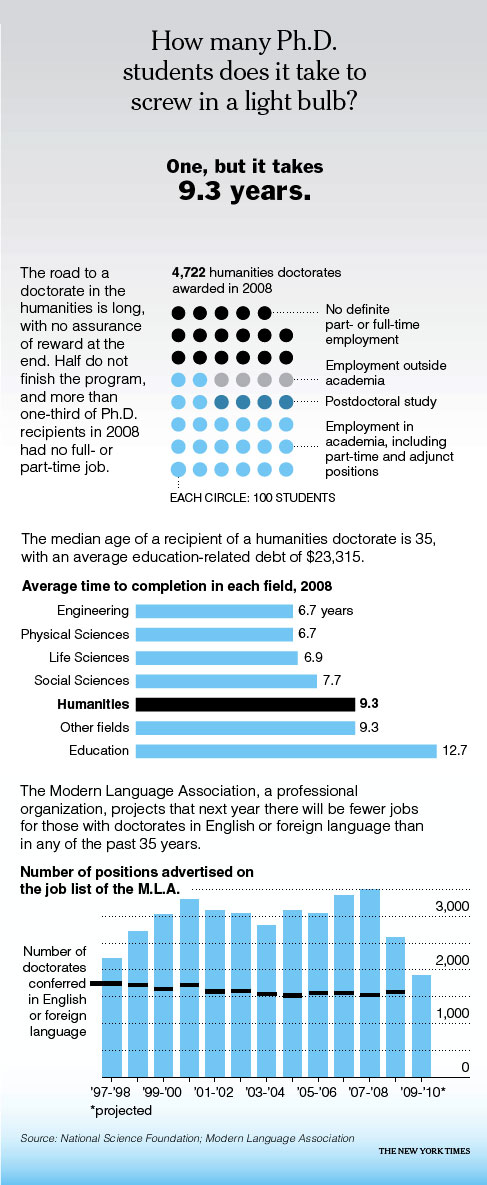
In the United States, given that most students take time off, nearly a dozen years can pass between receiving a B.A. and Ph.D. About half who enter a humanities doctoral program drop out along the way. The average student receiving a Ph.D. today is 35 years old, $23,000 in debt and facing a historically bad job market. Adjunct jobs — with year-to-year contracts, no benefits and no security — may be the only option.

Louis Menand, an English professor at Harvard and another longtime critic of the Ph.D. production process, notes: “Lives are warped because of the length and uncertainty of the doctoral education process.” In his new book, “The Marketplace of Ideas,” he writes, “Put in less personal terms, there is a huge social inefficiency in taking people of high intelligence and devoting resources to training them in programs that half will never complete and for jobs that most will not get.”

In the spring issue of the Modern Language Association’s newsletter, Sidonie Smith, an English professor at the University of Michigan and president of the organization, resuscitated a proposal that had been swirling around blue-ribbon task forces and educational panels for years: to broaden the range of research options beyond the classic dissertation to include already-published peer-reviewed essays, research portfolios and digital publications and presentations. Aside from shortening the Ph.D. process, she argues, this would make scholarship less arcane and more relevant.

Despite high-level support for reform, educators say that wholesale change is not likely any time soon. For one, any meaningful transformation in doctoral requirements must be adopted universally, says Richard Wheeler, interim vice chancellor for academic affairs and former dean of the graduate college at the University of Illinois, Urbana-Champaign. Who would want to attend a program that another university — and potential employer — doesn’t recognize as valid? “It hasn’t reached enough of a crisis point yet,” Dr. Wheeler says.

“It’s very hard to get through the graduate student experience,” he adds.

The union of graduate students at Illinois staged a brief strike in November over guarantees that their tuition would be waived. Dr. Wheeler attributes the protest to general discontent as much as specific employment issues. “There’s despair, anger, frustration,” he says. “A lot of people are unhappy.”

Dr. Wheeler, who received his English Ph.D. in 1969, took four years to finish. Graduate programs have since added more stringent requirements, he says, and expectations for what a degree holder is supposed to have accomplished have radically increased. He had not published anything when he was hired; today, applicants are expected to have a list of published research on their résumés.

The job problem has been brewing for years. In 1989, William G. Bowen and Julie Ann Sosa issued a widely publicized report that forecast a huge turnover in faculty and suggested the creation of a federal program to increase humanities and social sciences Ph.D.’s. Many students — Dr. Pannapacker included — took that advice to heart. Ph.D. production in English and American language and literature grew 61 percent between 1987 and 1995; history Ph.D.’s rose by 51 percent.

By the late 1990s, though, the spanking-new degree candidates discovered just how mistaken the Bowen-Sosa report was. The end of mandatory retirement and the increase in the use of part-time and adjunct faculty meant there were many more exceptionally qualified job seekers than jobs. The current recession has only exacerbated the problem, with many institutions imposing hiring freezes or layoffs. The M.L.A., for example, reported that its total job listings dropped by a quarter in the 2008-2009 academic year, the largest single-year decline in the 34 years that the organization has been doing job counts. And these numbers don’t include postings that were subsequently canceled because of budget cuts.

At the same time, the practice of hiring off-tenure teachers is growing. According to a new survey of humanities departments by the American Academy of Arts and Sciences, half of the faculty members in English and foreign languages — more than any other department — are not on a tenure track. Part of the reason for the large number is that freshman composition classes, which are often required, are taught by those departments, and adjuncts.

Unlike in life science or engineering, the number of doctoral degrees awarded in the humanities — the pool of fields that generally include languages, history, philosophy, music, drama and archeology — has actually dipped in the last few years, with 4,722 recipients in 2008 (down from 5,112 in 2007), according to the National Science Foundation.

But more than a third of those degree-holders had no definite job (part or full time, off or on a tenure track) or any postdoctoral study commitment.

The number of degrees may dip further. Some major universities, including Harvard, Princeton, the University of Chicago, Emory and Northwestern, reduced the number of doctoral students in the humanities and social sciences they admitted this past year. Much more radical cuts would be required to bring the supply of graduates and the demand for them into balance, and that would be a solution that stirs up its own problems. If enrollment drops too low, there may not be enough students to justify courses in specialized areas.

Other practical reasons exist for resisting reductions. Doctoral programs bring prestige to a university and help retain faculty members who want to mentor the next generation of scholars. They also provide the staff for courses offered to first- and second-year undergraduates — a task many tenured faculty members resist. Even graduate students on full scholarships are cheap labor if they are teaching enough tuition-paying undergraduates.

Dr. Wheeler would like to reverse that practice, at least. “Putting as many faculty in front of undergraduates as possible,” he says, would not only improve the quality of education but would also increase the demand for more tenured faculty members over time.

Funding to hire the professors in the first place has to be there, however.

Dr. Pannapacker has rebuked graduate schools for perpetuating a culture in which unattainable academic careers are portrayed as the only worthwhile goal, and for failing to level with students about their true prospects. With more transparency — if every graduate program published its attrition rate, average debt of its students, time to completion, and what kind of job its graduates got — undergraduates, he says, could make more-informed choices.

“Academe encourages students to think of what they’re doing as a special kind of calling or vocation which is exempt from the rules of the marketplace,” he says. Those who look to work outside the scholarly world are seen as rejecting the academy’s core values. “They socialize students into believing they can’t leave academe or shouldn’t, which is why they hang on year after year as adjuncts, rather than pursue alternative careers.”

A bad job market, too, tempts graduate students to stay even longer, since being out on the job circuit for more than a year tends to taint candidates.

As the number of tenure-track jobs shrink, Ms. Stewart of the Council of Graduate Schools says, the profession needs to address these failings.

“Humanities Ph.D.’s have focused exclusively on the academic job market,” Ms. Stewart says. “They don’t have anyplace else to go, or they don’t perceive that they have anyplace else to go.”

The First Word Was Light

Your first word of all was light,
and time began. Then for long you were silent.

Your second word was man, and fear began,
which grips us still.

Are you about to speak again?
I don’t want your third word.

— Rilke, From The Book of Hours I, 44

It Was As Though a Girl Came Forth

It was as though a girl came forth
from the marriage of song and lyre,
shining like springtime.
She became inseparable from my own hearing.

She slept in me. Everything was in her sleep:
the trees I had loved, the distances
that had opened, the meadows —
all that had ever moved me.

She slept the world. Singing god, how
have you fashioned her, that she does not long
to have once been awake? See: she took form and slept.

Where is her death? Will you discover
the answer before your song is spent?
If I forget her, will she disappear?

— Rilke, Sonnets to Orpheus I, 2

Hours of Childhood

. . . Oh hours of childhood,
when each figure hid more than the past
and no future existed.
We were growing, of course, and we sometimes tried
to do it fast, half for the sake of those
whose grownupness was all they had.
Yet when we were by ourselves,
our play was in eternity. We dwelt
in the interval between world and toy,
that place created from the beginning of time
for the purest of actions.

— Rilke, From the Fourth Duino Elegy

Notice

Persons attempting to find a motive in this narrative will be prosecuted; persons attempting to find a moral in it will be banished; persons attempting to find a plot in it will be shot.

BY ORDER OF THE AUTHOR
Per G. G., CHIEF OF ORDNANCE

— Mark Twain, Adventures of Huckleberry Finn