
Year: 2010
Braking Away
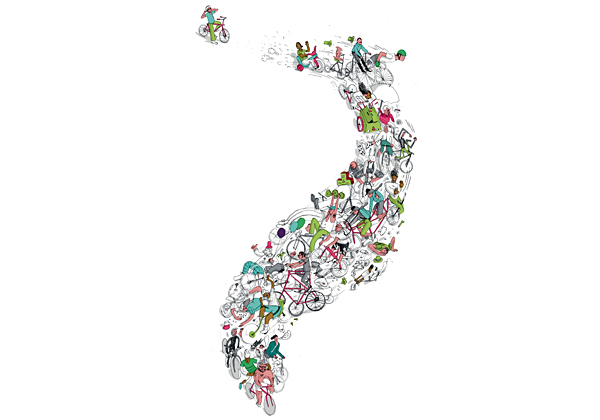
By CHRIS RASCHKA
Op-Ed Contributor
Published: May 1, 2010, NYT
TEN years ago, riding a bicycle through the streets of New York was still considered outlandish behavior at best, and possibly insane. At the time, I viewed this with chagrin, but also complacency. I biked everywhere.
Like a goat in a cattle drive, I was jostled by a delivery van on Ninth Avenue, went over my handlebars because of an out-of-town driver on Seventh, and was casually bumped into by a limousine driver on Sixth who stopped and got out to see if I had damaged his side-view mirror, while I lay unattended on the sidewalk.
But in the last few years, bicycling has become an accepted and much safer way to get around the city. Bike lanes abound, putting cars, trucks and vans at least a couple of feet farther from me. On the many paths along the rivers I can find breezy quiet and truly fresh air.
Perhaps looking for a new challenge, I’ve been attempting something unexpected in New York City bike-riding behavior: I stop for red lights.
The reasons for this are not as obvious as you might think. While it is true that my running of red lights in the past has led to one big traffic ticket and one court summons, fear of retribution is not the main thing.
Nor is concern for my own safety the primary reason. My legal record notwithstanding, I’ve never been a hell-bent rider. Certainly, I didn’t want to hit anyone. And, yes, I believe a bike-friendly city deserves friendlier bikers — but these, too, are ancillary reasons.
No, for me, the real reason for stopping at red lights — seriously, not even right on red! — is simply to see if it can be done.
Frankly, it is not easy. In the old days, reds meant merely coasting for a second, looking left or right and charging through. If I lingered even a moment too long waiting for the Midtown traffic to clear, I was sure to receive the scorn of New York’s bike messengers. One even gleefully shouted, as he passed me by, “Amateur!”
Now, forget about it — I might as well be an alien. First of all, I am the only one. I have never seen another bicyclist waiting at a red light simply because it was red. Children ride past me and snicker. Bankers, with their suit-legs neatly clipped, pedal by on their folding bikes and cast silent derision my way. Even gray-haired matrons whiz past me, the sprockets of their three-speeds clicking out a steady refrain — an accusation, really: chump chump chumpety chump chump chumpety chump chump.
These are trying moments — especially at the little red light on the Hudson River bike path at 39th Street, which, for no apparent reason, lasts for half a minute too long, an eon in bike time.
Still, there are compensations. Cab drivers roll down their windows to chat, inevitably remarking, “You are the only one, the only one.” Moms with strollers seem to like me, and sometimes tell me so. The sight of police officers no longer makes me wince. Relaxed on my saddle, one foot on the curb, arms folded across my chest, I can enjoy just being still for a moment. I can appreciate angles of buildings never noticed before, or vistas down avenues like dreamscapes.
And then the light turns green and I ride off again.
Chris Raschka is the author and illustrator of the forthcoming children’s book “Little Black Crow.”
The Pink Floyd Night School
Why every graduate deserves a few aimless years after college.
By MARK EDMUNDSON
Op-Ed Contributor
Published: May 1, 2010, NYT
Batesville, Va.
“So, what are you doing after graduation?”
In the spring of my last year in college I posed that question to at least a dozen fellow graduates-to-be at my little out-of-the-way school in Vermont. The answers they gave me were satisfying in the extreme: not very much, just kick back, hang out, look things over, take it slow. It was 1974. That’s what you were supposed to say.
My classmates weren’t, strictly speaking, telling the truth. They were, one might even say, lying outrageously. By graduation day, it was clear that most of my contemporaries would be trotting off to law school and graduate school and to cool and unusual internships in New York and San Francisco.
But I did take it slow. After graduation, I spent five years wandering around doing nothing — or getting as close to it as I could manage. I was a cab driver, an obsessed moviegoer, a wanderer in the mountains of Colorado, a teacher at a crazy grand hippie school in Vermont, the manager of a movie house (who didn’t do much managing), a crewman on a ship and a doorman at a disco.
The most memorable job of all, though, was a gig on the stage crew for a rock production company in Jersey City. We did our shows at Roosevelt Stadium, a grungy behemoth that could hold 60,000, counting seats on the grass. I humped amps out of the trucks and onto the stage; six or so hours later I humped them back. I did it for the Grateful Dead and Alice Cooper and the Allman Brothers and Crosby, Stills & Nash on the night that Richard Nixon resigned. But the most memorable night of that most memorable job was the night of Pink Floyd.
Pink Floyd demanded a certain quality of sound. They wanted their amps stacked high, not just on stage, where they were so broad and tall and forbidding that they looked like a barricade in the Paris Commune. They also wanted amp clusters at three highly elevated points around the stadium, and I spent the morning lugging huge blocks of wood and circuitry up and up and up the stairs of the decayed old bowl.
There was one other assignment: a parachute-like white silken canopy roof that Pink Floyd required over the stage. It took about six hours to get the thing up and in position. We were told that this was the first use of the canopy and Pink’s guys were unsteady. They had some blueprints, but those turned out not to be of much use. Eventually the roof did rise and inflate, with American know-how applied. Such know-how involved a lot of spontaneous knot-tying and strategic rope tangling.
Pink Floyd went on at about 10 that night and the amp clusters that we’d expended all that servile sweat to build didn’t work — people had sat on them, kicked them or cut the cords. So Pink made its noise, the towers stayed mute, the mob flicked on lighters at the end and then we spent three hours breaking the amps down and loading the truck. We refused to go after the speakers all the way up the stadium steps and, after some sharp words, Pink’s guys had to scramble up and retrieve them.
There was, for the record, almost always tension between the roadies and the stage crew. One time, at a show by (if memory serves) Queen, their five roadies got into a brawl with a dozen of our stage crew guys; then the house security, mostly Jersey bikers and black-belt karate devotees, heard the noise and jumped in. The roadies held on for a while, but finally they saw it was a lost cause. One of them grabbed a case of champagne from the truck cab and opened a bottle and passed it around — all became drunk and happy.
Pink’s road manager wanted the inflatable canopy brought down gently, then folded and packed securely in its wooden boxes. The problem was that the thing was full of helium and no one knew where the release valve was; we’d also secured it to the stage with so many knots of such foolish intricacy that their disentanglement would have given a gang of sailors pause. Everyone was tired. Those once intoxicated were no longer. It was 4 a.m. and time to go home.
An hour went into concocting strategies to get the floating pillowy roof down. It became a regular seminar. Then came Jim — Jimbo — our crew chief, who looked like a good-natured Viking captain and who defended the integrity of his stage crew at every turn, even going so far as to have screamed at Stevie Nicks, who was yelling at me for having dropped a guitar case, that he was the only one who had the right to holler at Edmundson. Faced with the Pink Floyd roof crisis, Jimbo did what he always could be counted on to do in critical circumstances, which is to say, he did something.
Jimbo walked softly to a corner of the stage, reached into his pocket, removed a buck knife and with it began to saw one of the ropes attaching the holy celestial roof to the earth. Three or four of us, his minions, did the same. “Hey, what are you doing?” wailed Pink’s head roadie. “I’ll smash your — ” Only then did he realize that Jimbo had a knife in his hand, and that some of the rest of us did, too. In the space of a few minutes, we sawed through the ropes.
There came a great sighing noise as the last thick cord broke apart. For a moment there was nothing; for another moment, more of the same.
Then the canopy rose into the air and began to float away, like a gorgeous cloud, white and soft. The sun at that moment burst above the horizon and the silk bloomed into a soft crimson tinge. Jimbo started to laugh his big bear-bellied laugh. We all joined. Even Pink’s guys did. We were like little kids on the last day of school. We stood on the naked stage, watching the silk roof go up and out, wafting over the Atlantic. Some of us waved.
“So, what are you doing after graduation?” Thirty-five years later, a college teacher, I ask my students the old question. They aren’t inclined to dissimulate now. The culture is on their side when they tell me about law school and med school and higher degrees in journalism and business; or when they talk about a research grant in China or a well-paying gig teaching English in Japan.
I’m impressed, sure, but I’m worried about them too. Aren’t they deciding too soon? Shouldn’t they hang out a little, learn to take it slow? I can’t help it. I flash on that canopy of white silk floating out into the void. I can see it as though it were still there. I want to point up to it. I’d like for my students to see it, too.
Mark Edmundson, a professor of English at the University of Virginia, is the author of the forthcoming memoir “The Fine Wisdom and Perfect Teachings of the Kings of Rock and Roll.”
Complexity isn’t complicated
By DAVID SEGAL
Published: April 30, 2010, NYT
Ladies and gentlemen, the state of our union is stumped.
The Great Recession and the wars in Iraq and Afghanistan, arguably the toughest problems we’ve confronted in decades, are nothing if not spectacularly complicated. Trying to size up these puzzles is like gaping at a homemade contraption that has mysteriously evolved into something even its designers can no longer fathom, let alone operate and dismantle. Is there an owner’s manual for this thing? Can it be unplugged? If we figure out where it’s getting fuel, can we starve it and hope it expires?
Look at the military’s PowerPoint slide of the Afghanistan war, a labyrinth of cross-thatching lines and arrows swirling around words like INSURGENTS and COALITION CAPACITY & PRIORITIES. “When we understand this slide,” said Gen. Stanley A. McChrystal, who leads the American effort in Afghanistan, “we’ll have won the war.”
At the same time, we’re learning more about the financial instruments that caused our economic collapse, and it’s now clear that “exotic,” the adjective of choice, won’t suffice. Synthetic collateralized debt obligations are impenetrable on purpose, built for maximum opacity. They’re also lethal mysteries to companies like A.I.G., an insurance firm whose supposed expertise is assessing risk. A.I.G. needed an $85 billion government loan to remain solvent.
You sense that the march toward complexity has turned into a sprint in the debate about health care reform and even the gargantuan oil spill in the Gulf of Mexico, challenges so baroque, and with so many disparate and moving parts, the best you can do is hope that someone in charge understands them. Complexity used to signify progress — it was the frisson of a new gadget, the riddle of some advance in technology. Now complexity lurks behind the most expensive and intractable issues of our age. It’s the pet that grew fangs and started eating the furniture.
Of course, a nagging sense of incomprehension is a perennial feature of the human experience. When a character in “The Winter’s Tale” describes a spectacle that “lames report to follow it and undoes description to do it,” Shakespeare is talking about the reunion of King Leontes and a daughter presumed dead for many years. But the sentiment works just as well as a reaction to events preceding the Troubled Asset Relief Program. The difference is that Shakespeare’s speakers tend to marvel at natural mysteries, and when confronting them the playwright seems to endorse a certain humility. Today, our mysteries are self-created, and humility seems like a response we can’t afford.
“Are We Doomed?” read the headline to an article in New Scientist, a British magazine that last year took a long look at complexity. (Spoiler alert: maybe.) There is a lot of end-of-days talk when it comes to this subject. You will find a strain of it in the work of Joseph Tainter, an anthropologist at the University of Utah and the author of “The Collapse of Complex Societies.” In the book, Mr. Tainter examines three ancient civilizations, including the Roman Empire, and explains how complexity drove them to ruin, essentially by bankrupting them.
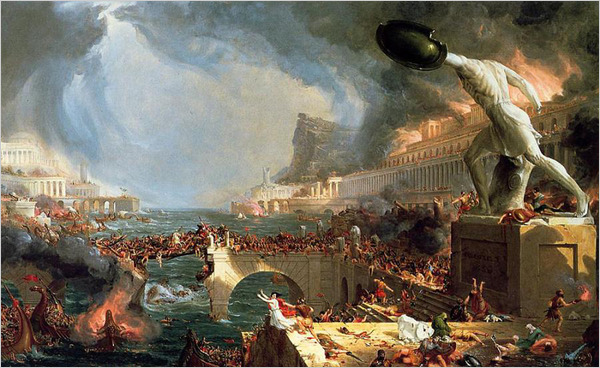
As Went the Romans?
Does he look at the complexity of the problems facing the United States and see doom? Possibly.
“Complexity creeps up on you,” he said in an interview. “It grows in ways, each of which seems reasonable at the time. It seemed reasonable at the time that we went into Afghanistan. It’s the cumulative costs that makes a society insolvent. Everything the Roman emperors did was a reasonable response in the situation that they found themselves in. It was the cumulative impact that did them in.”
Mr. Tainter isn’t peddling the nostalgic charms of simplicity, which is wise because there aren’t a lot of people who would buy it. Unless the subject is TV remote controls, most Americans have a fondness for complexity, or at least for ideas and objects that are hard to understand. In part that is because we assume complicated products come from sharp, impressive minds, and in part it’s because we understand that complexity is a fancy word for progress.
Just about every profession has become more complicated in recent decades. The sheer volume of data and rules that must be grasped by a certified public accountant, for instance, has exploded, says Gary Giroux, a professor of accounting at Texas A.& M. The bible of the business is the portentously named “Original Pronouncements,” a book that at its heftiest a few years ago ran to roughly 10,000 pages.
A century ago, Mr. Giroux says, there were no accounting courses, let alone “Original Pronouncements,” because accountants were just guys who double-checked the math of corporations to ensure there wasn’t internal fraud. What happened?
“There was no income tax until 1913,” he says, “and before the New Deal, there was no Securities and Exchange Commission.”
It’s been fashionable for some time to bash accounting for its encyclopedic list of rules and standards, which is perhaps why a public relations rep at the Financial Accounting Standards Board can come across as a little defensive when asked about the size of the group’s most famous door-stopping tome. But you can’t understand where all those regs came from without realizing that they made possible, and mirrored, the growth of the economy.
Which gets to the worrisome part of the complexity of problems we face today. Instead of improving our lives, it’s vexing them.
What we need, suggests Brenda Zimmerman, a professor at Schulich School of Business in Ontario, is a distinction between the complicated and the complex. It’s complicated, she says, to send a rocket to the moon — it requires blueprints, math and a lot of carefully calibrated hardware and expertly written software. Raising a child, on the other hand, is complex. It is an enormous challenge, but math and blueprints won’t help. Performing hip replacement surgery, she says, is complicated. It takes well-trained personnel, precision and carefully calibrated equipment. Running a health care system, on the other hand, is complex. It’s filled with thousands of parts and players, all of whom must act within a fluid, unpredictable environment. To run a system that is complex, it’s not enough to get the right people and the ideal equipment. It takes a set of simple principles that guide and shape the system. For instance: Teach everyone the best practices of doctors who are really good at hip replacement surgery.
“We get seduced by the complicated in Western society,” Ms. Zimmerman says. “We’re in awe of it and we pull away from the duty to ask simple questions, which we do whenever we deal with matters that are complex.”
Those complicated financial instruments that helped bludgeon the economy, she says, should have been subjected to elemental tests: Is this good for consumers? What are the risks involved?
Of course, nobody at Goldman Sachs or any other large financial institution meant to wreck the economy. The United States military didn’t invade Iraq or Afghanistan thinking that one day its efforts would be mounted on a bewildering PowerPoint slide. The engineers who designed the BP oil platform that exploded and sank and produced one of the largest oil spills in history built it with multiple back-up systems.
But complexity has a way of defeating good intentions. As we clean up these messes, there is no point in hoping for a new age of simplicity. The best we can do is hope the solutions are just complicated enough to work.
A version of this article appeared in print on May 2, 2010, on page WK1 of the New York edition.
A Circle
Surely our heart travels not only from the ghostly to the holy, but it makes a circle. And we know only half of it.
— Rilke, Letter to Marianne von Goldschmidt-Rothschild
December 5, 1914
Drudgery
I know that your profession is difficult and contrary to your nature. I cannot remove your distress; I can only urge you to consider whether all occupations are not challenging and hostile in some measure to one’s individuality, and saturated with the resentments of those who grimly and sullenly pursue them from duty only. The situation in which you must live now is not more burdened with conventions, prejudices, and errors than any other — and even if some occupation appears to offer greater freedom, it is a rare person who is able to stay open to the great matters that shape authentic living. Only the person who accepts solitude can place himself under the deep laws of the universe. When he steps into the fresh morning or out into the event-filled evening, all that is not him falls away, as if he had died, although he stands in the teeming midst of life.
— Rilke, Rome, December 23, 1903
Letters to a Young Poet
a soul’s not properly responsible
There’s a point of poverty at which the spirit isn’t with the body all the time. It finds the body really too unbearable. So it’s almost as if you were talking to the soul itself. And a soul’s not properly responsible.
— Louis-Ferdinand Celine
Starving poets
The profession of letters is, after all, the only one in which one can make no money without being ridiculous.
— Jules Renard
A Second Translator’s Note
In April 1943, Le Petit Prince was published in New York, a year before Antoine Saint-Exupéry was shot down over the Mediterranean by German reconnaissance planes. The English translation, by Katherine Woods, was copyrighted the same year . . . .
As in the case of contemporaries like Mann and Gide (the latter a great admirer of Saint-Exupéry), new versions of “canonical” translations raise questions (or at least suspicions) of lèse-majesté. A second translator into English of The Little Prince accepts the responsibility of such an imputation, for it must be acknowledged that all translations date; certain works never do. A new version of a work fifty-seven years old is entitled to and, indeed, is obliged to persist further in the letter of that work. Each decade has its circumlocutions, its compliances; the translator seeks these out, as we see in Ms. Woods’s pioneer endeavors, falls back on period makeshifts rather than confronting the often radical outrage of what the author, in his incomparable originality, ventures to say. The translator, it is seen in the fullness of time, so rarely ventures in this fashion, but rather falls back, as I say. It is the peculiar privilege of the next translator, in his own day and age, to sally forth, to be inordinate instead of placating or merely plausible. Time reveals all translation to be paraphrase, and it is in the longing for a standard version of a “beloved” work that we must begin again, we translators — that we must overtake one another.
— Richard Howard,
June 2000
The Scale of the Heart
To take things seriously — as my books are said to do — betokens no heaviness of spirit. Taking things seriously is no more than according things their true weight and seeing their innate value. It springs from a desire to weigh things on the scale of the heart rather than indulging in suspicion and distrust.
— Rilke, Letter to Rudolf Bodlander
March 13, 1922
Is it a terrible prison, not to be able to move from the place where you’re standing?
<Today one of the brothers asked me: Is it a terrible prison, not to be able to move from the place where you’re standing?>
.<You answered . . .>
.<I told him that I am now more free than he is. The inability to move frees me from the obligation to act.>
.<You who speak languages, you are such liars.>
— Orson Scott Card, Xenocide
Widening Circles
I live my life in widening circles
that reach out across the world.
I may not complete this last one
but I give myself to it.
I circle around God, around the primordial tower.
I’ve been circling for thousands of years
and I still don’t know: am I a falcon,
a storm, or a great song?
— Rilke, The Book of Hours I, 2
Be Near Me
Be near me when my light is low,
.
Be near me when the sensuous frame
.
Be near me when my faith is dry,
.
Be near me when I fade away,
.
— Alfred, Lord Tennyson, In Memoriam, Verse L
To be written in writing
True glory consists in doing what deserves to be written; in writing what deserves to be read.
— Pliny the Elder
Life in the colonies was no great shakes
Not far away the village tom-tom chopped my patience into little bits. Thousands of hard-working mosquitoes took possession of my legs, but I didn’t dare set foot on the ground because of the scorpions and snakes which, I assumed, had started on their abominable hunting expeditions. The snakes had plenty of rats to choose from, rats were gnawing away at everything that can be gnawed, I heard them on the wall, on the floor, and quivering, ready to drop, on the ceiling.
Finally the moon rose, and things were a little quieter in the shanty. All things considered, life in the colonies was no great shakes.
— Louis-Ferdinand Céline, Journey to the End of the Night
 The Floating Library