Gathering God

The poets have scattered you.
A storm ripped through the stammering.
I want to gather you up again
in a vessel that makes you glad.

I wander in the thousand winds
that you are churning,
and bring back everything I find.

The blind man needed you as a cup.
The servant concealed you.
The beggar held you out as I passed.

You see, I am one who likes to look for things.

— Rilke, The Book of Hours I, 55

Breath

Breath, you invisible poem!
Pure, continuous exchange
with all that is, flow and counterflow
where rhythmically I come to be.

Each time a wave that occurs just once
in a sea I discover I am.
You, innermost of oceans,
you, infinitude of space.

How many far places were once
within me. Some winds
are like my own child.

When I breathe them now, do they know me again?
Air, you silken surround,
completion and seed of my words.

— Rilke, Sonnets to Orpheus II, 1

Charged with the Transfiguration of All Things

How all things are in migration! How they seek refuge in us. How each of them desires to be relieved of externality and to live again in the Beyond which we enclose and deepen within ourselves. We are convents of lived things, dreamed things, impossible things; all that is in awe of this century saves itself within us and there, on its knees, pays its debt to eternity.

Little cemeteries that we are, adorned with the flowers of our futile gestures, containing so many corpses that demand that we testify to their souls. All prickly with crosses, all covered with inscriptions, all spaded up and shaken by countless daily burials, we are charged with the transmutation, the resurrection, the transfiguration of all things. For how can we save what is visible if not by using the language of absence, of the invisible?

And how to speak this language that remains mute unless we sing it with abandon and without any insistence on being understood.

— Rilke, Letter to Sophy Giauque
November 26, 1925

Borges on Pleasure Island

By RIVKA GALCHEN
Published: June 17, 2010
nyt.com
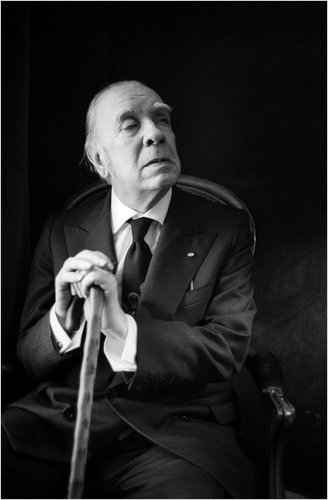
Borges in 1977

Little is quite as dull as literary worship; this essay on Borges is thus happily doomed. One finds oneself tempted toward learned-sounding inadequacies like: His work combines the elegance of mathematical proof with the emotionally profound wit of Dostoyevsky. Or: He courts paradox so primrosely, describing his Dupin-like detective character as having “reckless perspicacity” and the light in his infinite Library of Babel as being “insufficient, and unceasing.” But see, such worship is pale.

And problematic as well. More than any other 20th-century figure, Borges is the one designated — and often dismissed as — the Platonic ideal of Writer. His outrageous intellect is cited as proof of either his genius or of his bloodless cerebralism.

But Borges did have some mortal qualities. He lived most of his life with his mother. He loved detective and adventure novels. (His first story in English was published in Ellery Queen Mystery Magazine.) Though he started to go blind in his 30s, he never learned to read Braille. And in his later years he made some unappealing political remarks about being happy that, following the military overthrow of the Perón government, “gentlemen” were again running the country. (Perón, to be fair, had “promoted” Borges from head of the National Library to head of poultry inspection.) Such remarks are perhaps why he never won the Nobel.

But perhaps Borges’s most glorious and provocative “fault” was that he lived to be 86 and never wrote a novel. “It is a laborious madness, and an impoverishing one,” he wrote, in the introduction to a 1941 collection of his short stories, “the madness of composing vast books. . . . The better way to go about it is to pretend that those books already exist, and offer a summary, a commentary on them.”

He certainly did read vast books, however. For us Borges may be the ur-writer, but he thought of himself primarily as a reader; writing was just among the most intensely engaged ways of reading. In his essay “Literary Pleasure,” reprinted in ON WRITING (Penguin Classics, $15), one of three new Borges anthologies appearing this month under the general editorship of Suzanne Jill Levine, he says of his youthful reading — “the greatest literary joys I have experienced” — that he “believed everything, even errata and poor illustrations.” Reading was faith; writing a call-and-response form of prayer. To love a text: isn’t that just to find oneself helplessly casting about for something to say in return?

Which brings us back to worship. If serial rereading is one way to define worship, then one of Borges’s most revered gods was Robert Louis Stevenson. This even though in Borges’s time, Stevenson’s work was basically considered kid stuff. The first seven editions of the Norton Anthology of English Literature do not deign to include Stevenson, though he finally surfaces in the eighth edition, published in 2006. Borges not only commented on books that didn’t exist. He read books — pulpy and arcane alike — that few others bothered to see.

The Stevenson book Borges revisited most often was “The Wrecker,” a relatively obscure novel that Stevenson wrote with his stepson. Published in 1892, “The Wrecker” is a story of high seas adventure, high stakes speculation and high interest loans; it’s part mystery novel, part adventure novel, part mock Künstlerroman. The title refers to the practice of auctioning off the remains of wrecked ships along with any recoverable cargo, which is, yes, an irresistibly resonant metaphor for neglected books.

On the surface, “The Wrecker” could hardly resemble a Borges story less. At 500 pages, and full of incident, “The Wrecker” has the feel of a 27-course Victorian feast, served on a table crowded with doilies and finger bowls and odd utensils whose functions we can’t even imagine; Borges’s stories are more like truffle oil. Stevenson can barely go a page without mentioning bankruptcy, smuggling or sea captains; Borges, though he writes of bar fights and criminals, more often mentions Zeno’s paradox and the “Annals” of Tacitus. In the false dichotomy of the sword versus the pen, Stevenson is red and Borges black.

The main character in “The Wrecker,” Loudon Dodd, is a wealthy, untalented, unglamorous and highly likable young American man who cares nothing for his unearned money and longs for the life of an artist. Dodd goes to Paris to become a sculptor, fails at that, abruptly loses all his money, becomes involved in a series of wild business adventures through his charismatic friend Pinkerton, and eventually finds himself entangled in a maritime adventure involving opium trading, bunk stocks, debt and deception. All this adventure, it is almost explicitly said, eventually makes of him a kind of artist, or at least his life a kind of work of art, if a very pulpy one.

So why did Borges read and reread “The Wrecker”? What was it that he believed every detail of? And how was his own writing a way of reading Stevenson’s sacredly profane text? Borges’s readerly attention re-invents Stevenson, just as his writerly attention created those vast unwritten books that Borges chose not to write, but just to imagine and comment on.

Dodd and the other characters often marvel at how their lives have become as full of surprise and drama as a dime novel, and this is, basically, a happy thing. It’s as if to say that here, finally, are circumstances that do justice to the scope and scale of my emotions. It’s the idea of the objective correlative, done extra boyishly. In “The Wrecker,” the hyperbolized material world measures up to the outsize passions of the heart.

Think of it this way: there is a vast unwritten book that the heart reacts to, that it races and skips in response to, that it believes in. But it’s the heart’s belief in that vast unwritten book that brought the book into existence; what appears to be exclusively a response (the heart responding to the book) is, in fact, also a conjuring (the heart inventing the book to which it so desperately wishes to respond).

In his work, Borges achieves a related effect, by different means. Stories like “Pierre Menard, Author of the Quixote” and “The Book of Sand” refer to epic plots, but it’s the ideas and erudition, more than the action, that are colossal. Time, eternity, infinity and dreams — these are the only subjects commensurate to the passions of this quiet man who lived in Buenos Aires and in Geneva, though mostly in the vast nutshell of his own mind.

In “The False Problem of Ugolino,” an essay on Dante not included in “On Writing,” Borges quotes from an essay by Stevenson that makes the rather Borgesian claim that a book’s characters are only a string of words. “Blasphemous as this sounds to us,” Borges comments, “Achilles and Peer Gynt, Robinson Crusoe and Don Quixote, may be reduced to it.” Borges then adds: “The powerful men who ruled the earth, as well: Alexander is one string of words, Attila another.” The great deeds of the past may become no more than words, and no more than words are necessary to summon a power as grand and enduring even as Quixote or Achilles.

Among the vast books that do not really exist, and that Borges has commented on, are the innumerable pages of the future. Borges’s work answers the unanswerable weight of his reading, the boyish and the arcane at once. The pages of both what he wrote and what he only traced the shadows of present us with their own wavering interrogations; we are happy and afraid to be lost amid our insufficient and unceasing responses. Borges created his precursors, even Stevenson. We still do not know how to create Borges.

Rivka Galchen is the author of the novel “Atmospheric Disturbances.”

David Sings Before Saul (III)

Oh king, you conceal yourself in darkness,
and yet I have you in my power.
See, nothing has stopped this song of mine.
The room grows cold around us.
My orphaned heart and your wasted one
are caught together in the blindness of your wrath,
our teeth sunk into each other,
our claws twisted in a single fist.

Can you feel now how we are changing places?
My king, my king, what is heavy turns to spirit.
If we just keep hold of each other,
you grasping the young one and I the old,
we could revolve together like stars.

— Rilke, New Poems

Richard Cory

Whenever Richard Cory went down town,
We people on the pavement looked at him:
He was a gentleman from sole to crown,
Clean favored, and imperially slim.

And he was always quietly arrayed,
And he was always human when he talked;
But still he fluttered pulses when he said,
“Good-morning,” and he glittered when he walked.

And he was rich, richer than a king,
And admirably schooled in every grace:
In fine, we thought that he was everything
To make us wish that we were in his place.

So on we worked, and waited for the light,
And went without the meat, and cursed the bread;
And Richard Cory, one calm summer night,
Went home and put a bullet through his head.

— Edwin Arlington Robinson, 1897

David Sings Before Saul (II)

My king, all of this was yours.
The force of your living
oppressed and overshadowed me.
Come down from your thrown and break this harp
that you have wearied.

It is like a tree picked bare, and
through branches that once bore fruit
a depth is staring as from days to come,
days I cannot know.

Let me sleep no more beside the harp.
Look at my hand, still a boy’s hand.
Do you think it could not span
the octaves of a lover’s body?

— Rilke, New Poems

David Sings Before Saul (I)

My king, hear how my fingers on the strings
open distances we can travel through.
Stars careen around us
and we find we are falling like rain.
Earth blooms where this rain has fallen.

Girls you still remember are blooming too.
They are women now, and they draw me.
Young boys wait by the still closed door.
Slender and tense, they hold their breath.

Oh, might my playing restore it all to you!
But my music reels drunkenly.
It’s those nights of yours, those nights —
my singing moves me to imagine
the exhausted forms when you had done with them.

I can accompany your memories
because I feel them. But on which strings
can I pluck for you the dark groans of your lust?

— Rilke, New Poems

I Find You There

I find you there in all these things
I care for like a brother.
A seed, you nestle in the smallest of them,
and in the huge ones spread yourself hugely.

Such is the amazing play of the powers:
they give themselves so willingly,
swelling in the roots, thinning as the trunks rise,
and in the high leaves, resurrection.

— Rilke, The Book of Hours I, 22

Luke Havergal — Luke Havergal

Drive my dead thoughts over the universe
Like withered leaves to quicken a new birth!
And, by the incantation of this verse,

Scatter, as from an unextinguished hearth
Ashes and sparks, my words among mankind!
.

From Shelly’s “Ode to the West Wind”

.
Go to the western gate, Luke Havergal,
There where the vines cling crimson on the wall,
And in the twilight wait for what will come.
The leaves will whisper there of her, and some,
Like flying words, will strike you as they fall;
But go, and if you listen she will call.
Go to the western gate, Luke Havergal —
Luke Havergal.

No, there is not a dawn in eastern skies
To rift the fiery night that’s in your eyes;
But there, where western glooms are gathering,
The dark will end the dark, if anything:
God slays Himself with every leaf that flies,
And hell is more than half of paradise.
No, there is not a dawn in eastern skies —
In eastern skies.

Out of a grave I come to tell you this,
Out of a grave I come to quench the kiss
That flames upon your forehead with a glow
That blinds you to the way that you must go.
Yes, there is yet one way to where she is,
Bitter, but one that faith may never miss.
Out of a grave I come to tell you this —
To tell you this.

There is the western gate, Luke Havergal,
There are the crimson leaves upon the wall.
Go, for the winds are tearing them away, —
Nor think to riddle the dead words they say,
Nor any more to feel them as they fall;
But go, and if you trust her she will call.
There is the western gate, Luke Havergal —
Luke Havergal.

— Edwin Arlington Robinson’s incantation “Luke Havergal”

Constellation

Look at the sky. Is there no constellation called Rider?
For the image is imprinted on the mind:
this arrogance made from Earth and a second one astride,
driving him and holding him back.

Hunted, then harnessed: isn’t this
the sinewy nature of our being?
Path and turning, a touch to guide.
New distances. And the two are one.

But are they? Or is it only the going
that unites them? When they stop
they belong again to table or pasture.

The starry patterns fool us, too. Still,
it pleases us for a moment
to believe in them. That is all we need.

— Rilke, Sonnets to Orpheus I, 11

Man exists only insofar as he is separated from his surroundings

I do not know if it has ever been noted before that one of the main characteristics of life is discreteness. Unless a film of flesh envelops us, we die. Man exists only insofar as he is separated from his surroundings. The cranium is a space-traveler’s helmet. Stay inside or you perish. Death is divestment, death is communion. It may be wonderful to mix with the landscape, but to do so is the end of the tender ego.

— Vladimir Nabokov, Pnin

With Each Thing

Who can say what is? Who is able to judge the true worth of things?

I can only measure the world in terms of longing. All things are so ready to accommodate our many and often mistaken thoughts and wishes. With each thing I would like to rest for a night, after a day of “doing” with other things. I would like to sleep once with each thing, nestled in its warmth; to dream in the rhythm of its breathing, its dear, naked neighborliness against my limbs, and grow strong in the fragrance of its sleep. Then, early in the morning, before it awakens, before any good-byes, to move on, to move on. . . .

— Rilke, Early Journals

The Narrator’s Art of Integrating Telephone Conversations

Technically speaking, the narrator’s art of integrating telephone conversations still lags far behind that of rendering dialogues conducted from room to room, or from window to window across some narrow blue alley in an ancient town with water so precious, and the misery of donkeys, and rugs for sale, and minarets, and foreigners and melons, and the vibrant morning echoes.

— Vladimir Nabokov, Pnin

A Wondrous Knowing of the World

Sexual pleasure is no different from the sensory experience of pure looking or the feel on the tongue of a luscious fruit; it is a wondrous knowing of the world, given to us so that we may learn its fullness and radiance. The problem is not our acceptance of it; the problem is that this experience is so often misused and squandered. It is taken to enliven the deadened places of our lives, to distract instead of heightening our awareness.

People have even made eating into something it is not meant to be. Experienced as automatic impulse on the one hand, or as excess on the other, the nature of this physical necessity is distorted, and similarly distorted are all the other simple requirements for the renewing of life.

— Rilke, Worpswede, July 16, 1903
Letters to a Young Poet