L’ombre était nuptiale, auguste et solennelle

When I look into the fishponds in my garden,
(And not mine only, for every garden is riddled
With eel holes and reflected moons), methinks
I see a Thing armed with a rake that seems,
Out of the ooze, out of the immanence
Among the eels of heaven, to strike at me —
At Me the holy, Me divine! And yet
How tedious is a guilty conscience! How
Tedious, for that matter, an unguilty one!
What wonder if the horror of the fishponds
Draws us toward the rake? And the Thing strikes,
And I, the uneasy Person, in the mud,
Or in the liquid moonlight, thankfully
Find others than myself to have that blind
Or radiant being.

— Aldous Huxley, Ape and Essence

Conscience, custom

Conscience, custom — the first makes cowards,
Makes saints of us sometimes, makes human beings.
The other makes Patriots, Papists, Protestants,
Makes Babbitts, Sadists, Swedes or Slovaks,
Makes killers of Kulaks, chlorinators of Jews,
Makes all who mangle, for lofty motives,
Quivering flesh, without qualm or question
To mar their certainty of Supreme Service.

— Aldous Huxley, Ape and Essence

Sleeping Poole

He does not stir, but lies as though dead.

And this, too, is the beatific being of somebody who most certainly isn’t Alfred Pool D.Sc. For sleep is one of the preconditions of the Incarnation, the primary instrument of divine immanence. Sleeping, we cease to live that we may be lived (how blessedly!) by some nameless Other who takes this opportunity to restore the mind to sanity and bring healing to the abused and self-tormented body.

From breakfast to bedtime you may be doing everything in your power to outrage Nature and deny the fact of your Glassy Essence. But even the angriest ape at last grows weary of his tricks and has to sleep. And, while he sleeps, the indwelling Compassion preserves him, willy nilly, from the suicide which, in his waking hours, he has tried so frantically hard to commit. Then the sun rises again, and our ape wakes up once more to his own self and the freedom of his personal will — to yet another day of trick playing or, if he chooses, to the beginnings of self-knowledge, to the first steps toward his liberation.

— Aldous Huxley, Ape and Essence

Barnes & Borders: Weird.

Dear Borders Customer,

My name is William Lynch, CEO of Barnes & Noble, and I’m writing to you today on behalf of the entire B&N team to make you aware of important information regarding your Borders account.

First of all let me say Barnes & Noble uniquely appreciates the importance bookstores play within local communities, and we’re very sorry your Borders store closed.

As part of Borders ceasing operations, we acquired some of its assets including Borders brand trademarks and their customer list. The subject matter of your DVD and other video purchases will be part of the transferred information. The federal bankruptcy court approved this sale on September 26, 2011.

Our intent in buying the Borders customer list is simply to try and earn your business. The majority of our stores are within close proximity to former Borders store locations, and for those that aren’t, we offer our award- winning NOOK™ digital reading devices that provide a bookstore in your pocket. We are readers like you, and hope that through our stores, NOOK devices, and our bn.com online bookstore we can win your trust and provide you with a place to read and shop.

It’s important for you to understand however you have the absolute right to opt-out of having your customer data transferred to Barnes & Noble. If you would like to opt-out, we will ensure all your data we receive from Borders is disposed of in a secure and confidential manner. Please visit www.bn.com/borders before October 15, 2011 to do so.

Should you choose not to opt-out by October 15, 2011, be assured your information will be covered under the Barnes & Noble privacy policy, which can be accessed at www.bn.com/privacy. B&N will maintain any of your data according to this policy and our strict privacy standards.

At Barnes & Noble we share your love of books — whatever shape they take. We also take our responsibility to service communities by providing a local bookstore very seriously. In the coming weeks, assuming you don’t opt-out, you’ll be hearing from us with some offers to encourage you to shop our stores and try our NOOK products. We hope you’ll give us a chance to be your bookstore.

The Cynic

CYNIC, n. A blackguard whose faulty vision sees things as they are, not as they ought to be. Hence the custom among the Scythians of plucking out a cynic’s eyes to improve his vision.

SATAN, n. One of the Creator’s lamentable mistakes, repented in sashcloth and axes. Being instated as an archangel, Satan made himself multifariously objectionable and was finally expelled from Heaven. Halfway in his descent he paused, bent his head in thought a moment and at last went back. “There is one favor that I should like to ask,” said he.

“Name it.”

“Man, I understand, is about to be created. He will need laws.”

“What, wretch! you his appointed adversary, charged from the dawn of eternity with hatred of his soul — you ask for the right to make his laws?”

“Pardon; what I have to ask is that he be permitted to make them himself.”

It was so ordered.

— Ambrose Bierce, The Devil’s Dictionary

What I saw of the Civil War

Dead horses were everywhere; a few disabled caissons, or limbers, reclining on one elbow, as it were; ammunition wagons standing disconsolate behind four or six sprawling mules. Men? There were men enough; all dead apparently, except one, who lay near where I had halted my platoon to await the slower movement of the line — a Federal sergeant, variously hurt, who had been a fine giant in his time. He lay face upward, taking in his breath in convulsive, rattling snorts, and blowing it out in sputters of froth which crawled creamily down his cheeks, piling itself alongside his neck and ears. A bullet had clipped a groove in his skull, above the temple; from this the brain protruded in bosses, dropping off in flakes and strings. I had not previously known one could get on, even in this unsatisfactory fashion, with so little brain. One of my men whom I knew for a womanish fellow, asked if he should put his bayonet through him. Inexpressibly shocked by the cold-blooded proposal, I told him I thought not; it was unusual, and too many were looking.

— Ambrose Bierce, from “What I Saw of Shiloh” (1862)

The Poem That Changed the World?

If you can hold on to and repeat to yourself the simplest fact of existence—atoms and void and nothing else, atoms and void and nothing else—your life will change.

Titus Lucretius Carus, ca. 99 BC.


When Stephen Greenblatt, the eminent Renaissance scholar and Harvard professor of English, titled his new book The Swerve, it’s a safe bet that he wasn’t thinking about the current slang meaning of the word, which according to Urban Dictionary is “used most often as a sexual reference,” as in “get your swerve on.” The swerve Greenblatt has in mind, rather, is the abrupt, unpredictable movement of atoms that, according to the ancient Roman poet Lucretius, makes possible the creation and destruction of everything in the universe. “The swerve—which Lucretius called declinatioinclinatio, or clinamen—is only the most minimal of motions,” Greenblatt explains. “But it is enough to set off a ceaseless chain of collisions. Whatever exists in the universe exists because of these random collisions of minute particles.”

There is, however, a nice symmetry between the ancient and current senses of the word. For the universe Lucretius portrays in De rerum natura, the 7,000-line epic poem that is the main character of Greenblatt’s story, is definitely one that likes to get its swerve on. Or, to use the Roman’s preferred terminology, it is governed by Venus, the goddess of Love. The poem (quoted here in Frank Copley’s translation) begins with an invocation to Venus:

For soon as the year has bared her springtime face,
and bars are down for the breeze of growth and birth,
in heaven the birds first mark your passage, Lady,
and you; your power pulses in their hearts …
in every creature you sink love’s tingling dart,
luring them lustily to create their kind.

All this makes Lucretius sound like a pious polytheist, about to offer up a hecatomb to the goddess of love. In fact, Greenblatt explains, the core doctrine of De rerum natura is an uncompromising atheism, which understands the gods as nothing more than metaphors. While Greenblatt has several stories to tell in The Swerve—there are vibrant descriptions of the lifestyle of ancient Roman aristocrats, the corruption of the medieval Papacy, and the backbiting of Renaissance scholars—his real subject is the intellectual revolution of Epicureanism, the Greek philosophical school to which Lucretius belonged. Epicurus, its fourth-century founder, taught that the universe was completely material, made up of nothing but atoms and space. The power that drove life to multiply and evolve was irresistible but blind, the result of purely physical forces. It followed that there was no afterlife, no divine punishment, and no purpose to human existence except the cultivation of pleasure and the avoidance of pain.

For this reason, the word “epicurean” came to mean a seeker of luxury, a sybarite; but in fact, Greenblatt shows, the original Epicureans led a modest lifestyle. Their philosophy was intended not as a license for indulgence but as a therapy for the fear of death. “Against other things it is possible to obtain security, but when it comes to death we human beings all live in an unwalled city,” Epicurus said, and this message is at the heart of De rerum natura.

In his remarkably personal introduction, Greenblatt writes that it was this promise of equanimity toward death that first drew him to Lucretius’s poem as an undergraduate, when he picked up a copy for 10 cents in a bargain bin at the Yale Coop. The fear of death, he writes, “dominated my entire childhood,” thanks to “my mother’s absolute certainty that she was destined for an early death.” This fear was, happily, groundless—she lived to be almost 90—but “she had blighted much of her life—and cast a shadow on my own—in the service of her obsessive fear.” Greenblatt was thus a perfect audience for Lucretius’s rationalist message, which he summarizes: “If you can hold on to and repeat to yourself the simplest fact of existence—atoms and void and nothing else, atoms and void and nothing else—your life will change.”

The Swerve is powered by Greenblatt’s evangelical enthusiasm for this message. Indeed, he is more interested in explaining Epicureanism, and its intellectual and emotional ramifications, than he is in reading De rerum natura, and the reader learns little about the literary qualities of the poem. It appears in Greenblatt’s story, rather, as a symbolic time capsule, protecting its ancient secular wisdom through the Dark Ages and the Christian Middle Ages—periods Greenblatt depicts in highly conventional terms as poisoned by religion, uniformly grim and ascetic.

When Lucretius was rediscovered—ironically enough, in a monastery library—in 1417, by the Italian humanist Poggio Bracciolini, Greenblatt imagines the moment as the birth of the Renaissance: “There were no heroic gestures, no observers keenly recording the great event for posterity, no signs in heaven or on earth that everything had changed forever. A short, genial, cannily alert man in his late thirties reached out one day, took a very old manuscript off a library shelf, saw with excitement what he had discovered, and ordered that it be copied. That was all; but it was enough.”

In fact, of course, it was not nearly enough. Greenblatt knows that any such claim for De rerum natura is absurdly overblown—“one poem by itself was certainly not responsible for an entire intellectual, moral, and social transformation,” he grants early on. Yet the subtitle of the book is “How the World Became Modern,” and the implied answer is that it became modern by reading Lucretius and learning to think like him. Greenblatt’s brief final chapter, “Afterlives,” does show that De rerum natura influenced on some seminal modern writers, including Montaigne, whose annotated copy of the poem was discovered in 1989. More often, however, what Greenblatt finds is not so much direct influence as a general similarity of outlook—as when he associates Lucretius’s materialism with Galileo’s, or his rational hedonism with Jefferson’s “pursuit of happiness.” To say that “the atoms of Lucretius had left their traces on the Declaration of Independence” seems at best poetic license.

A more important problem with The Swerve is that Greenblatt’s account of Epicureanism makes it sound rather more consoling than it really is. Greenblatt dwells at length on the way Lucretius’s thoroughgoing materialism cleanses the human conscience of specters like “religious fanaticism” and “ascetic self-denial” and “dreams of limitless power.” “In short,” he writes, “it became possible—never easy, but possible—in the poet Auden’s phrase to find the mortal world enough.” Yet this is not only not easy. The worldview Lucretius proposes—atoms and void and nothing else—is the very one that has driven many other modern writers to despair and rebellion. From Leopardi to Kierkegaard to Camus, modern literature can be seen as a document of what happens when humanity is liberated into a void. It is not nearly as pretty a picture as Greenblatt optimistically suggests.

— Adam Kirsch
Slate

Hetacomb

[T]hey ranged the holy hecatomb all orderly round the altar of the god. They washed their hands and took up the barley-meal to sprinkle over the victims [cattle], while [the priest] lifted up his hands and prayed aloud on their behalf. . . .

When they had done praying and sprinkling the barley-meal, they drew back the heads of the victims and killed and flayed them. They cut out the thigh-bones, wrapped them round in two layers of fat, set some pieces of raw meat on the top of them, and then [the priest] laid them on the wood fire and poured wine over them, while the young men stood near him with five-pronged spits in their hands. When the thigh-bones were burned and they had tasted the inward meats, they cut the rest up small, put the pieces upon the spits, roasted them till they were done, and drew them off: then, when they had finished their work and the feast was ready, they ate it, and every man had his full share, so that all were satisfied. As soon as they had had enough to eat and drink, pages filled the mixing-bowl with wine and water and handed it round, after giving every man his drink-offering.

Thus all day long the young men worshipped the god with song, hymning him and chaunting the joyous paean, and the god took pleasure in their voices.

Iliad
(Samuel Butler tr.)

I would, but I need the eggs

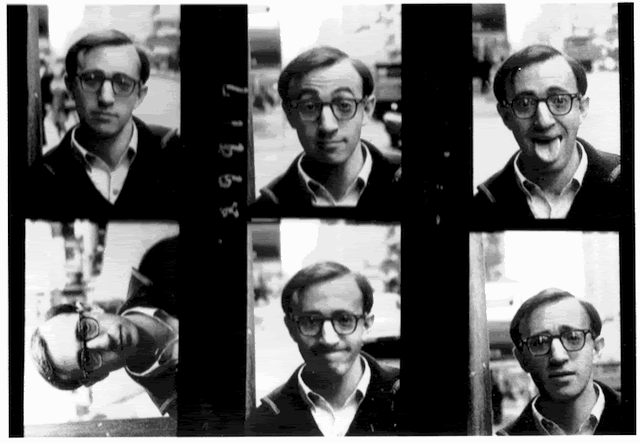
The two biggest myths about me are that I’m an intellectual, because I wear these glasses, and that I’m an artist because my films lose money. Those two myths have been prevalent for many years.

— Woody Allen

Yo que me figuraba el paraiso bajo la especie de una biblioteca

The composition of vast books is a laborious and impoverishing extravagance. To go on for five hundred pages developing an idea whose perfect oral exposition is possible in a few minutes! A better course of procedure is to pretend that these books already exist, and then to offer a resume, a commentary . . . More reasonable, more inept, more indolent, I have preferred to write notes upon imaginary books.

Beauty inexpressible, peace beyond understanding . . .

Ends are ape-chosen; only the means are man’s.

NARRATOR

Love casts out fear; but conversely fear casts out love. And not only love. Fear also casts out intelligence, casts out goodness, casts out all thought of beauty and truth. What remains is the dumb or studiedly jocular desperation of one who is aware of the obscene Presence in the corner of the room and knows that the door is locked, that there aren’t any windows. And now the thing bears down on him. He feels a hand on his sleeve, smells a stinking breath, as the executioner’s assistant leans almost amorously toward him. “Your turn next, brother. Kindly step this way.” And in an instant his quiet terror is transmuted into a frenzy as violent as it is futile. There is no longer a man among his fellow men, no longer a rational being speaking articulately to other rational beings; there is only a lacerated animal, screaming and struggling in the trap. For in the end fear casts out even a man’s humanity. And fear, my good friends, fear is the very basis and foundation of modern life. Fear of the much touted technology which, while it raises our standard of living, increases the probability of our violently dying. Fear of the science which takes away with one hand even more than what it so profusely gives with the other. Fear of the demonstrably fatal institutions for which, in our suicidal loyalty, we are ready to kill and die. Fear of the Great Men whom we have raised, by popular acclaim, to a power which they use, inevitably, to murder and enslave us. Fear of the War we don’t want and yet do everything we can to bring about.

As the Narrator speaks, we dissolve to the alfresco picnic of the baboons and their captive Einsteins. They eat and drink, with gusto, while the first two bars of “Onward Christian Soldiers” are repeated again and again, faster and faster, louder and louder. Suddenly the music is interrupted by the first of a succession of enormous explosions. Darkness. A long-drawn, deafening noise of crashing, rending, screaming, moaning. Then silence and increasing light, and once again it is the hour before sunrise, with the morning star and the delicate, pure music.

NARRATOR

Beauty inexpressible, peace beyond understanding . . .

Far off, from below the horizon, a column of rosy smoke pushes up into the sky, swells out into the likeness of an enormous toadstool and hangs there, eclipsing the solitary planet.

We dissolve again to the scene of the picnic. The baboons are all dead. Horribly disfigured by burns, the two Einsteins lie side by side under what remains of a flowering apple tree. Not far off a pressure tank is still oozing its Improved Glanders.

FIRST EINSTEIN

It’s unjust, it isn’t right . . .

SECOND EINSTEIN

We, who never did any harm to anybody;

FIRST EINSTEIN

We, who lived only for Truth.

NARRATOR

And that precisely is why you are dying in the murderous service of baboons. Pascal explained it all more than three hundred years ago. “We make an idol of truth; for truth without charity is not God, but his image and idol, which we must neither love nor worship.” You lived for the worship of an idol. But, in the last analysis, the name of every idol is Moloch. So here you are, my friends, here you are.

Stirred by a sudden gust, the stagnant plague-fog noiselessly advances, sends a wreath of pus-colored vapor swirling among the apple blossoms, then descends to engulf the two recumbent figures. A choking scream announces the death, by suicide, of twentieth-century science.

— Aldous Huxley, Ape and Essence (1948)

My Pilot days are closing in

Transcript

UNIBALL:

HI….

I AM WRITING TO THE MAKERS OF THE UNIBALL ‘GEL IMPACT’ PEN. UNFORTUNATELY I AM DOING SO WITH A PILOT P-500. AS OF THIS MOMENT, I HAVE YET TO LOCATE YOUR MAGNIFICENT PEN IN A STORE. AS SOON AS I FIND ONE I WILL PURCHASE ONE.

THIS IS THE DEAL….

I AM A STAND-UP COMEDIAN, MY NAME IS MITCH HEDBERG. I HAVE BEEN ON ‘THE LATE SHOW WITH DAVID LETTERMAN’ SIX TIMES. I HAVE A ½ HOUR COMEDY CENTRAL SPECIAL THAT IS PLAYED ON THE CHANNEL ALL THE TIME. I’VE MADE A GUEST APPEARANCE ON ‘THAT 70’S SHOW’ AND I HAVE A VERY VERY SMALL ROLE IN THE NEW CAMERON CROWE FILM, ‘ALMOST FAMOUS.’ I’VE DONE JUST ABOUT EVERY CABLE COMEDY SHOW AROUND.

RIGHT NOW I AM ON A TOUR IN AN RV WITH MY WIFE. OUR NEXT STOP IS RALEIGH, N.C.. ONE EVENING WE PULLED INTO A KOA TO SLEEP. I HAD TO FILL OUT A RESIGNATION SLIP AND THE SECURITY GUY HANDED ME ONE OF YOUR GEL IMPACT PENS TO DO THE JOB.

IT WAS A VERY SATISFYING WRITING EXPERIENCE TO SAY VERY LITTLE.

I WOULD LOVE TO ARRANGE A SPONSORSHIP DEAL WITH YOUR COMPANY SO I CAN PLUG THE THING. I’D BE SO HAPPY TO WEAR A UNIBALL T-SHIRT ON MY NEXT LETTERMAN SPOT. I’D PROMOTE THE PEN ANYWAY POSSIBLE.

I STILL HANDWRITE MOST OF MY JOKES. PERHAPS I WILL TYPE THEM MORE IF UNIBALL UNLEASHES A GEL IMPACT KEYBOARD. I USE PENS CONSTANTLY. YOUR PEN IS IT. I’VE TRIED BUYING EXPENSIVE PENS BUT NONE HAVE LIVED UP TO THE G.I.. SO SMOOTH AND EASY TO CONTROL.

IS THERE ANYTHING WE CAN DO TOGETHER? WOULD YOU BE INTERESTED IN CO-SPONSORING A TOUR? WE COULD PUT A LARGE BANNER ACROSS THE BACK OF THE STAGE: “GEL IMPACT IS RESPONSIBLE FOR THE WRITTEN VERSIONS OF THE JOKES THIS COMEDIAN IS SAYING.”

I’D BE SO PROUD.

LET ME KNOW WHAT YOU THINK AND THANKS A TON FOR READING THIS.

MY PILOT DAYS ARE CLOSING IN.

SINCERELY,

(Signed)

MITCH HEDBERG
(Address redacted)

SORRY ABOUT ANY SPELLING MISHAPS!

Letters of Note


Signed, Mister Rogers

Transcript:

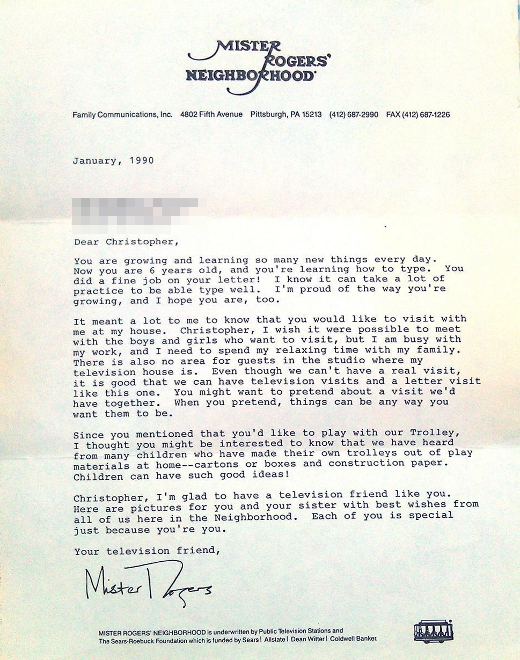
January, 1990

Dear Christopher,

You are growing and learning so many new things every day. Now you are 6 years old, and you’re learning how to type. You did a fine job on your letter! I know it can take a lot of practice to be able to type well. I’m proud of that way you’re growing, and I hope you are, too.

It meant a lot to me to know that you would like to visit with me at my house. Christopher, I wish it were possible to meet with the boys and girls who want to visit, but I am busy with my work, and I need to spend my relaxing time with my family. There is also no area for guests in the studio where my television house is. Even though we can’t have a real visit, it is good that we can have television visits and a letter visit like this one. You might want to pretend about a visit we’d have together. When you pretend, things can be any way you want them to be.

Since you mentioned that you’d like to play with our Trolley, I thought you might be interested to know that we have heard from many children who have made their own trolleys out of play materials at home–cartons or boxes and construction paper. Children can have such good ideas!

Christopher, I’m glad to have a television friend like you. Here are pictures for you and your sister with best wishes from all of us here in the Neighborhood. Each of you is special just because you’re you.

You television friend,

(Signed, ‘Mister Rogers’)

Transcript

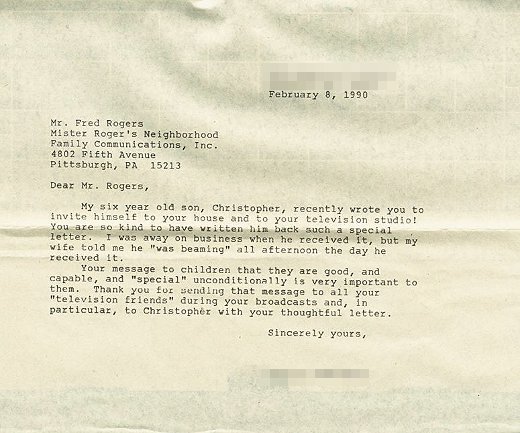
February 8, 1990

Dear Mr. Rogers,

My six year old son, Christopher, recently wrote you to invite himself to your house and to your television studio! You are so kind to have written him back such a special letter. I was away on business when he received it, but my wife told me he “was beaming” all afternoon the day he received it.

Your message to children that they are good, and capable, and “special” unconditionally is very important to them. Thank you for sending that message to all your “television friends” during your broadcasts and, in particular, to Christopher with your thoughtful letter.

Sincerely yours,

[Redacted]

Transcript

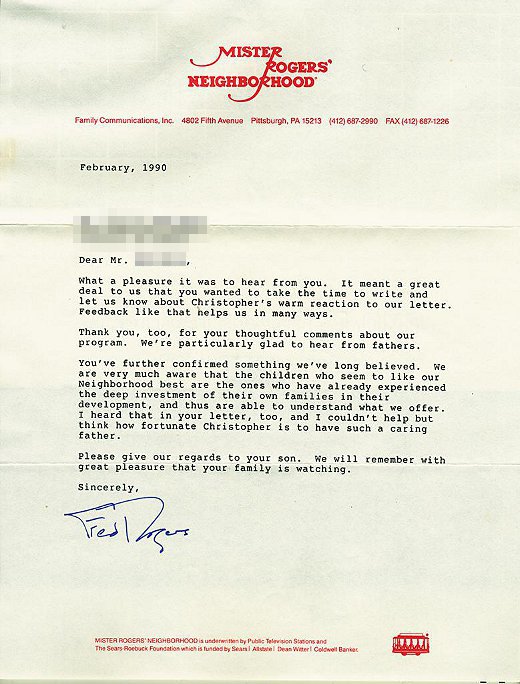
February, 1990

Dear Mr. [redacted],

What a pleasure it was to hear from you. It meant a great deal to us that you wanted to take the time to write and let us know about Christopher’s warm reaction to our letter. Feedback like that helps us in many ways.

Thank you, too, for your thoughtful comments about our program. We’re particularly glad to hear from fathers.

You’ve further confirmed something we’ve long believed. We are very much aware that the children who seem to like our Neighborhood best are the ones who have already experienced the deep investment of their own families in their development, and thus are able to understand what we offer. I heard that in your letter, too, and I couldn’t help but think how fortunate Christopher is to have such a caring father.

Please give our regards to your son. We will remember with great pleasure that your family is watching.

Sincerely,

(Signed, ‘Fred Rogers’)

Letters of Note