By Avi Steinberg
theparisreview
 Porn books and librarians have always had a passionate, mutually defining relationship—it was, in fact, a prudish French librarian in the early nineteenth century who coined the word pornography. So it comes as no surprise that the sexy librarian, a fixture of the pornographic imagination, is most at home in books. Each year, new titles are added to the librarian-porn bookshelf. This past season’s crop included additions like Hot for Librarian by Anastasia Carrera; Lucy the Librarian—Dewey and His Decimal by John and Shauna Michaels; The Nympho Librarian and Other Stories by Chrissie Bentley and Jenny Swallows; A Librarian’s Desire by Ava Delaney, author of the Kinky Club series; and soft-core selections like Sweet Magick by Penny Watson. The conventions of the form—the dimly lit stacks, the librarian’s mask of thick glasses and hair tied into a bun, et cetera—are, of course, well known. Unlike video porn, where these conventions are typically used as a wholesale substitute for narrative, porn books still feel the compulsion to tell a story, to make the glasses and bun mean something. I was curious just what story these new books were telling. What does our most current version of the librarian fantasy say about us? To answer this question, I visited the library.
Almost immediately, I hit a snag. It is close to impossible to browse a serious library’s collection of porn and porn criticism without getting sucked into big, sexy historical theories. Within an hour of my visit to Harvard’s Widener Library, I was beginning to suspect that smut had been behind the rise of … everything. I discovered that pornos caused the French Revolution, and that the Renaissance really got going when images of hard-core, swan-on-guy action began to circulate among the people. Every pornographer of note, it seemed, was a pop philosopher; every philosopher, a closet pornographer. As for the rise of the novel, of literary realism, this, I learned, was linked to a certain eighteenth-century depiction of a ponytailed dude taking it from behind from another ponytailed dude while the first dude gets sucked off by a chick, who is also taking it from behind from yet a third ponytailed dude, all while another chick—who happens to be wearing a lovely Dormeuse-style cap—rides piggyback on the first dude, which positions her perfectly to flog the third dude, while being orally pleasured from behind by the second dude. The caption to this illustration reads, “A Typical Scene.” According to the pile of books I’d stacked onto my library desk, our story is nothing but the evolutionary history of the Porno sapiens.
Just as I was letting this thought settle in, I began to hear moaning sounds. At first, I dismissed these as some kind of auditory hallucination, an occupational hazard of reading too much porn. But then I looked around and determined that this particular moaning belonged to a real woman standing a few rows away. To be precise, she was in the process of being properly pinned to the bookshelf by a male companion. After a hasty glance, I retreated to my carrel but can report that the proceedings were, if not quite spirited, certainly forceful—a book fell from the shelf—and that they terminated in muffled resound and a swift escape.
I was alone again in the silence of the stacks. Never before had the questions of the library sex fantasy been so close at hand yet so elusive. What was the relationship between these library fuckers and what I had been reading? And what was the relationship between the library fuckers and what they had been reading? Wasn’t library sex all about harmonizing books with experience, about connecting our unruly and our rule-abiding selves? And, if so, why did I find that the stories told in last year’s library-porn books consistently painted a grim picture of twenty-first-century library sex? Why did many of the best sex scenes in today’s librarian porn take place outside of a library?
 It wasn’t always this way. Library sex began with high hopes. Long before the era of the public library, stories of sex among books were set in private collections, in secluded humanist studies. The protagonist of Antonio Vignali’s 1526 La Cazzaria (The Book of the Prick) examines a collection of raunchy books and manuscripts in a private study as he awaits the arrival of a lover. The presence of smutty works in progress is telling: there is an elegant cross-pollination here. Books inspire sex, sex creates books—and all within the four walls of the library.
A Chinese Tale, a filthy poem published anonymously in 1740 and available on the streets of London for a shilling, introduces Cham-yam, a young lady blessed with “a most inviting Tit, and dainty, / As ere seen ’twixt twelve and twenty.” She is sitting in her study. After detailing a long, breathless bibliography of erotic books, the poet concludes, “What more can heighten mortal Sense / Than all this soft Magnificence?” Cham-yam, curious to understand the rise and fall of civilizations—how, in other words, the male passion for sex leads to great wars and upheavals—lifts her naked leg onto a table and gazes into a carefully placed looking glass. There, between her legs, she beholds the secret to understanding the tides of history, “the World’s great Primum Mobile, / That Master-piece! That Source of Passion! / that Thing! that’s never out of Fashion.” The library sex that follows is understood as an advanced study of history that unifies all bodies of knowledge in the bodies of the people who pursue knowledge.
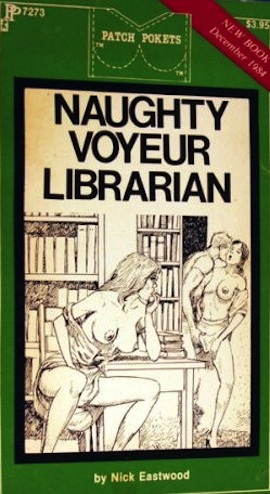
 It took more than two hundred years, the creation of the public library, the rise of women in the profession of librarianship and second-wave feminism for library sex to get serious again, in the 1970s. Although there is no authoritative list of titles from this late-twentieth-century renaissance, serious readers and writers of contemporary library porn consistently cite Bang the Librarian Hard, Hot Pants Librarian, The Librarian Gets Hot, The Librarian Got Hot, The Librarian Loves to Lick, and scores of other titles from those years.
Bang the Librarian Hard is a case in point of this earnest libertine revival. After a dirty interlude with the school’s coach on her office floor, librarian Samantha turns to the man and says, “Hasn’t your attitude toward libraries and librarians changed in this past hour?” Samantha is a proud activist, a progressive. Her passionate approach to library science also makes a strong impression on the conservative head librarian, an older woman who hasn’t benefited from women’s lib. There is a poignant cultural moment when Ms. Gustafson turns to Samantha during a threesome and says, “I’m so grateful to you, my dear.” After a great deal more shagging, on a pile of noncirculating books and on a marvelous secret bed that flips out of the stacks, Samantha rises to the post of head librarian—Ms. Gustafson retires and founds an NGO dedicated to “sex counseling for undersexed older women.” After a celebratory roll in the hay, Samantha muses on her triumphs and on history.
Head librarian, she thought. She was so fucking proud of that … She was going to be known as the best fucking librarian in Madison High School history.
This was also the era of the road-tripping sexy librarian, the picaresque heroine. Remember Lynn, in Waldo Beck’s 1974 The Lusty Librarian? After fornicating with a prudish American college town she responded to her critics by traveling to Spain and fornicating with a hotel mariachi band. With Lynn, and her cohort, there was a confident sense that the library had set them free. Even on the road, they were sexy librarians.
Today’s library porn lit is a totally different story. An inferiority complex has crept into the books’ marketing divisions, as evidenced by the anxiety-laden description of 2008’s The Librarian’s Naughty Habit:
Though not quite a classic on a par with The Librarian Loves to Lick and lacking the studied innocence of Horny Peeping Librarian, The Librarian’s Naughty Habit is easily the finest account of sex and the circulation desk that we at the Olympia Press can legally do.
Gone are the boasts of being the law-bending revolutionary, “the best fucking librarian”: the best that can be said of contemporary library porn is that it’s legal. Another recent title, Lucy the Librarian, is a good example of this year’s gloomy mood. In Lucy, we read of a “pleasantly plump” public librarian and her tryst with a mysterious reader. The book dishes up American-size portions of the genre’s conventions: the outsize appetites of repressed book lovers, the S and M underpinnings of the Dewey Decimal System, the librarian’s uniform, and, of course, transgressive screwing in a semipublic corner of the shelves.
 But a closer look at Lucy reveals a zeitgeist of anxiety. In a lot of recent library-porn lit, sex is set against an anguished backstory. Lucy, we learn, is a woman of her desperate times. She hasn’t had sex in two years, ever since her boyfriend left her for a woman who works in … the video industry. When Lucy tells another librarian of her plan to linger after-hours to do “online research”—an excuse for a rendezvous in the stacks—her library colleague tartly replies, “You know the porn’s blocked, right?” The joke is supposed to be on the coworker and, by extension, on our culture of video porn. Lucy’s very real encounter in the stacks is the modern library’s attempted rejoinder to the loneliness of life online. The physicality of the library space is presented here as a concrete alternative to the interminable virtualness of contemporary erotic imagination. It’s the last argument for the library’s continued relevance as a space and of the subversive potential of books—both of which are, ironically, called into question by the very existence of Lucy. This book, like all recent library-porn books, cannot not be found on any actual shelf in the real world. It lives exclusively in virtual space.
Existential anxiety has become the central theme of these books. In a 2010 book, Ava Delaney’sThe Librarian’s Love—not to be confused with its precursor, Delaney’s 2011 A Librarian’s Desire—Erica, a weary librarian, suddenly encounters an old boyfriend in her section of the stacks. In graphic detail we learn just how “a nearly extinct flame is rekindled in the Paleontology section.” The threat of extinction has become a mainstay of recent library porn: again and again, the neglected love life of the librarian is a stand-in for the doomed state of the library generally.
According to our porn books, the library, once a hothouse of eros and a laboratory of realism, has become a burial site. But somewhere on those shelves there’s still a memory of when books were really subversive, when being a libertine was actually about Voltaire and freethinking, and young girls were guarded from the corrupting influence of novels. The fantasy of awakening the librarian is also a fantasy of awakening the subversive power of the book, of excavating life from a dying cultural monument—or else scratching a bit of graffiti on it.
The library sex fantasy has, in other words, entered an apocalyptic period. “Throw me on my back in the dark room with the microfiche,” says the narrator of “Checking Out,” the final story of 2011’s Nympho Librarian. “Fuck me amidst the relics of a world that progress threw away.” And in the eyes of the next generation, whose view isn’t sweetened by nostalgia, things look even bleaker. In another story from Nympho we overhear the devastating comment of a brash young paramour—a boy with no memory of a world before Google—as he pinions his elder librarian mistress to a shelf of Russian lit (“not a section of the library that received many visitors”).
“I like your hair down like that,” he says, “it makes you look abandoned.”






 The Floating Library