Luminous beings are we, not this crude matter.
— Yoda

Luminous beings are we, not this crude matter.
— Yoda
When any of these pantomimic gentlemen, who are so clever that they can imitate anything, comes to us, and makes a proposal to exhibit himself and his poetry, we will fall down and worship him as a sweet and holy and wonderful being; but we must also inform him that in our State such as he are not permitted to exist; the law will not allow them. And so when we have anointed him with myrrh, and set a garland of wool upon his head, we shall send him away to another city.
— Plato, Republic
via Bertrand Russell,
A History of Western Philosophy
By John Banville
ft
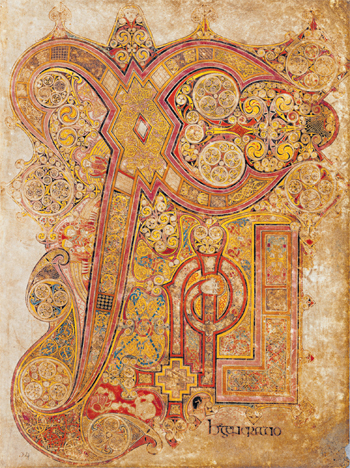
The story of the Book of Kells, of the mystery surrounding its provenance and the anonymity of the master scribes and artists who executed it, is a splendid romance. Few emblems of medieval European civilisation have caught the imagination of the international public to the same degree. Every year tens of thousands of visitors to Dublin file through the Long Room of Trinity College to view its intricately decorated pages. The artistry, colour, exuberance and wit that went into the making of this illuminated version of the four Gospels, described in the 11th-century Annals of Ulster as “primh-mind iarthair domain”, “the most precious object of the western world”, are an enduring source of awe and admiration. Here is a spark of brilliant light shining for us out of the Dark Ages.
The “Book of Kells” is probably a misnomer. Certainly the book was kept at Kells, a pleasant town in County Meath some 40 miles northwest of Dublin, from the beginning of the 11th century until it was sent to Dublin in the early 1650s for safe-keeping. It is not known for sure, however, where it originated. The best scholarly guess is that it was composed, or at least that its composition was begun, by Columban monks on the small, fertile island of Iona, off Mull on the west coast of Scotland, around the year 800.
The book, or codex, the more precise term for a manuscript volume, was from the start closely linked with the name of Columcille. The Annals of Ulster, for instance, refer to it specifically as “the great Gospel of Colum Cille”. This saint – Columcille translates as the “Dove of the Church” – is a potent figure in medieval Insular history, that is, the history of Ireland and Britain. He is Christian Ireland’s St George, but without the great-sword, and the pious counterpart, for generations of Irish schoolchildren, of the legendary warrior-hero Cuchulainn.
Columcille, or Columba, as he was known to the Latin-speaking world, was born in 521 or 522 into the aristocratic family of the O’Neills of Tír Connaill, roughly present-day Donegal. At the beginning of the 560s he travelled with 12 companions, in echo of Christ and his apostles, on a mission to Scotland to convert the Picts. In 563 he settled on Iona and founded a settlement there, which was to endure for centuries. Members of the community would go on to set up other monastic houses, including one on the great rock of Lindisfarne in Northumberland, established by the Ionan monk Aidan in 635.
At the close of the 8th century the tranquil life of Iona was violently disrupted by the arrival of the Viking longships. Raids were recorded in 795; in 802, when the settlement was “burned by the heathens”, as the Ulster annalists put it; and in 806, when 68 inhabitants were slaughtered. The following year a part of the monastic community transferred to Kells, where there was a royal hill-fort owned by the southern branch of Columcille’s family. The annals speak of Kells at this time as the “noue ciuitatis” of the Columban monks. The word “ciuitatis” means place of refuge, the circumference of which, according to one historical source, could be measured by an angel with a reed in his hand – it must have been a small fort indeed – which possibly accounts for the depiction in the Book of Kells of a number of angels holding what are probably reeds.
This last is one of many fascinating conjectures put forward by Bernard Meehan in The Book of Kells, a sumptuous – it is the only word for it – volume containing more than 80 pages from the manuscript reproduced full-size and in full, ravishing colour, as well as five comprehensive chapters on the historical background, the elements of the book, the manner of decoration, the work of the scribes and artists involved, and the physical features of the book.
Meehan, head of research collections and keeper of manuscripts at Trinity College, is surely the world’s foremost contemporary authority on the Book of Kells, which he has lived with and worked on throughout his professional career. His new book is a triumph of scholarly investigation and interpretation. Although he maintains an appropriately sober tone throughout, it is clear that he finds this marvellous artefact – indeed, this work of art – as fascinating and compellingly mysterious today as he did when he first set himself to unravelling its secrets some 30 years ago.
One of the endearing features of this version of the Gospels is that it is not particularly accurate. “While the scripts of the Book of Kells have a unique verve and beauty,” Meehan writes, “its text is erratic, with many errors resulting from eyeskip (where the scribe’s eye has jumped from a word to its next appearance, omitting the intervening text or letter).” This calls down a rare but stern professorial rebuke: “There is considerable carelessness in transcription.” Reading this, one’s deplorably feckless imagination wanders back through the smoke of the centuries to that frail little isle afloat in the wild Atlantic, where in a stone beehive hut a lonely scribe, hunched with quill in hand over his sheet of vellum, halts suddenly as he spots a mistranscription, claps a hand to his brow and utters whatever might have been the monastic equivalent of “Oh, shit!”

Those poor scribes – there were four of them, “prosaically termed A, B, C and D”, as Meehan sympathetically remarks – had their work cut out for them. The Book of Kells was made from 180 calf skins – an indication, by the way, of the comparative wealth of the monastic community, for in those days cows were money – and of the complete work, 680 pages remain, some folios as well as the original binding having been lost or destroyed. The scribes, employing broad quill pens held at right angles to the page, wrote with surprising speed, at an estimated rate of about 180 words per hour; the illustrator-artists, of course, would have worked much more slowly.
An elegant playfulness is evident throughout, with contingencies often being turned into occasions of bravura inventiveness. Meehan points out that to achieve an evenly justified right-hand margin, sometimes the final letter or letters of a word had to be inscribed below the remainder, and offers the example from the bottom of the verso of folio 276, where the final t of the word dixit is placed below the rest of the word, forming a flamboyant cross with the second stroke of the x. Elsewhere, too, necessity offered opportunity. The major illustrated pages would have taken very much longer to execute than script pages, and in order not to delay the process of transcription, the reverse sides would have been left blank to be filled in later with text. “Having to guess how much space to leave on these occasions,” Meehan writes, “the scribes normally erred on the conservative side, knowing that space could be filled with decoration if necessary.” Send in the artists.

The Irish have a weakness for puns, and this is as evident in the Book of Kells as it is in Finnegans Wake, although in the former the puns are for the most part visual, for no monk would think to tamper with the Gospel texts. A delightful example of visual punning occurs on the recto of folio 63. Meehan cites another scholar, George Henderson, identifying an insect on this page as a fly, “consistent with its place in the text, at Matthew 12.24, where the Pharisees say, ‘This man casteth not out devils but by Beelzebub, the prince of the devils’, for the name ‘Beelzebub’ is glossed in the list of Hebrew names in the Book of Kells as meaning ‘having flies’ or ‘Lord of flies’.”

Matters of doctrinal dispute, too, give rise to the occasional sly squib. The early Irish Church had its differences with Rome, for example on the thorny question of the dating of Easter, which led to a “great dispute” and a resulting Irish hostility towards St Peter, the founder of the Roman Church. According to the Venerable Bede, the Columbans had been persuaded in the early 700s to adopt the Roman method for fixing the date for Easter, but as Meehan points out, evidence in the Book of Kells points to a lingering resentment among the scribes and artists of Iona. Thus on the recto of folio 180, a line of text referring to Peter’s denial of Christ incorporates the figure of a hare, an animal known for its timidity.

An even more ingenious leporine dig is spotted by Meehan, with equal ingenuity, on the verso of folio 87. “The hare here, forming the S of Simile, gazes back overleaf to folio 87r, where Peter expresses doubt about following Jesus. It is precisely on the other side of the leaf from the pet of petrus, suggesting a deliberate association, to Peter’s disadvantage, between the words petrus and Simile and the animal, Peter being ‘like to’ a hare.” We should look with indulgence upon these harmless sallies. After all, as James Joyce pointed out, the Church of Rome was built on a pun, when Christ chose Peter (Petrus) as the rock (petra) of its foundation.
The Book of Kells is endlessly fascinating, boundlessly inspiring. “For many in Ireland,” Meehan remarks, “it symbolizes the power of learning, the impact of Christianity on the life of the country, and the spirit of artistic imagination.” So it is for many in the world at large, also. You do not have to be a Christian to appreciate the book’s beauty and power, expressing as it does our love of the natural world and at the same time the pathos of our yearning towards transcendence. In the beginning was the word, declares the Gospel of St John, and thereafter, we might add, came the transcribers of that word.
how the hell do you do this?
change the colors shapes and size
I’m clueless
not one thing I recognize
so foolish
every now’s a big surprise
help me to get through this
stay with me until I die
there’s nothing else I wanna try
— Built to Spill, “Reasons”
By Scott Van Wynsberghe
nationalpost

Its name sounds like the title of a Robert Ludlum thriller, and it has bamboozled generations of spies. An emperor reputedly once owned it, the Jesuits later acquired it and Yale University now has the infuriating thing. For those in the know, all that is needed is to roll one’s eyes and mutter about the Voynich Manuscript, which was discovered (or, technically, rediscovered) a century ago this year.
Wisely, Yale University’s Beinecke Rare Book and Manuscript Library decided to be open about so controversial an item, and the entire manuscript has been [external] posted online for scrutiny. There, one finds an object that initially does not seem to merit the fuss.
Physically, the manuscript is not large and has been measured (at a laboratory hired by the Beinecke Library) at just 23.5 x 16.2 cm, or just over 9” x 6”. Nor is it very lengthy. It once had no more than 116 leaves (or folios), each numbered on only one side, but 14 of them vanished as much as centuries ago, so just 102 remain. Counting both sides of each leaf, that makes 204 “pages,” although purists can be fussy on that point. (For the record, the Beinecke Library follows the convention whereby the leaf or folio on the right side of an open book is referred to as “recto,” while the reverse of that same leaf is “verso.” Thus, instead of references like “page 9,” one instead gets “folio 9 recto.”)
Once the technical minutia is out of the way, however, amazement follows. The manuscript is handwritten in a tidy, curvy format that cannot be read by anyone. When the individual characters of the writing are transliterated into a format of Roman letters adopted by Voynich buffs for the sake of convenience, the text provides such extreme nonsense as: “yteedy qotal dol shedy qokedar chcthey otordoror qokal otedy qokedy qokedy dal qokedy qokedy skam.”
The writing is accompanied by hundreds of illustrations, which one would expect to provide some guidance, but the opposite is the case. The pictures include perplexing charts of the cosmos, lots of unidentified plants and images of naked women either bathing or interacting with a bizarre network of tubes. (And the tubes are not even phallic: Sometimes, the women are inside them.)
For such a dreadful conundrum, the world has one man to thank — rare-book dealer Wilfrid Voynich. A former student agitator in flight from imperial Russia, Voynich transplanted himself first to the U.K. and then (as of 1914) to the United States, all the while building a reputation as a connoisseur of ancient scribblings. At some point in 1912 — nobody seems to know precisely when — he found the manuscript that bears his name.
Up to his death in 1930, Voynich was so evasive about the details of his discovery that one might reasonably wonder if he himself created the manuscript. However, the document was radiocarbon tested at the University of Arizona in 2009, yielding an origin point in the early 1400s. As well, the correspondence of a renowned scholar of the 1600s, the Jesuit Athanasius Kircher, has revealed a handful of apparent references to the manuscript. One of his contacts, the Prague-based physician Johannes Marcus Marci, evidently sent the manuscript to him for interpretation in the mid-1660s.
So the manuscript is not a modern fraud, but its provenance still remains very sketchy. In a 1930 letter written by Voynich’s wife Ethel — and not opened until her own death in 1960 — it was somewhat clarified that Voynich found the manuscript, thanks to a Jesuit priest named Joseph Strickland, at Frascati, near Rome. Voynich buffs have taken that to mean the Jesuit centre at the Villa Mondragone, near Frascati, where Strickland worked. In any case, Ethel revealed that Fr. Strickland swore Voynich to secrecy, implying that the transaction was somehow dicey.
How the manuscript got to Frascati is murky but must have had something to do with the Jesuit Kircher and his presumed receipt of it from Dr. Marci. In turn, Kircher was told by Marci that the latter had obtained it through the will of a late friend, George Baresch (also known by the Latin handle of “Barschius”). As well, Marci had heard a claim that the manuscript was once owned by Holy Roman Emperor Rudolf II (who reigned from 1576-1611), and ultraviolet examination of folio 1 recto has indeed revealed the faded signature of Rudolf’s chief botanist and alchemist, Jacobj à Tepenece.
Prior to Rudolf, however, there are at least 150 years of utter mystery. The very earliest theories about the manuscript centred on the English philosopher-monk Roger Bacon, who lived in the 1200s, but his era is ruled out by the radiocarbon test. In a 2011 article for the Skeptical Inquirer magazine, Voynich researcher Klaus Schmeh listed (and scoffed at) other candidates who have been proposed over the years, including artist Leonardo da Vinci, an Italian architect of the 1400s named Antonio Averlino and even an underground group of Cathar heretics. An English occultist, John Dee, has often come up, but online Voynich authority Philip Neal strongly discounts him.
Schmeh has wondered if the actual perpetrator may simply have been some unknown mentally ill person, but that looks impossible. Although all Voynich researchers may not agree, there has been a strong argument since the 1970s that the handwriting of the manuscript indicates at least two authors, not one. As well, linguist and computer expert Gordon Rugg has pointed out that the manuscript does not statistically conform to the known patterns of insane ravings, whatever its actual contents.
With the manuscript’s origin hopelessly obscure, Voynich enthusiasts have had no other choice but to try to crack the text. That daunting task has been made a little less grim by such online resources as the Beinecke Library (to which the manuscript was donated in 1969 by rare-book dealer H.P. Kraus, who bought it after Ethel Voynich’s death). Today, anyone can pretend to be a Voynich pundit. For much of its earlier history, however, the Voynich field was the preserve of a small circle of devotees — many of whom came from the shadows.
According to an historian of cryptology, David Kahn, Voynich consulted various authorities about his puzzling manuscript, and, in 1917, he approached MI-8, the U.S. military’s codebreaking unit during the First World War. The unit’s commander, Herbert O. Yardley, took a look at the manuscript, but it was a subordinate, John M. Manly, who became obsessed with it. When a possibly unhinged scholar named William R. Newbold began claiming in 1921 that he had solved the manuscript, Manly would lead the charge that discredited him. (Amusingly, Voynich was torn between the two men: The New York Timeslater revealed that both Manly and Newbold’s widow figured in Voynich’s will.)
Other significant intelligence personnel who joined the Voynich field in the decades to come were William F. Friedman (a legendary U.S. codebreaker of the Second World War), John H. Tiltman (a British contemporary of Friedman, also acclaimed), Prescott Currier (a U.S. Navy specialist), Yale University professor Robert S. Brumbaugh (previously a cipher sleuth for the U.S. Army) and Mary D’Imperio (whose highly regarded 1978 book on the manuscript can be consulted at the website of the National Security Agency).
Despite their skills, not one of the above was able to read the manuscript, leading to the growing suspicion that the text does not involve any encryption, because that would have been broken by now. And it may not even involve any actual language, either: In 2004, the aforementioned Gordon Rugg declared that the text was just gibberish — an ancient hoax possibly assembled through a non-functional version of a Renaissance coding technique called the “Cardan grille.” Rugg could not, however, explain why anyone in the Renaissance would do such a thing, nor did he address the amazing effort that went into the hundreds of illustrations. After a century of study, the Voynich Manuscript still mocks us.
And when it’s later
Open up your window just in case
You’re a radar
Built to scan the deeps of outer space
And if you recognize
Subtle patterns in the sky
Don’t take it as a sign
Unless it eases your mind
— Built to Spill

By David P. Barash
chronicle
Critics claim that evolutionary biology is, at best, guesswork. The reality is otherwise. Evolutionists have nailed down how an enormous number of previously unexplained phenomena—in anatomy, physiology, embryology, behavior—have evolved. There are still mysteries, however, and one of the most prominent is the origins of homosexuality.
The mystery is simple enough. Its solution, however, has thus far eluded our best scientific minds.
First the mystery.
The sine qua non for any trait to have evolved is for it to correlate positively with reproductive success, or, more precisely, with success in projecting genes relevant to that trait into the future. So, if homosexuality is in any sense a product of evolution—and it clearly is, for reasons to be explained—then genetic factors associated with same-sex preference must enjoy some sort of reproductive advantage. The problem should be obvious: If homosexuals reproduce less than heterosexuals—and they do—then why has natural selection not operated against it?
The paradox of homosexuality is especially pronounced for individuals whose homosexual preference is exclusive; that is, who have no inclination toward heterosexuality. But the mystery persists even for those who are bisexual, since it is mathematically provable that even a tiny difference in reproductive outcome can drive substantial evolutionary change.
J.B.S. Haldane, one of the giants of evolutionary theory, imagined two alternative genes, one initially found in 99.9 percent of a population and the other in just 0.1 percent. He then calculated that if the rare gene had merely a 1-percent advantage (it produced 101 descendants each generation to the abundant gene’s 100), in just 4,000 generations—a mere instant in evolutionary terms—the situation would be reversed, with the formerly rare gene occurring in 99.9 percent of the population’s genetic pool. Such is the power of compound interest, acting via natural selection.
For our purposes, the implication is significant: Anything that diminishes, even slightly, the reproductive performance of any gene should (in evolutionary terms) be vigorously selected against. And homosexuality certainly seems like one of those things. Gay men, for example, have children at about 20 percent of the rate of heterosexual men. I haven’t seen reliable data for lesbians, but it seems likely that a similar pattern exists. And it seems more than likely that someone who is bisexual would have a lower reproductive output than someone whose romantic time and effort were devoted exclusively to the opposite sex.
Nor can we solve the mystery by arguing that homosexuality is a “learned” behavior. That ship has sailed, and the consensus among scientists is that same-sex preference is rooted in our biology. Some of the evidence comes from the widespread distribution of homosexuality among animals in the wild. Moreover, witness its high and persistent cross-cultural existence in Homo sapiens.
In the early 1990s, a geneticist at the National Institutes of Health led a study that reported the existence of a specific allele, Xq28, located on the X chromosome, that predicted gay-versus-straight sexual orientation in men. Subsequent research has been confusing, showing that the situation is at least considerably more complicated than had been hoped by some (notably, most gay-rights advocates) and feared by others (who insist that sexual orientation is entirely a “lifestyle choice”).
Some studies have failed to confirm any role for Xq28 in gay behavior, while others have been supportive of the original research. It is also increasingly clear that whatever its impact on male homosexuality, this particular gene does not relate to lesbianism. Moreover, other research strongly suggests that there are regions on autosomal (nonsex) chromosomes, too, that influence sexual orientation in people.
So a reasonable summary is that, when it comes to male homosexuality, there is almost certainly a direct influence, although probably not strict control, by one or more alleles. Ditto for female homosexuality, although the genetic mechanism(s), and almost certainly the relevant genes themselves, differ between the sexes.
Beyond the suggestive but inconclusive search for DNA specific to sexual orientation, other genetic evidence has emerged. A welter of data on siblings and twins show that the role of genes in homosexual orientation is complicated and far from fully understood—but real. Among noteworthy findings: The concordance of homosexuality for adopted (hence genetically unrelated) siblings is lower than that for biological siblings, which in turn is lower than that for fraternal (nonidentical) twins, which is lower than that for identical twins.
Gay-lesbian differences in those outcomes further support the idea that the genetic influence upon homosexuality differs somewhat, somehow, between women and men. Other studies confirm that the tendency to be lesbian or gay has a substantial chance of being inherited.
Consider, too, that across cultures, the proportion of the population that is homosexual is roughly the same. We are left with an undeniable evolutionary puzzle: What maintains the underlying genetic propensity for homosexuality, whatever its specific manifestations? Unlike most mystery stories, in which the case is typically solved at the finish, this one has no ending: We simply do not know.
Here are some promising possibilities.
Kin selection. Scientists speculate that altruism may be maintained if the genes producing it help a genetic relative and hence give an advantage to those altruistic genes. The same could be true of homosexuality. Insofar as homosexuals have been freed from investing time and energy in their own reproduction, perhaps they are able to help their relatives rear offspring, to the ultimate evolutionary benefit of any homosexuality-promoting genes present in those children.
Unfortunately, available evidence does not show that homosexuals spend an especially large amount of time helping their relatives, or even interacting with them. Not so fast, however: Those results are based on surveys; they reveal opinions and attitudes rather than actual behavior. Moreover, they involve modern industrialized societies, which presumably are not especially representative of humanity’s ancestral situations.
Some recent research has focused on male homosexuals among a more traditional population on Samoa. Known as fa’afafine, these men do not reproduce, are fully accepted into Samoan society in general and into their kin-based families in particular, and lavish attention upon their nieces and nephews—with whom they share, on average, 25 percent of their genes.
Social prestige. Since there is some anthropological evidence that in preindustrial societies homosexual men are more than randomly likely to become priests or shamans, perhaps the additional social prestige conveyed to their heterosexual relatives might give a reproductive boost to those relatives, and thereby to any shared genes carrying a predisposition toward homosexuality. An appealing idea, but once again, sadly lacking in empirical support.
Group selection. Although the great majority of biologists maintain that natural selection occurs at the level of individuals and their genes rather than groups, it is at least possible that human beings are an exception; that groups containing homosexuals might have done better than groups composed entirely of straights. It has recently been argued, most cogently by the anthropologist Sarah B. Hrdy, that for much of human evolutionary history, child-rearing was not the province of parents (especially mothers) alone. Rather, our ancestors engaged in a great deal of “allomothering,” whereby nonparents—other genetic relatives in particular—pitched in. It makes sense that such a system would have been derived by Homo sapiens, of all primate species the one whose infants are born the most helpless and require the largest investment of effort. If sufficient numbers of those assistants had been gay, their groups may have benefited disproportionately.
Alternatively, if some human ancestors with a same-sex preference reproduced less (or even not at all), that, in itself, could have freed up resources for their straight relatives, without necessarily requiring that the former were especially collaborative. Other group-level models have also been proposed, focusing on social interaction rather than resource exploitation: Homosexuality might correlate with greater sociality and social cooperation; similarly, it might deter violent competition for females.
Balanced polymorphisms. Perhaps a genetic predisposition for homosexuality, even if a fitness liability, somehow conveys a compensating benefit when combined with one or more other genes, as with the famous case of sickle-cell disease, in which the gene causing the disease also helped prevent malaria in regions where it was epidemic. Although no precise candidate genes have been identified for homosexuality, the possibility cannot be excluded.
Sexually antagonistic selection. What if one or more genes that predispose toward homosexuality (and with it, reduced reproductive output) in one sex actually work in the opposite manner in the other sex? I prefer the phrase “sexuallycomplementary selection”: A fitness detriment when genes exist in one sex—say, gay males—could be more than compensated for by a fitness enhancement when they exist in another sex.
One study has found that female relatives of gay men have more children than do those of straight men. This suggests that genes for homosexuality, although disadvantageous for gay men and their male relatives, could have a reproductive benefit among straight women.
To my knowledge, however, there is as yet no evidence for a reciprocal influence, whereby the male relatives of female homosexuals have a higher reproductive fitness than do male relatives of heterosexual women. And perhaps there never will be, given the accumulating evidence that female homosexuality and male homosexuality may be genetically underwritten in different ways.
A nonadaptive byproduct. Homosexual behavior might be neither adaptive nor maladaptive, but simply nonadaptive. That is, it might not have been selected for but persists instead as a byproduct of traits that presumably have been directly favored, such as yearning to form a pair bond, seeking emotional or physical gratification, etc. As to why such an inclination would exist at all—why human connections are perceived as pleasurable—the answer may well be that historically (and prehistorically), it has often been in the context of a continuing pair-bond that individuals were most likely to reproduce successfully.
There are lots of other hypotheses for the evolution of homosexuality, although they are not the “infinite cornucopia” that Leszek Kolakowski postulated could be argued for any given position. At this point, we know enough to know that we have a real mystery: Homosexuality does have biological roots, and the question is how the biological mechanism developed over evolutionary time.
Another question (also yet unanswered) is why should we bother to find out.
There is a chilling moment at the end of Ray Bradbury’s The Martian Chronicles,when a human family, having escaped to Mars to avoid impending nuclear war, looks eagerly into the “canals” of their new planetary home, expecting to see Martians. They do: their own reflections.
It wasn’t terribly long ago that reputable astronomers entertained the notion that there really were canals on Mars. From our current vantage, that is clearly fantasy. And yet, in important ways, we are still strangers to ourselves, often surprised when we glimpse our own images. Like Bradbury’s fictional family, we, too, could come to see humanity, reflected in all its wonderful diversity, and know ourselves at last for precisely what we are, if we simply looked hard enough.
Unlike the United States military, with its defunct “don’t ask, don’t tell” policy, many reputable investigators are therefore asking … not who is homosexual, but why are there homosexuals. We can be confident that eventually, nature will tell.

By Alexandra Mullen
bnreview
More than 300 years ago, Johann Sebastian Bach was born in the small German town of Eisenach. Unlike his contemporary Handel, he never traveled very far. But from this intense central point, Bach — or at least the sound waves representing him — seems to be filling up the universe. Three of his pieces are on Voyager’s golden disc which is now approaching the brink of interstellar space; and at the same time, as Paul Elie, the author of Reinventing Bach, says, “He is in my pocket.” How has Bach in our time become a Godlike being whose center is everywhere and whose circumference nowhere?
By juxtaposing the space capsule and the pocket, Elie captures two elements of Bach — the domestic and the transcendent. They were certainly evident in his own life of playing, rehearsing, composing, teaching, and performing music, where there was not much distance or difference between the clavier at home and the organ at church. By juxtaposing the LP and the iPod, Elie reminds us of how technology has democratized and universalized Bach — all of us can “play” him now whether we’re picking through a score at the piano or listening to recordings of Edwin Fischer’s impassioned wrong notes or Glenn Gould’s equally impassioned right ones.
I single out Fischer and Gould’s piano recordings because while both Fischer and Gould give highly individual performances, they represent two different ways of thinking about what a recording is. Fischer’s recordings sound old, not just because of the background hissings and pops but also because they are embedded in concert practice: one continuous take, one continuous flow distilling concentrated experience with that particular piece at that particular moment in that particular space, warts, felicities, and all. Gould’s recording of the same pieces sound—well, newer, certainly, but in some sense out of time and even location: Gould consciously exploited “take-twoness” — not so much to eliminate flubs (although that too) as to craft peaks of brilliance on an instrument inhabiting its own sound-world.
For Elie, whose previous book, The Life You Save May Be Your Own, concentrated on four American Catholic writers, the spiritual and the technological are not antithetical:
In an age of recordings, the past isn’t wholly past and the present isn’t wholly present, and our suspension in time, our intimacy with the most sublime expressions of people distant and dead, is a central fact of our experience. This is at once a benefit and a quandary, and in it, I would venture, are the makings of a spirituality of technology.
Some Bach pianists have the gift of bringing out lines of music in a score that I’ve never noticed before — I think particularly of Gould’s and Simone Dinnerstein’s startling different but utterly compelling versions of the Goldberg Variations. Elie has a similar ability to hear new connections between well-known notes. I find him particularly thought-provoking when he marks long historical phrases. In one passage, after considering the physical placement of the church organist (literally lofty, back turned to the service), Bach’s chorales, and the goals of the Reformation that lead “every believer [to] hope for a direct encounter with the thing itself,” Elie moves outward to our day: “Recordings heighten the effect, completing the transition from eye to ear, from seeing to hearing, that the Reformation had brought about. The organist is done away with. So is the church building. So are the limits of space and time, of stamina and attention. The music of Bach is all that is left. The recordings pour out perfection: they enable the listener to import transcendence into an ordinary room, to “play” the music without making it.” Is it just a fluke that some early recording studios were deconsecrated churches?
I have been singling out technological contemplations, but Elie has many strengths and strands: detailed and beautifully described moments of listening, engagingly narrated summaries of scholarship, alert attention to telling facts, and a loving knowledge of many different kinds of music, including Robert Johnson and Led Zeppelin. There’s plenty of audiophile information — wax cylinder, recording, mono, stereo, different kinds of tape, 78s, long-playing records, CD’s, iPods — and a lot on the placement of microphones.
Wearing his learning lightly (with wonderful endnotes as a ground), Elie is polyphonic and contrapuntal. In counterpoint, as Nicholas Slonimsky defines it, “each voice has a destiny of its own.” Elie’s book is held together by chain of voices following one other as they make an entrance, step back, overlap, and enter again to reveal a new aspect against the changing conversation: Schweitzer to Casals to Stokowski to Gould to Ma. Other voices too move in and out, filling out the progressions: Tureck, Schoenberg, Einstein, Jobs, even the musically fantastic Mickey Mouse. The voice hovering over all is Elie’s own, modest, serious, attuned to the whole.
Among the wonder of Bach’s music, according to Elie, is that “it sounds inventive — it doesn’t finish the musical thought so much as keep it aloft.” Above all it is this aspect of keeping a musical idea in play, Elie feels, that has inspired so many musicians to enter into this long conversation.
It’s a conversation that has technical or professional aspects, but that also welcomes interested amateurs like Elie and me. Here are two signs of my engagement provoked by this book: first, the number of comments I’ve made in the margins, often disagreements over the role of technology; second, the number of times I’ve turned to CDs, DVDs, iTunes, and YouTube to listen to something he mentioned. Both a benefit and a quandary indeed. The perfection of recordings can be transcendent, yes, but also inhibiting for sublunary amateurs. From a technical point of view, Gould’s Apollonian super-perfection is now an every-day occurrence thanks to the ability to drop in a single-note retouch for a flub. (I’ll leave autotune alone.) For example, I particularly like something Elie doesn’t mention perhaps because he doesn’t: the domestic intimacy of overhearing Gould hum in the background of, say, the English Suites. But I’ve been entranced by some of the YouTube videos he does mention that make the power of Bach visible, from vibrating graphic animations to a Japanese performance of the Matthew Passion to Mstislav Rostropovich playing at the Berlin Wall — in front of exuberant Western graffiti including (Elie strikingly fails to mention given his eye for recurrence) Mickey Mouse.
It is a pleasure to read such a serious and inventive book on Bach, and that’s saying something.
In studying a philosopher, the right attitude is neither reverence nor contempt, but first a kind of hypothetical sympathy, until it is possible to know what it feels like to believe in his theories, and only then a revival of the critical attitude, which should resemble, as far as possible, the state of mind of a person abandoning opinions which he has hitherto held. Contempt interferes with the first part of this process, and reverence with the second. Two things are to be remembered: that a man whose theories are worth studying may be presumed to have had some intelligence, but that no man is likely to have arrived at complete and final truth on any subject whatever. When an intelligent man expresses a view which seems to us obviously absurd, we should not attempt to prove that it is somehow true, but we should try to understand how it ever came to seem true. This exercise of historical and psychological imagination at once enlarges the scope of our thinking, and helps us to realize how foolish many of our own cherished prejudices will seem to an age which has a different temper of mind.
— Bertrand Russell, A History of Western Philosophy
His most important contribution to science was his discovery of air as a separate substance. This he proved by the observation that when a bucket or any similar vessel is put upside down into water, the water does not enter into the bucket. He says:
When a girl, playing with a water-clock of shining brass, puts the orifice of the pipe upon her comely hand, and dips the water-clock into the yielding mass of silvery water, the stream does not then flow into the vessel, but the bulk of the air inside, pressing upon the close-packed perforations, keeps it out till she uncovers the compressed stream; but then air escapes and an equal volume of water runs in.
This passage occurs in an explanation of respiration.
— Bertrand Russell, A History of Western Philosophy
O glad, glad on the Mountains
To swoon in the race outworn,
When the holy fawn-skin clings
And all else sweeps away,
To the joy of the quick red fountains,
The blood of the hill-goat torn,
The glory of wild-beast ravenings
Where the hill-top catches the day,
To the Phrygian, Lydian mountains
‘Tis Bromios leads the way.
— Euripides, Bacchae
via Bertrand Russell,
A History of Western Philosophy
By Joseph Epstein
wsj
No one should read Marcel Proust’s “In Search of Lost Time” for the first time. A first reading, however carefully conducted, cannot hope to unlock the book’s complexity, its depth, its inexhaustible richness. Roughly a million words and more than 3,000 pages long, it is a novel I have read twice, and one of the reasons I continue to exercise and eat and drink moderately and have a physical every year into my 70s is that I hope to live long enough to read it one more time.
Told with France’s Belle Epoque (that bright and lavish quarter of a century before World War I permanently darkened all life in Europe) as its background, “In Search of Lost Time” is the recollections of a first-person narrator over several decades. This narrator, who bears many resemblances to its author (he is called Marcel, and his family and circumstances are similar to Proust’s) but who also differs from him in striking ways (chief among them that his life is not devoted to writing a great novel), is relentless in his energy for analysis. In his detailed attempt to remember all things past, he is as all-inclusive as literature can get; what normal people filter out of memory the narrator channels in. And so it was with Proust himself: While most authors working at revision tend to take things out of their manuscripts, up to his death in 1922 Proust was continuing to add things to his.

“In Search of Lost Time” is a masterwork. Masterworks seem to require new translations every half-century or so, and such has been the case with Proust’s vast novel. Penguin has recently undertaken a re-translation, with different hands assigned each of the novel’s seven volumes, though, alas, not each of these hands is up to the difficult task of translating Proust, and so the translation is uneven. I prefer Terence Kilmartin’s 1970s reworking of the earlier C.K. Scott Moncrieff translation, which appeared under the title “Remembrance of Things Past” (a phrase that Scott Moncrieff took from Shakespeare’s Sonnet XXX: “When to the sessions of sweet silent thought / I summon up remembrance of things past”). It remains in print from Random House, and among its other advantages is that the edition is spaciously printed, no small benefit in a lengthy work composed of sentences sometimes running several cubits long.
Masterworks also engender writing about them by superior people. Small books have been written about Proust’s novel by François Mauriac, Samuel Beckett and Jean-François Revel. Other studies of the book have been done by the poets Howard Moss and Howard Nemerov and the critic Roger Shattuck. Full-length biographies of Proust have been written by George Painter, André Maurois, William C. Carter and Jean-Yves Tadié. Others have written books about photography and Proust; about painting and Proust; about his May 1922 dinner meeting with James Joyce, Igor Stravinsky and other of the great figures of Modernism; about his interest in but limited knowledge of English. There is even an excellent biography of Proust’s mother, who played so important a role in his life. Proustolators, of whom I count myself one, do not want for excellent reading about their idol.
With “Monsieur Proust’s Library,” Anka Muhlstein has added another volume to the collection of splendid books about Proust. A woman of intellectual refinement, subtle understanding and deep literary culture, Ms. Muhlstein has written an excellent biography of Astolphe de Custine, the 19th-century French aristocrat who did for Russia what Alexis de Tocqueville did for the United States. Her previous book, “Balzac’s Omelette,” was a study of the place of food in that novelist’s life and in his work.
“Monsieur Proust’s Library” is a variation on her Balzac book. Early in “Balzac’s Omelette” she wrote: “Tell me where you eat, what you eat, and what time of day you eat, and I will tell you who you are.” Much to it, but there is even more to be learned by discovering, as Ms. Muhlstein in effect does in “Monsieur Proust’s Library,” what a person reads and when, what he thinks of what he reads, and what effect it has had on him. Omelettes for Balzac, books for Proust: Ms. Muhlstein is an excellent provisioner of high-quality intellectual goods.
Marcel Proust (1871-1922) was immensely well read. “In Search of Lost Time” encapsulates within itself the main traditions in French literature: both in fiction (from Madame de Lafayette through Stendhal, Balzac, Flaubert and Zola) and in the belle-lettristic-philosophical line (from Montaigne through Pascal, La Rochefoucauld and Chamfort). Proust formed a strong taste for generalization through these latter writers. I own a small book of his maxims, drawn from the novel and his discursive writings, and an unusually high quotient of them are dazzling. Let one example suffice: “It has been said that the greatest praise of God lies in the negation of the atheist, who considers creation sufficiently perfect to dispense with a creator.”
As an asthmatic child, Proust read more than most children. Ms. Muhlstein recounts that, by the age of 15, he was already immersed in contemporary literature, having read the essays and novels of Anatole France and Pierre Loti, the poetry of Mallarmé and Leconte de Lisle, and a number of the novels of Dostoyevsky, Tolstoy, Dickens and George Eliot. Unlike Henry James, who referred to their works as “baggy monsters,” Proust fully appreciated the great Russian novelists. He thought Tolstoy “a serene god,” valuing especially his ability to generalize in the form of setting down laws about human nature. Ms. Muhlstein informs us that, for Proust, Dostoyevsky surpassed all other writers, and that he found “The Idiot” the most beautiful novel he had ever read. He admired Dostoyesky’s skill with sudden twists in plot, providing the plausible surprises that propelled his novels.
In his 1905 essay “On Reading,” a key document, Ms. Muhlstein notes, in Proust’s freeing himself to write his great novel, he quoted Descartes: “The reading of all good books is like a conversation with the most cultivated of men of past centuries who have been their authors.” Proust’s examination of “the original psychological act called reading,” that “noblest of distractions,” holds that books are superior to conversation, which “dissipates immediately.”
A book, he felt, is “a friendship . . . and the fact that it is directed to one who is dead, who is absent, gives it something disinterested, almost moving.” Books are actually better than friends, Proust thought, because you turn to them only when you truly desire their company and can ignore them when you wish, neither of which is true of a friend. One also frequently loves people in books, “to whom one had given more of one’s attention and tenderness [than] to people in real life.” In his own novel, Proust wrote: “Real life, life at last laid bare and illuminated—the only life in consequence which can be said to be really lived—is literature.”
Ms. Mulstein provides a comprehensive conspectus of Proust’s reading tastes and habits. But the true strength of her book resides in her lucidly setting out how Proust put his reading to work in the creation of “In Search of Lost Time.” Characters in the novel are imbued with the ideas of the writers Proust admired. The painter Elstir, for example, enunciates many of the theories of the English art critic John Ruskin, whom Proust translated with the help of his mother (whose English was superior to his). As Ms. Muhlstein remarks, Proust also “endows his great creation, Charles Swann, with Ruskin’s artistic taste.”
The narrator’s grandmother is a devoted reader of Madame de Sévigné—whose 17th-century letters are unparalleled for their maternal endearment—who supplies the model for her treatment of her own daughter, the narrator’s mother. At home the Baron de Charlus attempts to imitate the quotidian life of Louis XIV as chronicled by the memoirs of Saint-Simon. Charlus, perhaps the most brilliant of all Proust’s characters—certainly the novel comes most alive when he is at its forefront—is a great reader. The writer Bergotte, who some say is modeled on Anatole France, held many of the views on literature that Proust himself held. The Brothers Goncourt, whose journals provide the most intimate view we have of the great 19th-century French writers—Flaubert, Maupassant, Gautier and others—figure throughout the novel in both direct and indirect ways. Racine’s play “Phèdre,” drawn from the Greek myth about a woman’s passion for her stepson, is used throughout to illustratel’amour-malade: illicit love, possessiveness, jealousy, disappointment, rejection.
Perhaps no other novel has ever been written in which so many characters are readers, and what they read and how they react to it often determine their standing in Proust’s and ultimately our eyes. Characters reveal themselves by snobbishly criticizing lapses in style in Balzac, or, in the instance of the narrator’s friend Bloch, chalking up Ruskin as “a dreary bore.” The Duchesse de Guermantes, who is socially and artistically the central female character in the novel, sees literature as a weapon of social domination, using her heterodox opinions about books to shock and make others uncomfortable. “In Search of Lost Time,” as Ms. Muhlstein demonstrates, is not merely a magnificent book but also a highly bookish book.
The one sentence in “Monsieur Proust’s Library” with which I find myself in disagreement comes late, when Ms. Muhlstein, considering Proust’s condemnation of the Goncourt brothers for their attacks on the morality of their contemporaries, writes: “For Proust literature had nothing to do with morality.” Perhaps Ms. Muhlstein meant to write “conventional morality,” because a reversal of that sentence—”For Proust literature had everything to do with morality”—is closer to the truth. No other modern author was more alive than he to the toll taken by snobbery, cruelty, brutishness; none so exalted kindness, loftiness of spirit, sweetness of character, the kind and generous heart. No great novelist has ever written oblivious to morality, and Marcel Proust is among the novelists in that small and blessed circle of the very greatest of the great.
Three or four times only in my youth did I glimpse the Joyous Isles, before they were lost to fogs, depressions, cold fronts, ill winds, and contrary tides . . . I mistook them for adulthood. Assuming they were a fixed feature in my life’s voyage, I neglected to record their latitude, their longitude, their approach. Young ruddy fool. What wouldn’t I give now for a never-changing map of the ever-constant ineffable? To possess, as it were, an atlas of clouds.
— David Mitchell, Cloud Atlas
The thought of suicide was entertained by nearly everyone, if only for a brief time. It was born of the hopelessness of the situation, the constant danger of death looming over us daily and hourly, and the closeness of the deaths suffered by many of the others. From personal convictions which will be mentioned later, I made myself a firm promise, on my first evening in camp, that I would not “run into the wire.” This was a phrase used in camp to describe the most popular method of suicide — touching the electrically charged barbed-wire fence. It was not entirely difficult for me to make this decision. There was little point of committing suicide, since, for the average inmate, life expectation, calculating objectively and counting all likely chances, was very poor. He could not with any assurance expect to be among the small percentage of men who survived all the selection. The prisoner of Auschwitz, in the first phase of shock, did not fear death. Even the gas chambers lost their horrors for him after the first few days — after all, they spared him the act of committing suicide.
— Viktor E. Frankl, Man’s Search for Meaning
By John Connelly
thenation
Earlier this year, while conferring a posthumous Presidential Medal of Freedom on the Polish hero Jan Karski, Barack Obama inadvertently touched off the greatest crisis in US-Polish relations in recent memory. The man he honored had served as a courier for the Polish resistance against Hitler, and in 1942 Karski traveled across occupied Europe to tell Western leaders about the Nazi war crimes being committed in Poland, including the Holocaust. Karski had been sent on this secret mission, Obama explained, after fellow underground fighters had told him that “Jews were being murdered on a massive scale and smuggled him into the Warsaw Ghetto and a Polish death camp to see for himself.” It was late evening in Warsaw when Obama spoke, but within minutes Polish officials were demanding an apology for his use of the phrase “Polish death camp,” which they thought scandalous.
Even those well-versed in European history must wonder why. After all, the media routinely speak of “French camps” from which Jews were sent to their deaths, and the phrase doesn’t draw similar ire from the French government. On the contrary, in July the French president himself, François Hollande, began a widely covered speech on the seventieth anniversary of the roundup of Jews at Vélodrome d’Hiver by stating, “We’ve gathered this morning to remember the horror of a crime, express the sorrow of those who experienced the tragedy…and therefore France’s responsibility.” Why are Poles so sensitive on the matter of Polish camps? Readers of Halik Kochanski’s new book, The Eagle Unbowed, will ask the opposite question: How could a famously well-educated person such as Barack Obama be so insensitive regarding the simple facts about Poland, the first country to stand up to Hitler?
Here’s one undisputed, essential fact: after the Nazis and their Soviet allies overran Poland in September 1939, they did not permit the Poles to form a new national government. The Soviets made the eastern Polish territories into western Soviet republics; the Germans annexed the western Polish territories into the Reich and made central Poland a “General Government” that they ruled directly. This arrangement was radically different from those in Nazi-occupied France, Denmark or Slovakia, which were ruled by collaborationist regimes. The French camps, then, really were French—that is, operated by French collaborators (a fact stressed by Hollande in his July speech). In Poland the death camps were German, like most other institutions. The Germans allowed the Poles no administration above the village level, reduced the police force to 15,000 men and made the population into a pool of slave labor. They denied Poles schooling above grade six and closed down newspapers and journals while making vodka and pornography readily available. Meat rations disappeared almost entirely, and the population was kept on a starvation diet.
To break Polish resistance, the Germans staged frequent “round-ups,” cordoning off sections of a city’s streets and detaining everyone caught in the dragnet, or sealing off apartment houses, trams or churches and arresting everyone inside. The prisoners were sent to concentration camps or to the Reich as slave labor—or, if circumstances required, kept as hostages, to be shot if Germans were killed by the Polish underground (the ratio was 100 Poles for every German). As one of Kochanski’s sources recalled, in this climate of terror “there was never a moment when we did not feel threatened.”
By 1942, the SS had devised a plan to deport some 31 million Slavs to areas beyond the Ural Mountains. That number was to include 85 percent of all Poles. (A small percentage would stay behind and be forcibly “Germanized.”) In their place would come millions of German settlers, and with them the transformation of Poland into the eastern marches of the thousand-year Reich. The plan calculated a fatality rate from deliberate starvation of up to 80 percent. The mass expulsions began in late 1942, when the Germans cleared some 300 villages near Lublin.
Poles resisted these genocidal policies. By 1944, an underground “Home Army” (AK) had grown to more then 400,000 soldiers on Polish territory, who harassed the Germans while awaiting the right moment for an uprising. Thousands of other Poles escaped and continued the fight outside Poland. Polish pilots accounted for one of every eight German planes shot down during the Battle of Britain. An entire army of Poles left the Soviet Union in 1942 and fought through North Africa and up the Italian peninsula. In September 1944, a Polish parachute brigade under British command dropped into the Netherlands, and the following year Polish soldiers fought their way into Germany, from the west as well as the east.
Despite these efforts, the Poles saw themselves as a nation betrayed. Home Army units broke out of hiding to assist the Red Army as it entered prewar Polish territory early in 1944. Yet instead of welcoming them as allies, Soviet authorities arrested the Polish soldiers and sent them to camps. In August 1944, with Red Army troops encamped on the opposite bank of the Vistula River, the Home Army staged an uprising against the Germans in Warsaw. Soviet forces simply looked on as the Germans regrouped and destroyed the insurgency. Some 200,000 Poles lost their lives. (More than 2 million non-Jewish Poles died in World War II.) Though Poland was the first state to resist Hitler, it lost huge swaths of territory to the Soviet Union without its Western allies so much as uttering a protest. Poles from the lost areas were placed in cattle cars and resettled in central and western Poland (some of which was being “cleansed” of Germans).
Such dramas of idealism, self-sacrifice and betrayal—told well if selectively in Kochanski’s history—seem indelibly compelling. So how did they escape Obama and his speechwriters? The Eagle Unbowed is billed as the “first truly comprehensive account” of Poland in World War II, but previous works have told the basic story. On my small office shelf I count five such volumes (including Timothy Snyder’s important recent work Bloodlands). Why do Westerners remain so ignorant about the simple facts of Poland’s war?
Clues are offered by Jan Gross and Irena Grudzinska-Gross in their new book Golden Harvest. The facts are not so simple, because the country they depict hardly resembles the one described by Kochanski. Instead of starved and recalcitrant victims, gentile Poles appear as accomplices in Nazi policies to exterminate their Jewish co-citizens. These policies involved not only death camps but also massive seizures of Jewish property. After deporting Jews from ghettos, German officials confiscated and sent home the most valuable loot—but much remained to tempt local Poles. When news circulated that Germans were about to clear a ghetto, peasants from surrounding villages drove up their horse carts to haul away all they could. Lust for gold sent Poles to fields around Treblinka and other German death camps, where they dug many meters into the earth seeking tooth fillings and jewelry. Regions around the camps experienced economic booms.
Rather than being heroic, Poles appear in Golden Harvest not so different from other Europeans in their willingness to aid Hitler in destroying the Jews. Such a perspective, which may seem unremarkable to Western readers, culminates a revolution in historical thinking within Poland itself, sparked some eleven years ago by the publication of Jan Gross’s book Neighbors (2001). Previously, the standard view was that Poles did not help the Nazis because the Nazis viewed Poles as subhumans unfit for collaboration; instead, the Germans sought camp guards from the Ukrainian or Baltic populations. If Poles did not rescue more Jews, that was because of the penalties for doing so: unlike any other people under Nazi occupation, Poles hiding Jews were punished with death for themselves and their families.
In Neighbors, Gross began to undermine this consensus by showing that in the small town of Jedwabne in northeast Poland, on July 10, 1941, Poles murdered their Jewish neighbors in a day-long orgy of violence. After recovering from the shock of this revelation, Polish historians examined previously neglected sources and found more than twenty other places where Poles—encouraged but not forced by the Germans—had abused and killed Jews in the summer of 1941. A new Polish Center for Holocaust Research in Warsaw has pushed forward this revolution. Historians still agree that the overwhelming majority of Polish Jews were killed by the Germans, first in overcrowded ghettos under conditions calculated to kill slowly, and then through deportations to the death camps, a process mostly completed by late 1942. But they estimate that some 10 percent of Poland’s Jews escaped deportation and sought shelter in villages and forests, often in large family units. The great majority of these Jews (probably more than 80 percent) did not survive until liberation because Poles helped Germans hunt them down.
In their studies of rural Poland, the Polish historians Jan Grabowski, who teaches at the University of Ottawa, and Barbara Engelking, of the Institute of Philosophy and Sociology at the Polish Academy of Sciences in Warsaw, have shown how this happened. First, German police and Polish village leaders enlisted peasants to comb the forests for Jews who were attempting to survive, often in hand-dug caves and bunkers. Once discovered, the Jews were usually executed on the spot, often by German policemen but sometimes by Polish ones. Jews who took shelter with Polish peasants likewise were usually hunted down and killed. This was due not to frequent patrols by the German police, who were actually few and far between, but to the watchful eyes of other Poles, recording in an invisible ledger every commonplace fact, such as extra portions of bread or milk being consumed by a given household. The members of one Polish family lost their lives when German gendarmes—tipped off by the family’s neighbors—discovered stores of food intended for Jews in hiding (who were also discovered and shot).
Polish historians have long known about Polish collaborators, whom they described as marginal, the dregs of society. Now a consensus is arising among researchers that the denouncers came from all walks of life. In villages around Kielce, for example, local elites orchestrated the killing of several hundred Jews, lending the crimes a “kind of official imprimatur,” according to Gross. Polish policemen tended to be well-situated heads of families. In his investigation of a district in southeastern Poland, Grabowski discovered that peasants with medium-size properties were overrepresented among the collaborators.
Jan and Irena Gross do not claim that all Poles took part in looting Jews’ property, let alone in killing them. Yet those who did could count on the tacit acceptance of their communities. Villagers also knew about the Polish underground but divulged nothing about it to the Germans, for that would have violated a societal consensus. Indeed, thousands of Poles eagerly risked death in the Home Army. Young people in particular plunged enthusiastically into all kinds of “suicidal” acts aimed at frustrating German policy—save the policy of killing Jews. By contrast, stealing from, hunting down and murdering Jews did not flout commonly shared values. Again and again, postwar court testimony speaks of a Jew discovered in hiding and begging his neighbors (with whom he might have played as a child) for his life, yet being delivered to the gendarmes and then shot. All of this occurred in the open. Alina Skibinska, who has read hundreds of court files and other documents, said she has not encountered a single case where villagers found escaped Jews and either let them return to the forest or decided to hide them themselves. The new historical work makes it clear that rural Poland was a hostile, indeed deadly, environment for Jews seeking help.
* * *
Halik Kochanski does not deny that Jews under German occupation faced a different situation from Poles. “For all the sufferings of the Christian Poles during this period,” she writes, “they were not being subjected to the unprecedented policy of calculated and deliberate extermination that the Polish Jews faced.” Yet though Kochanski reads Polish, the revolution in the history of Polish-Jewish relations has passed her by. She acknowledges the killings at Jedwabne but attributes them to German instigation. Of the pogroms in nearby Polish towns she says nothing, though she eagerly reports that Ukrainians abused Jews in eastern Poland. The “Ukrainians needed little encouragement,” she writes. But Poles needed no more.
Kochanski admits to the existence of anti-Semitism in Poland but denies it explanatory power. She cites an SS report from 1941 complaining there was “no real antisemitism” in the country, but she fails to ask whether the perspective of the SS is reliable on this score: Who, after all, might count as “real” anti-Semites for these hyper-racists? In keeping with the old stereotypes, Kochanski explains Polish hostility to the Jews as a reaction to the supposed Jewish sympathy for Communism. “One possible motive for taking part in the pogroms” at Jedwabne, she writes, “could have been revenge against the perceived prominence of the Jews in the Soviet administration.” Does that account for the hundreds of men, women and children who were burned to death in a single barn (and whose screams were so loud that a band was brought in to drown them out)?
Though she has not read recent studies of the fate of Jewish refugees, Kochanski does respond to earlier work by the Israeli historian Shmuel Krakowski on the Polish Home Army’s hunting down of Jewish partisans hiding in the forests. In tune with nationalist writers, she calls these partisans “Jewish bandits” and asserts that, by executing such alleged marauders, the AK “protected” the Polish population. And yet, if it had included Jews as part of the population to protect, the Polish underground would have fed those in hiding rather than hunt them down. In a sense, members of the AK were also bandits, dependent on the local population for provisions, taking by force what they could not obtain by consent. Why does Kochanski think that Polish Jewish partisans were a menace whereas Polish Christian partisans were not?
The answer is that Kochanski repeats the stereotypes of her sources. In the Polish mind, Jews were Communists, and armed groups of Jewish escapees were feared for showing particular brutality toward the Polish Christian population. The combing of forests for “bandits” thus produced a sense of security among Poles. Like the nationalist authors she favors, Kochanski assumes that most Poles wanted to help the Jews. Drawing on a few stories from eastern Poland (including recollections of her relatives), she asserts that “the outsourcing of Jewish labour [from camps] to local landowners and farmers gave the Poles the opportunity to provide assistance.” If more Jews did not survive, that was because they refused to help themselves. WÅ‚adysÅ‚awa Chomsowa, a Pole who was “very active in saving Jews,” noted, “the greatest difficulty was the passivity of the Jews themselves.” Kochanski cites a Jewish survivor from Wilno: “we should have mobilized and fought.”
If Kochanski had read more Jewish memoirs, she would feel the cold absence of sympathy characteristic of such opinions. Resistance is not spontaneous. A crowd consisting largely of women and children, herded by heavily armed and extremely violent guards, does not “as a man” start thrashing or hitting. Until the end, Jews could not be certain of their fate, though they could be certain that even a slight display of disobedience would result in the immediate execution of oneself and one’s loved ones. The Nazis diabolically exploited Jews’ devotion to their families: though Kochanski writes that the Jews of eastern Poland were “poorly guarded and had ample opportunities for escape,” it would have meant abandoning children and elderly parents to their fate. When some Jews finally did escape from the ghettos in 1942 to avoid being sent to the death camps, they fled in large family units—and that is how they met their deaths during the ensuing manhunts. In Kochanski’s account, Poles have no role in this story. She writes that some Jews “took to the forests where the Germans hunted them down.”
Referring to Polish attitudes toward Jews during the Holocaust, Kochanski writes that the issue has “provoked intense and highly emotional debates which show no sign of ending.” The implication is that the historiography consists of a predictable repetition of viewpoints, “Polish” and “Jewish.” In her book, the former mostly prevails.
* * *
One might have thought it understandable that destitute Poles would seize Jewish property after its owners were killed; after all, they also seized the property of other Poles. Historian Anna Machcewicz has written of a B-24 bomber that crashed in Poland; soon, local peasants went inside the wreckage and stripped the dead Polish crew of their clothes. Silent hoards of Polish looters descended on the Warsaw Ghetto after it was emptied in 1943, but the same thing happened in the ruins of the city’s west bank after the Germans left in January 1945. And after the fighting, millions of Poles moved in and began using property left by the Germans in the western part of the country. In desperate times, people take what they need to survive.
Jan Gross refuses to accept such reasoning. Though many in Poland dismiss him as a Jew, Gross represents a particular kind of Polish perspective, one that is self-critical though patriotic. Of the inhabitants of the villages around Treblinka, he writes: “It can be safely assumed that the customs of every social and ethnic group demand respect toward their dead. Such respect is not a sign of some ‘higher’ civilization, but of basic human solidarity. The body is not a thing; even after death it retains the shape of the person whom it was serving in life…. one cannot say that the despoiling of the ‘bottomless Treblinka earth,’ as Vasili Grossman described it, could be justified by poverty, need, or necessity.” Vital here are two words yoked together, “their dead”: in Gross’s telling, the murdered Jews were as much Polish as Jewish.
How to relate Poles and Jews is a question that has confounded historians. Gross himself omitted Jews from his first book, Polish Society Under German Occupation (1979), because they were “separated from the rest of the population and treated differently by the occupiers.” He wrote of the self-sacrifice and heroism of Poles as they created institutions to salvage their national life. Yet his sources made him wonder about the realities left out of this “heroic” narrative. At the Hoover Institution in Stanford, Gross discovered a shocking report written in 1940 by Jan Karski, who believed that Poles ought to understand that both Jews and Poles “are being unjustly persecuted by the same enemy.” However, “such an understanding does not exist among the broad masses of the Polish populace. Their attitude toward the Jews is overwhelmingly severe, often without pity.” Karski worried that this attitude made Poles vulnerable to demoralization. “A large percentage of them is benefitting from the rights that the new situation gives them…. ‘The solution of the Jewish Question’ by the Germans…is a serious and quite dangerous tool in the hands of the Germans, leading toward the ‘moral pacification’ of broad sections of Polish society.”
These observations were so embarrassing that Karski kept them out of his reports for the Western allies. They unsettled Gross because they called into question the stories he had imbibed growing up in postwar Poland, even in a household that found ethnic nationalism repugnant. His father was the Polish-Jewish barrister Zygmunt Gross, widely respected for defending victims of Stalinism in the early 1950s; his mother, the Polish gentile Hanna Szumanska, served in the Polish underground. She helped hide Zygmunt and other Jews, including a first husband denounced by neighbors (who were rewarded with a liter of vodka). His parents were a bridge for Jan to an older, romantic sense of Polishness, largely forgotten in mostly mono-ethnic postwar Poland—a Polishness that had included Jews, Lithuanians and Ukrainians. Jan, his parents and his wife Irena left Poland after the anti-Semitic campaign orchestrated by Polish Communists in 1968, first heading for Italy and then the United States. This was the “March emigration,” in which most remaining Polish Jews left the country. The former dissident publisher Barbara Torunczyk later recalled that Zygmunt was the first of the émigrés she saw return for a visit. That was in 1973: he was bringing back Hanna’s ashes to be laid to rest in Polish soil. Later, Jan would return with the ashes of his father.
After the collapse of Communism in 1989, Jan Gross spent more time in Poland and consulted previously inaccessible records. A sociologist by training, he also used methods considered unserious by Polish historians, such as talking to people who knew about the crimes. At pubs in Jedwabne, one could hear “incredible” stories about Jews being murdered in a barn that the historians knew nothing about. After Neighbors, Gross published Fear (2006), a study of the postwar pogroms in Krakow and Kielce (on July 3, 1946, in the latter city, Poles killed forty-two Jews who had survived the Holocaust). “I wrote this book,” he later said, “as a Pole who felt the events described were a stain on my Polish identity.”
Yet the intensity of this criticism left little space for the more tolerant Poland that was his parents’: none of the protagonists in Golden Harvest communicate values that transcend the ethnic perspective. Historian PaweÅ‚ Machcewicz, himself a leader in investigating the Jedwabne massacre, has criticized Gross for not including in his accounts the thousands of Poles who helped Jews. In Warsaw alone, some 25,000 Jews are thought to have lived in hiding before the outbreak of the uprising in August 1944, and, according to conservative estimates, at least three times that number of Poles would have been required to keep them alive. No other group is as numerous among the “Righteous Gentiles” honored at Yad Vashem as Poles.
Gross’s answer to criticisms like Machcewicz’s is that the heroic story is well-known in Poland, and his task as an author is to say something new. But why has no one before him told of Poles robbing and murdering Jews? Gross’s book on Jedwabne appeared sixty years after the crime. A partial explanation lies in the decades of collusion between Communism and nationalism. Poland’s Communists were placed in power by the Red Army and widely seen as lackeys of Moscow, Poland’s historic enemy. They therefore sought to boost support through an ethnic narrative that was anti-German but also, at times, anti-Semitic. The historians of Communist Poland ignored questions of wartime collaboration and wrote that 6 million Polish citizens had died, failing to note that more than half were Jewish. As late as 1995, only 8 percent of Poles surveyed believed that Auschwitz was, above all, a place where Jews were killed (of the 1.1 million people killed at Auschwitz, about 90 percent were Jewish); by 2010, that number had risen to 47.4 percent.
In this sense, the work of Jan and Irena Gross and younger Polish historians like Engelking and Grabowski is pedagogical: part of the broader democratization of Polish society, excavating and contextualizing evidence deemed inopportune by the Communist regime—for example, the hundreds of Yiddish-language memoirs left by survivors in the immediate postwar era and stored in the Jewish Historical Institute in Warsaw. Even historians on the far right are now admitting some Polish role in the Holocaust. But Kochanski, a military historian whose parents fought in the resistance, also wants to educate, and her target audience is Westerners ignorant of the Polish struggle against Nazi and Communist totalitarianism.
* * *
The question is whether these two images of Poland—a country of heroes and a country of collaborators—can be combined. The difficulty stems from the occupation itself. Rarely has a society been more violently divided than Polish society was during the war: Jews divided from Poles, but also Poles divided from other Poles. The Polish Jewish writer Janina Bauman, who escaped the Warsaw Ghetto with her mother and sister and lived among Poles, described the process. “Some time and several shelters passed,” she recalled, “before I realised that for the people who sheltered us our presence also meant more than great danger, nuisance, or extra income. Somehow it affected them, too. It boosted what was noble in them, or what was base. Sometimes it divided the family, at other times it brought the family together in a shared endeavor to help and survive.”
The base attained a distance from the noble that Westerners can scarcely imagine. But the story does not end there, for the distance between the two poles was also collapsed as each was inverted, and each inversion compounded. The base became more so by being presented as virtuous, and the noble eluded people’s reach because it was stigmatized as harmful, indeed self-serving. Jan Gross writes of a case in southern Poland where neighbors hounded a woman to dispose of the two Jewish children in her care, insisting she was “selfishly” endangering the village. They left her in peace only after she had assured them—falsely—that she had drowned the pair. Gross asks us to ponder the inversion of morality in a place where people breathed a sigh of relief believing that their neighbor had murdered two children. In his sources, Grabowski repeatedly encounters Polish police carrying out their “patriotic” duty of turning over Jewish women and children to the Germans. The debasement of the noble continued after the war, as Polish rescuers begged the Jews they had saved to keep quiet. The eminent critic Marcel Reich-Ranicki and his wife owed their salvation to the Polish worker “Bolek,” who housed them for fourteen months after they had fled the Warsaw Ghetto. When Soviet troops finally pushed the Germans back and liberated them, Bolek offered Reich-Ranicki a glass of vodka to celebrate but implored him to tell “no one that you were with us. I know this nation. They would never forgive us for sheltering two Jews.”
Reich-Ranicki kept his promise until 2000, when his autobiography appeared, to much acclaim, in Germany. Like him, historians such as Jan and Irena Gross are also exposing stories that have lain dormant beneath the surface for decades, unnoticed because they happened far away from Warsaw or Krakow, where urbane intellectuals construct “historical memory.” Gross cites an esteemed Polish ethno-musicologist who has spent decades collecting folklore in the Polish countryside, who is “enamored of Polish village life and its culture,” but who writes, “The most painful thing for me is the attitude in the countryside toward Jews, and a universal sense of triumph because they are no longer there.” A keen reporter for the Polish underground had already written in December 1942 that in the “soul” of Polish society, there was no “elemental protest” against the murder of the Jews. Instead, Poles felt “a subconscious satisfaction that there will be no Jews in the Polish organism.” This was a confirmation of Karski’s worst fears. By 1943, writes the historian Andrzej Zbikowski, Poles took for granted that the Jews would disappear, and a kind of solidarity spread through the Polish underground, from the (otherwise nonracist) socialists to the deeply anti-Semitic nationalists. The war would lead to the defeat of two enemies: the Germans, but also the Jews.
From a European perspective, Poland seems to be advancing toward a “normal” open society that is working its way through a difficult past. In France, decades elapsed before the public and the French state recognized the extent of native collaboration with the Nazis. What is different in Poland is the severity of the clash between the old and new narratives. The Polish underground was more massive, Polish collaboration far smaller than its French counterpart, and Polish suffering on a scale unknown in Western Europe—yet the crimes against Jews on Polish territory, and the virulence of native anti-Semitism, were also far greater. And even more is at stake here: the myth (not to say fiction) of martyrdom became a pillar of identity in Poland, a country made to live not only under the yoke of a system imposed by the Soviets but also in great poverty, forgotten by Europe and seemingly irrelevant. If Poland did not have a present, at least it had a past.
In a May 31 letter to his Polish counterpart, President Obama apologized for the words “Polish death camps.” “The killing centers at Auschwitz-Birkenau, Belzec, Treblinka, and elsewhere in occupied Poland were built and operated by the Nazi regime,” he wrote. “In contrast many Poles risked their lives—and gave their lives—to save Jews from the Holocaust.” Yet if one reads the newly translated memoirs of Jewish survivors, and the neglected court testimonies backing up the long-suppressed popular memories of looting and murder, one can say that during World War II, Poland itself became a death camp for Jews. If it worked effectively, that was because Poles helped keep it running. Exactly how many took part in the manhunts and denunciations isn’t known, but their numbers were significant enough to produce the result that the country’s nationalists wanted, satisfying widespread hopes that Poland would become “Polish.” To say so is not to hurl slander at the Poles from afar, but to reprise a story that ever more Poles are telling about themselves, in the name of a Poland that is at the same time very old and very new
 The Floating Library