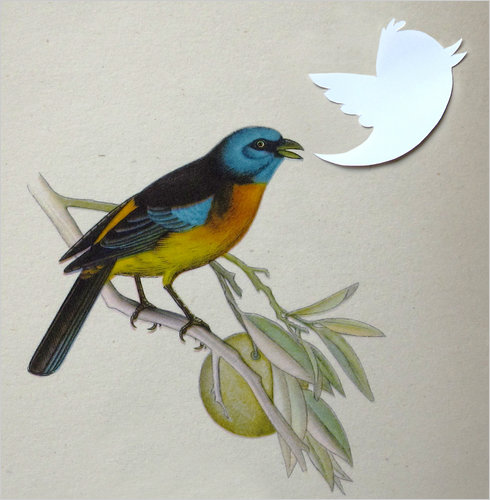
— Freddie DeBoer (via Jason at Sleepz and Thinkz)
Quotes
Beatles allusion makes me smile
His way of answering the phone sounded like ‘Mmmyellow.’
‘I want to tell you,’ the voice on the phone said. ‘My head is filled with things to say.’
Hal held three pairs of E.T.A sweatpants in the hand that didn’t hold the phone. He saw his older brother succumb to gravity and fall back limp against the pillows. Mario often sat up and fell back still asleep.
‘I don’t mind,’ Hal said softly, ‘I could wait forever.’
‘That’s what you think,’ the voice said. The connection was cut.
— David Foster Wallace, Infinite Jest
Mildred Bonk
In the eighth American-educational grade, Bruce Green fell dreadfully in love with a classmate who had the unlikely name of Mildred Bonk. The name was unlikely because if ever an eighth-grader looked like a Daphne Christianson or a Kimberly St.-Simone or something like that, it was Mildred Bonk. She was the kind of fatally pretty and nubile wraithlike figure who glides through the sweaty junior-high corridors of every nocturnal emitter’s dreamscape. Hair that Green had heard described by an overwrought teacher as ‘flaxen’; a body which the fickle angel of puberty — the same angel who didn’t even seem to know Bruce Green’s zip code — had visited, kissed, and already left, back in sixth; legs which not even orange Keds with purple-glitter-encrusted laces could make unserious. Shy, iridescent, coltish, pelvically anfractuous, amply busted, given to diffident movements of hand brushing flaxen hair from front of dear creamy forehead, movements which drove Bruce Green up a private tree. A vision in a sundress and silly shoes. Mildred L. Bonk.
— David Foster Wallace, Infinite Jest
A Firsty Pop
A Firsty Pop is the hyacinth smell of young hard-ons, a whiff of school toilets, locker rooms, and jockstraps, rectal mucus and summer feet, chigger lotion, and carbolic soap — whiffs you back to your first jackoff and leaves you sitting there on the toilet — if you don’t keep flying speed. Never linger over a Firsty.
— William S. Burroughs, Cities of the Red Night
Silver spots boil slowly
He leans against the wall of the toilet as silver spots boil slowly in front of his eyes.
— William S. Burroughs, Cities of the Red Night
Borges and I :: Frank Bidart
We fill pre-existing forms and when we fill them we change them and are changed.
The desolating landscape in Borges’ “Borges and I” — in which the voice of “I” tells us that its other self, Borges, is the self who makes literature, who in the process of making literature falsifies and exaggerates, while the self that is speaking to us now must go on living so that Borges may continue to fashion literature — is seductive and even oddly comforting, but, I think, false.
The voice of this “I” asserts a disparity between its essential self and its worldly second self, the self who seeks embodiment through making things, through work, who in making takes on something false, inessential, inauthentic.
The voice of this “I” tells us that Spinoza understood that everything wishes to continue in its own being, a stone wishes to be a stone eternally, that all “I” wishes is to remain unchanged, itself.
With its lonely emblematic title, “Borges and I” seems to be offered as a paradigm for the life of consciousness, the life of knowing and making, the life of the writer.
The notion that Frank has a self that has remained the same and that knows what it would be if its writing self did not exist — like all assertions about the systems that hold sway beneath the moon, the opposite of this seems to me to be true, as true.
When Borges’ “I” confesses that Borges falsifies and exaggerates it seems to do so to cast aside falsity and exaggeration, to attain an entire candor unobtainable by Borges.
This “I” therefore allows us to enter an inaccessible magic space, a hitherto inarticulate space of intimacy and honesty earlier denied us, where voice, for the first time, has replaced silence.
— Sweet fiction, in which bravado and despair beckon from a cold panache, in which the protected essential self suffers flashes of its existence to be immortalized by a writing self that is incapable of performing its actions without mixing our essence with what is false.
Frank had the illusion, when he talked to himself in the cliches he used when he talked to himself, that when he made his poems he was changed in making them, that arriving at the order the poem suddenly arrived at out of the chaos of the materials the poem let enter itself out of the chaos of life, consciousness then, only then, could know itself, Sherlock Holmes was somebody or something before cracking its first case but not Sherlock Holmes, act is the cracked mirror not only of motive but self, no other way, tiny mirror that fails to focus in small the whole of the great room.
But Frank had the illusion that his poems also had cruelly replaced his past, that finally they were all he knew of it though he knew they were not, everything else was shards refusing to make a pattern and in any case he had written about his mother and father until the poems saw as much as he saw and saw more and he only saw what he saw in the act of making them.
He had never had a self that wished to continue in its own being, survival meant ceasing to be what its being was.
Frank had the illusion that though the universe of one of his poems seemed so close to what seemed his own universe at the second of writing it that he wasn’t sure how they differed even though the paraphernalia often differed, after he had written it its universe was never exactly his universe, and so, soon, it disgusted him a little, the mirror was dirty and cracked.
Secretly he was glad it was dirty and cracked, because after he had made a big order, a book, only when he had come to despise it a little, only after he had at last given up the illusion that this was what was, only then could he write more.
He felt terror at the prospect of becoming again the person who could find or see or make no mirror, for even Olivier, trying to trap the beast who had killed his father, when he suavely told Frank as Frank listened to the phonograph long afternoons lying on the bed as a kid, when Olivier told him what art must be, even Olivier insisted that art is a mirror held up by an artist who himself needs to see something, held up before a nature that recoils before it.
We fill pre-existing forms and when we fill them we change them and are changed.
Everything in art is a formal question, so he tried to do it in prose with much blank white space.
How are you, George?
Todd exploded. And Cindy got promoted. . . And I dreamt of you.
— George Washington Winsterhammerman, Visioneers
I like a view
I like a view but I like to sit with my back turned to it.
— Gertrude Stein, The Autobiography of Alice B. Toklas
911
Genetic Typo
By David M. Ewalt
Forbes.com
In May 2010, geneticist J. Craig Venter and his team made news by creating the first “synthetic life form,” replacing the genetic code in a bacterium with DNA they’d composed on a computer.
But during a presentation delivered Monday morning at the South By Southwest convention in Austin, Texas, Venter talked about two ways the landmark innovation went wrong.
In order to distinguish their synthetic DNA from that naturally present in the bacterium, Venter’s team coded several famous quotes into their DNA, including one from James Joyce’s A Portrait of the Artist of a Young Man: “To live, to err, to fall, to triumph, to recreate life out of life.”
After announcing their work, Venter explained, his team received a cease and desist letter from Joyce’s estate, saying that he’d used the Irish writer’s work without permission. ”We thought it fell under fair use,” said Venter.
The synthetic DNA also included a quote from physicist Richard Feynman, “What I cannot build, I cannot understand.”
That prompted a note from Caltech, the school where Feyman taught for decades. They sent Venter a photo of the blackboard on which Feynman composed the quote –and it showed that he actually wrote, “What I cannot create, I do not understand.”
“We agreed what was on the Internet was wrong,” said Venter. “So we’re going back to change the genetic code to correct it.”
Corrections Editor — Herman Cohen
He notices a gap on the shelf and searches the book skyscrapers rising from the floor for the missing volume. He locates it (A Dictionary of Birds, Part IV: Sheathbill–Zygodactyli), slides it back into place, hikes up his belt, lines himself up with his desk chair, and inserts his bottom — one more bulky reference work returned to its rightful home.
— Tom Rachman, The Imperfectionists
Yasir Qadhi article
Reading Lolita at Twelve
By Nick Antosca
theparisreview.org
When my dad gave me a stack of his old college paperbacks, I think the education he hoped to foster was aesthetic, not erotic. But one of the books was Lolita, and to a twelve-year-old boy with passable reading comprehension skills, the twelve-year-old girl with the “honey-hued shoulders” and the apple-patterned dress was, above all else, sexy:
There my beauty lay down on her stomach, showing me, showing the thousand eyes wide open in my eyed blood, her slightly raised shoulder blades, and the bloom along the incurvation of her spine, and the swellings of her tense narrow nates clothed in black, and the seaside of her schoolgirl thighs.
At least Nabokov was teaching me fresh vocabulary. I had to look up nates, of course, but another new word, nymphet, was helpfully defined throughout the book. Suddenly I saw the world through wiser eyes. Who among my seventh-grade classmates, I wondered with a frisson, was such a creature? What girl had that “soul-shattering, insidious charm” that, while invisible to me, made the antennae of certain adult males tremble?
For much of middle school, I’d been enamored of a smart and introverted girl in my grade. I’ll call her Anna. Red-haired, freckled, and painfully pale, Anna was hardly a dead ringer for Dolores Haze, but I was observant enough to recognize the “ineffable signs—the slightly feline outline of a cheekbone, the slenderness of a downy limb”—that marked her as a nymphet.
My imagination required a corresponding nympholept, and the Humbert Humbert of Brunswick Middle School could only be our affable fourth-period teacher, a tall, handsome, offhandedly suave man who was soon slipping in Anna’s bedroom window to ravish her—and be ravished by her—on a nightly basis, as a perturbed cocker spaniel looked on. (I’d once overheard her mention her dog at school.) I loathed and admired him. How could I ever hope to compete?
What Nabokov prettified with a murderer’s fancy prose style, I saw with bracing clarity. This was 1995, and hardcore Internet porn was not yet easily accessible to twelve-year-olds, but my imagination was ambitious. No permutation of heterosexual sex escaped it.
Let me re-emphasize that their trysts took place entirely inside my head. I spent most fourth periods in a daze, playing obscene scenarios on a mental loop. Whenever I tired of one (her parents are sleeping, and Anna and our teacher have to be quiet), another effortlessly assembled itself (our class goes on an overnight field trip, and Anna and our teacher have adjoining rooms). I was like the narrator of James Salter’s A Sport and a Pastime, constructing an elaborate erotic saga that starred two people I hardly knew.
Underneath it all ran a current of guilt. Even if I didn’t quite grasp the nature of my radical misreading of the novel—Humbert’s a predator, not a competitor—I understood that for the majority of readers it didn’t tend to provoke reactions like mine. How weird and fucked-up was I?
Years later, in high school, Anna became my first girlfriend. Occasionally I’d look at her and remember with a jolt of mortification the six weeks or so she spent as one of my mental sex puppets. We had a running game of asking each other, “What are you thinking?” at unexpected moments, and the unspoken rule was that you had to answer honestly. I always did, but she never asked at the right time. That was probably for the best.
Nick Antosca is the author of Fires and Midnight Picnic, which received a Shirley Jackson Award.
From the gallows
I had heard the Sergeant’s words and understood them thoroughly but they were no more significant than the clear sounds that infest the air at all times — the far cry of gulls, the disturbance a breeze will make in its blowing and water falling headlong down a hill. Down into the earth where dead men go I would go soon and maybe come out of it again in some healthy way, free and innocent of all human perplexity. I would perhaps be the chill of an April wind, an essential part of some indomitable river or be personally concerned in the ageless perfection of some rank mountain bearing down upon the mind by occupying forever a position in the blue easy distance. Or perhaps a smaller thing like movement in the grass on an unbearable breathless yellow day, some hidden creature going about its business — I might well be responsible for that or for some important part of it. Or even those unaccountable distinctions that make an evening recognisable from its own morning, the smells and sounds and sights of the perfected and matured essences of the day, these might not be innocent of my meddling and my abiding presence.
. . . . Or perhaps I would be an influence that prevails in water, something sea-borne and far away, some certain arrangement of sun, light and water unknown and unbeheld, something far-from-usual. There are in the great world whirls of fluid and vaporous existences obtaining in their own unpassing time, unwatched and uninterpreted, valid only in their un-understandable mystery, justified only in their eyeless and mindless immeasurability, unassailable in their actual abstraction; of the inner quality of such a thing I might well in my own time be the true quintessential pith. I might belong to a lonely shore or be the agony of the sea when it bursts upon it in despair.
— Flann O’Brien, The Third Policeman
Twitter, Twitter, Burning Bright
By Randy Kennedy
nyt.com
As literary coincidences go, it might not carry quite the same cosmic portent as Halley’s Comet appearing in the month of Mark Twain’s birth. But Monday happens to be both World Poetry Day and the fifth anniversary of the moment when a young American software designer named Jack Dorsey sent out to the world the first message using the service that soon became known as Twitter.
The ambrosial stuff of poesy it was not, except maybe to Dilbert fans: “inviting coworkers.”
But the confluence of these two events — both having to do with humanity’s deep and sometimes uncontrollable need to communicate — is occasioning a fresh outpouring of opinion about the future of Twitter as a vehicle for real creativity, not just for entertaining train wrecks like Charlie Sheen’s.
For much of Twitter’s life, the idea that its 140-character stricture could be a crucible for a new kind of ambitious writing has been, more than anything else, a punch line. The 2009 publication of “Twitterature” — a book in which 80 works of Western literature are boiled down into Twitter messages (“Laertes is unhappy that I killed his father and sister. What a drama queen! Oh well, fight this evening.”) — didn’t help matters.
But there’s evidence that the literary flowering of Twitter may actually be taking place. The Twitter haiku movement — “twaiku” to its initiates — is well under way. Science fiction and mystery enthusiasts especially have gravitated to its communal immediacy. And even litterateurs, with a capital L, seem to be warming to it.
For two years, John Wray, the author of the well-regarded novel “Lowboy,” has been spinning out a Twitter story based on a character named Citizen that he cut from the novel, a contemporary version of the serialization that Dickens and other fiction writers once enjoyed.
“I don’t view the constraints of the format as in any way necessarily precluding literary quality,” he said. “It’s just a different form. And it’s still early days, so people are still really trying to figure out how to communicate with it, beyond just reporting that their Cheerios are soggy.” (Mr. Wray’s breakfast-food posts are, at the very least, far funnier than the usual kind: “Citizen opened the book. Inside, he found the purpose of existence expressed logarithmically. From what he could tell, it involved toast.”)
The linguist Ben Zimmer said he thought the growing popularity of the service as a creative outlet could be ascribed to the same “impulse that goes into writing a sonnet, of accepting those kind of limits.” But he admitted that his favorite Twitter literature in recent weeks has not been exactly Shakespearean: the wildly profane and popular Twitter musings that purported to be by the Chicago mayor-elect, Rahm Emanuel, but whose real author was recently revealed to be the rock journalist Dan Sinker.
“The deeper you got into it,” Mr. Zimmer said, “the more novelistic it became, and it was really compelling. It’s almost impossible to see it working in a traditional novel format. But as a Twitter creation it was hilarious, and worth every word.”
Calling all bards! Week in Review asked four poets each to write a poem within Twitter’s text limit of 140 characters — title and author name not included. Share your own verse on Twitter using the hash tag #poetweet.
Twitter Poem
The poem creates a space.
It hides in a tent in a forest.
Making its own bed it falls asleep in the dark,
wakes up under a lamp or the sun.
Billy Collins, whose new book of poems is “Horoscopes for the Dead.”
earth donates
break in a wave train
fallout active plume cloud spills
red reactors give
cross characters translated
in kanji could say much more
Claudia Rankine, whose latest book of poems is “Don’t Let Me Be Lonely.”
Teeny tiny poem
Teeny tiny poem/just enuf 2hold/1 xllent big word/Impluvium/open-eyed courtyrd/collectng rain/as all poems do/ skylife, open/birds do:/ tweet
Elizabeth Alexander, whose latest book of poems is “Crave Radiance,” and who wrote and delivered a poem for the inauguration of President Barack Obama.
Low Pay Piecework
The fifth-grade teacher and her followers—
Five classes, twenty-eight in each, all hers:
One-hundred-and-forty different characters.
Robert Pinsky, whose “Selected Poems” will be published next month.