James Joyce fly porn

Stuck on the pane two flies buzzed, stuck.

Glowing wine on his palate lingered swallowed. Crushing in the winepress grapes of Burgundy. Sun’s heat it is. Seems to a secret touch telling me memory. Touched his sense moistened remembered. Hidden under wild ferns on Howth below us bay sleeping: sky. No sound. The sky. The bay purple by the Lion’s head. Green by Drumleck. Yellowgreen towards Sutton. Fields of undersea, the lines faint brown in grass, buried cities. Pillowed on my coat she had her hair, earwigs in the heather scrub my hand under her nape, you’ll toss me all. O wonder! Coolsoft with ointments her hand touched me, caressed: her eyes upon me did not turn away. Ravished over her I lay, full lips full open, kissed her mouth. Yum. Softly she gave me in my mouth the seedcake warm and chewed. Mawkish pulp her mouth had mumbled sweetsour of her spittle. Joy: I ate it: joy. Young life, her lips that gave me pouting. Soft warm sticky gumjelly lips. Flowers her eyes were, take me, willing eyes. Pebbles fell. She lay still. A goat. No-one. High on Ben Howth rhododendrons a nannygoat walking surefooted, dropping currants. Screened under ferns she laughed warmfolded. Wildly I lay on her, kissed her: eyes, her lips, her stretched neck beating, woman’s breasts full in her blouse of nun’s veiling, fat nipples upright. Hot I tongued her. She kissed me. I was kissed. All yielding she tossed my hair. Kissed, she kissed me.

Me. And me now.

Stuck, the flies buzzed.

— James Joyce, Ulysses

Now that things are so simple, there’s so much to do

There are people who say, ‘If music’s that easy to write, I could do it.’ Of course they could, but they don’t. I find [Morton] Feldman’s own statement more affirmative. We were driving back from some place in New England where a concert had been given. He is a large man and falls asleep easily. Out of a sound sleep, he awoke to say, ‘Now that things are so simple, there’s so much to do.’

— John Cage, Indeterminacy
via 

It’s MY fantasy

Raquel Welch: [. . .] I remember Jimmy Coburn once said to me, “You know what’s the sexiest thing of all? A little mystery.” And he was so right about that. When you put it all out there, there’s nothing left to the imagination. So where am I going to participate? I’ve said this before and I still agree with it, the most erogenous zone is the brain. It’s all happening there. Otherwise, it’s just body parts.

MH: You once said that you think sex is overrated. Could you elaborate?

Raquel Welch: I mean just the sex act itself.

MH: Really? Are you sure you’ve been doing it right?

Raquel Welch: I think we’ve gotten to the point in our culture where we’re all sex addicts, literally. We have equated happiness in life with as many orgasms as you can possibly pack in, regardless of where it is that you deposit your love interest.

MH: Okay, admittedly that doesn’t make sex sound very appealing at all.

Raquel Welch: It’s just dehumanizing. And I have to honestly say, I think this era of porn is at least partially responsible for it. Where is the anticipation and the personalization? It’s all pre-fab now. You have these images coming at you unannounced and unsolicited. It just gets to be so plastic and phony to me. Maybe men respond to that. But is it really better than an experience with a real life girl that he cares about? It’s an exploitation of the poor male’s libidos. Poor babies, they can’t control themselves.

MH: I cannot dispute any of what you’re saying.

Raquel Welch: I just imagine them sitting in front of their computers, completely annihilated. They haven’t done anything, they don’t have a job, they barely have ambition anymore. And it makes for laziness and a not very good sex partner. Do they know how to negotiate something that isn’t pre-fab and injected directly into their brain?

MH: You make some good points, but it could also be argued that railing against kids today and their sexual obsessiveness could come across as a little over-the-hill cranky and prudish.

Raquel Welch: I know it does, and I’m fine with that. I don’t care if I’m becoming one of those old fogies who says, “Back in my day we didn’t have to hear about sex all the time.” Can you imagine? My fantasies were all made up on my own. They’re ruining us with all the explanations and the graphicness. Nobody remembers what it’s like to be left to form your own ideas about what’s erotic and sexual. We’re not allowed any individuality. I thought that was the fun of the whole thing. It’s my fantasy. I didn’t pick it off the Internet somewhere. It’s my fantasy.

— Men’s Health interview with Raquel Welch

And you… you can read me anything

*

The book of love is long and boring
No one can lift the damn thing
It’s full of charts and facts and figures
And instructions for dancing

But I, I love it when you read to me
And you, you can read me anything

The book of love has music in it
In fact that’s where music comes from
Some of it is just transcendental
Some of it is just really dumb

But I, I love it when you sing to me
And you, you can sing me anything

The book of love is long and boring
And written very long ago
It’s full of flowers and heart-shaped boxes
And things we’re all too young to know

But I, I love it when you give me things
And you, you ought to give me wedding rings
I, I love it when you give me things
And you, you ought to give me wedding rings

— The Magnetic Fields, “The Book of Love”

No doubt of a bellyful

With the addition of milk or buttermilk potatoes form a scientifically satisfactory diet, as the physique of the pre-famine Irish proved. Arthur Young contrasted the Irishman’s potato diet favorably with the contemporary English labourer’s bread and cheese. The Irish, he wrote, “have a bellyful . . . I will not assert that potatoes are a better food than bread and cheese but I have no doubt of a bellyful of the one being much better than half a bellyful of the other.”

— Cecil Woodham-Smith, The Great Hunger: Ireland 1845-1849

Do We Need Stories?

Let’s tackle one of the literary set’s favorite orthodoxies head on: that the world “needs stories.” There is an enormous need,” Jonathan Franzen declares in an interview with Corriere della Sera (there’s no escape these days), “for long, elaborate, complex stories, such as can only be written by an author concentrating alone, free from the deafening chatter of Twitter.”

Of course as a novelist it is convenient to think that by the nature of the job one is on the side of the good, supplying an urgent and general need. I can also imagine readers drawing comfort from the idea that their fiction habit is essential sustenance and not a luxury. But what is the nature of this need? What would happen if it wasn’t met? We might also ask: why does Franzen refer to complexstories? And why is it important not to be interrupted by Twitter and Facebook? Are such interruptions any worse than an old land line phone call, or simply friends and family buzzing around your writing table? Jane Austen, we recall, loved to write in domestic spaces where she was open to constant interruption.

Proponents of “the world needs stories” thesis are legion, but one of the more elaborate statements comes in Salman Rushdie’s novel Haroun and the Sea of Stories (1990). Here, in a text that falls between fable and magical realism, the telling of many stories is aligned with the idea of a natural ecology; in the normal and healthy way of things, we’re told, all the different stories of the world flow together in a great ocean of narrative. But now this harmony is threatened by an evil “cultmaster” who seeks to poison and eventually shut off the flow of stories, imposing universal silence and sterility as part of a bid for omnipotence.

Given Rushdie’s personal plight at the time of writing, it’s hard not to think of the “cultmaster” as a metamorphosis of the Ayatollah Khomeini. Stories are presented as a manifestation of the natural pluralism of the imagination, engaged in a mortal battle against any fundamentalism that would impose its own, univocal version: fiction is on the side of freedom. Of course.

Rushdie’s narrative is charming, but his ocean of stories argument never, to risk a pun, holds water. Far from flowing together in a harmonious ecology, stories tend to be in constant competition with each other. Far from imposing silence, cults, religions, and ideologies of all kinds have their own noisy stories to tell. Christian fundamentalism with its virgin birth, miracles, exorcisms, and angels boasts a rich narrative flora; if we toss into the mix the Catholic saints and their colorful martyrdoms we can hardly complain that the censorship and repression of the Inquisition resulted in story-less silence.

Rather the problem is that preacher and polemicist want us to accept just one, mutually exclusive set of stories, one vision, which we must believe is true. And many people are happy to do this. Once they’ve signed up to a Christian, Muslim, Buddhist, or even liberal pluralist narrative it’s unlikely they’ll go out of their way to research competing accounts of the world. People tend to use stories of whatever kind to bolster their beliefs, not to question them.

But I doubt if this politicized version of the we-need-stories thesis was what a writer like Franzen was thinking of. “This is an excellent novel,” I remember a fellow judge for a literary prize repeatedly telling the rest of the jury every time he encouraged us to vote for a book, “because it offers complex moral situations that help us get a sense of how to live and behave.” The argument here is that the world has become immensely complicated and the complex stories of our novels help us to see our way through it, to shape a trajectory for ourselves in the increasingly fragmented and ill-defined social world we move in.

There’s something to be said for this idea, though of course stories are by no means the exclusive territory of novels; the political, sports, and crime pages of the newspapers are full of fascinating stories, many of them extremely challenging and complex. What the novel offers, however, is a tale mediated by the individual writer who (alone, away from Facebook and Twitter) works hard to shape it and deliver it in a way that he or she feels is especially attractive, compelling, and right.

Here again, though, even if we are not immediately aware of it, and even when the author is celebrated for his or her elusive ambiguity (another lit-crit commonplace), such stories compete for our assent and seek to seduce us toward the author’s point of view. D.H. Lawrence attacked Tolstoy’s novels as evil, immoral, and deeply corrupting. Writing about Thomas Hardy he rather brilliantly questions the motives behind Hardy’s habit of having his more talented and spiritually adventurous characters destroyed by society; Hardy goes “against himself” Lawrence tells us (meaning, against his own specially gifted nature), to “stand with the average against the exception,” and all this “in order to explain his own sense of failure.” To Lawrence’s mind, a tremendously complex story like Jude the Obscure becomes an invitation not to try to realize your full potential but to settle instead for self-preservation. Hardy reinforces the mental habits of the frightened reader. It is pernicious. In this view of things, rather than needing stories we need to learn how to smell out their drift and resist them.

But there’s something deeper going on. Even before we actually tell any stories, the language we use teems with them in embryo form. There are words that simply denote things in nature: a pebble, a tree. There are words that describe objects we make: to know the word “chair” is to understand about moving from standing to sitting and appreciate the match of the human body with certain shapes and materials. But there are also words that come complete with entire narratives, or rather that can’t come without them. The only way we can understand words like God, angel, devil, ghost, is through stories, since these entities do not allow themselves to be known in other ways, or not to the likes of me. Here not only is the word invented—all words are—but the referent is invented too, and a story to suit. God is a one-word creation story.

Arguably the most important word in the invented-referents category is “self.” We would like the self to exist perhaps, but does it really? What is it? The need to surround it with a lexical cluster of reinforcing terms—identity, character, personality, soul—all with equally dubious referents suggests our anxiety. The more words we invent, the more we feel reassured that there really is something there to refer to.

Like God, the self requires a story; it is the account of how each of us accrues and sheds attributes over seventy or eighty years—youth, vigor, job, spouse, success, failure—while remaining, at some deep level, myself, my soul. One of the accomplishments of the novel, which as we know blossomed with the consolidation of Western individualism, has been to reinforce this ingenious invention, to have us believe more and more strongly in this sovereign self whose essential identity remains unchanged by all vicissitudes. Telling the stories of various characters in relation to each other, how something started, how it developed, how it ended, novels are intimately involved with the way we make up ourselves. They reinforce a process we are engaged in every moment of the day, self creation. They sustain the idea of a self projected through time, a self eager to be a real something (even at the cost of great suffering) and not an illusion.

The more complex and historically dense the stories are, the stronger the impression they give of unique and protracted individual identity beneath surface transformations, conversions, dilemmas, aberrations. In this sense, even pessimistic novels—say, J.M. Coetzee’s Disgrace—can be encouraging: however hard circumstances may be, you do have a self, a personal story to shape and live. You are a unique something that can fight back against all the confusion around. You have pathos.

This is all perfectly respectable. But do we actually need this intensification of self that novels provide? Do we need it more than ever before?

I suspect not. If we asked the question of, for example, a Buddhist priest, he or she would probably tell us that it is precisely this illusion of selfhood that makes so many in the West unhappy. We are in thrall to the narrative of selves that do not really exist in the way we imagine, a fabrication in which most novel-writing connives. Schopenhauer would have agreed. He spoke of people “deluded into an absolutely false view of life by reading novels,” something that “generally has the most harmful effect on their whole lives.” Like the Buddhist priest, he would have preferred silence or the school of experience, or the kind of myth or fable that did not invite excited identification with an author alter ego.

Personally, I fear I’m too enmired in narrative and self narrative to bail out now. I love an engaging novel, I love a complex novel; but I am quite sure I don’t need it. And my recently discovered ability, as discussed in this space a couple of weeks ago, to set down even some fine novels before reaching the end does give me a glimmer of hope that I may yet make a bid for freedom from the fiction that wonderfully enslaves us.

— Tim Parks
nybooks

People base decisions on moral intuition, not reason

By William Saletan
nytimes

You’re smart. You’re liberal. You’re well informed. You think conservatives are narrow-minded. You can’t understand why working-class Americans vote Republican. You figure they’re being duped. You’re wrong.

This isn’t an accusation from the right. It’s a friendly warning from Jonathan Haidt, a social psychologist at the University of Virginia who, until 2009, considered himself a partisan liberal. In “The ­Righteous Mind[: Why Good People Are Divided by Politics and Religion],” Haidt seeks to enrich liberalism, and political discourse generally, with a deeper awareness of human nature. Like other psychologists who have ventured into political coaching, such as George Lakoff and Drew Westen, Haidt argues that people are fundamentally intuitive, not rational. If you want to persuade others, you have to appeal to their sentiments. But Haidt is looking for more than victory. He’s looking for wisdom. That’s what makes “The Righteous Mind” well worth reading. Politics isn’t just about ­manipulating people who disagree with you. It’s about learning from them.

Haidt seems to delight in mischief. Drawing on ethnography, evolutionary theory and experimental psychology, he sets out to trash the modern faith in reason. In Haidt’s retelling, all the fools, foils and villains of intellectual history are recast as heroes. David Hume, the Scottish philosopher who notoriously said reason was fit only to be “the slave of the passions,” was largely correct. E. O. Wilson, the ecologist who was branded a fascist for stressing the biological origins of human behavior, has been vindicated by the study of moral emotions. Even Glaucon, the cynic in Plato’s “Republic” who told Socrates that people would behave ethically only if they thought they were being watched, was “the guy who got it right.”

To the question many people ask about politics — Why doesn’t the other side listen to reason? — Haidt replies: We were never designed to listen to reason. When you ask people moral questions, time their responses and scan their brains, their answers and brain activation patterns indicate that they reach conclusions quickly and produce reasons later only to justify what they’ve decided. The funniest and most painful illustrations are Haidt’s transcripts of interviews about bizarre scenarios. Is it wrong to have sex with a dead chicken? How about with your sister? Is it O.K. to defecate in a urinal? If your dog dies, why not eat it? Under interrogation, most subjects in psychology experiments agree these things are wrong. But none can explain why.

The problem isn’t that people don’t reason. They do reason. But their arguments aim to support their conclusions, not yours. Reason doesn’t work like a judge or teacher, impartially weighing evidence or guiding us to wisdom. It works more like a lawyer or press secretary, justifying our acts and judgments to others. Haidt shows, for example, how subjects relentlessly marshal arguments for the incest taboo, no matter how thoroughly an interrogator demolishes these arguments.

To explain this persistence, Haidt invokes an evolutionary hypothesis: We compete for social status, and the key advantage in this struggle is the ability to influence others. Reason, in this view, evolved to help us spin, not to help us learn. So if you want to change people’s minds, Haidt concludes, don’t appeal to their reason. Appeal to reason’s boss: the underlying moral intuitions whose conclusions reason defends.

Haidt’s account of reason is a bit too simple — his whole book, after all, is a deployment of reason to advance learning — and his advice sounds cynical. But set aside those objections for now, and go with him. If you follow Haidt through the tunnel of cynicism, you’ll find that what he’s really after is enlightenment. He wants to open your mind to the moral intuitions of other people.

In the West, we think morality is all about harm, rights, fairness and consent. Does the guy own the chicken? Is the dog already dead? Is the sister of legal age? But step outside your neighborhood or your country, and you’ll discover that your perspective is highly anomalous. Haidt has read ethnographies, traveled the world and surveyed tens of thousands of people online. He and his colleagues have compiled a catalog of six fundamental ideas that commonly undergird moral systems: care, fairness, liberty, loyalty, authority and sanctity. Alongside these principles, he has found related themes that carry moral weight: divinity, community, hierarchy, tradition, sin and degradation.

The worldviews Haidt discusses may differ from yours. They don’t start with the individual. They start with the group or the cosmic order. They exalt families, armies and communities. They assume that people should be treated differently according to social role or status — elders should be honored, subordinates should be protected. They suppress forms of self-expression that might weaken the social fabric. They assume interdependence, not autonomy. They prize order, not equality.

These moral systems aren’t ignorant or backward. Haidt argues that they’re common in history and across the globe because they fit human nature. He compares them to cuisines. We acquire morality the same way we acquire food preferences: we start with what we’re given. If it tastes good, we stick with it. If it doesn’t, we reject it. People accept God, authority and karma because these ideas suit their moral taste buds. Haidt points to research showing that people punish cheaters, accept many hierarchies and don’t support equal distribution of benefits when contributions are unequal.

You don’t have to go abroad to see these ideas. You can find them in the Republican Party. Social conservatives see welfare and feminism as threats to responsibility and family stability. The Tea Party hates redistribution because it interferes with letting people reap what they earn. Faith, patriotism, valor, chastity, law and order — these Republican themes touch all six moral foundations, whereas Democrats, in Haidt’s analysis, focus almost entirely on care and fighting oppression. This is Haidt’s startling message to the left: When it comes to morality, conservatives are more broad-minded than liberals. They serve a more varied diet.

This is where Haidt diverges from other psychologists who have analyzed the left’s electoral failures. The usual argument of these psycho-­pundits is that conservative politicians manipulate voters’ neural roots — playing on our craving for authority, for example — to trick people into voting against their interests. But Haidt treats electoral success as a kind of evolutionary fitness test. He figures that if voters like Republican messages, there’s something in Republican messages worth liking. He chides psychologists who try to “explain away” conservatism, treating it as a pathology. Conservatism thrives because it fits how people think, and that’s what validates it. Workers who vote Republican aren’t fools. In Haidt’s words, they’re “voting for their moral interests.”

One of these interests is moral capital — norms, prac­tices and institutions, like religion and family values, that facilitate cooperation by constraining individualism. Toward this end, Haidt applauds the left for regulating corporate greed. But he worries that in other ways, liberals dissolve moral capital too recklessly. Welfare programs that substitute public aid for spousal and parental support undermine the ecology of the family. Education policies that let students sue teachers erode classroom authority. Multicultural education weakens the cultural glue of assimilation. Haidt agrees that old ways must sometimes be re-examined and changed. He just wants liberals to proceed with caution and protect the social pillars sustained by tradition.

Another aspect of human nature that conservatives understand better than liberals, according to Haidt, is parochial altruism, the inclination to care more about members of your group — particularly those who have made sacrifices for it —than about outsiders. Saving Darfur, submitting to the United Nations and paying taxes to educate children in another state may be noble, but they aren’t natural. What’s natural is giving to your church, helping your P.T.A. and rallying together as Americans against a foreign threat.

How far should liberals go toward incorporating these principles? Haidt says the shift has to be more than symbolic, but he doesn’t lay out a specific policy agenda. Instead, he highlights broad areas of culture and politics — family and assimilation, for example — on which liberals should consider compromise. He urges conservatives to entertain liberal ideas in the same way. The purpose of such compromises isn’t just to win elections. It’s to make society and government fit human nature.

The hardest part, Haidt finds, is getting liberals to open their minds. Anecdotally, he reports that when he talks about authority, loyalty and sanctity, many people in the audience spurn these ideas as the seeds of racism, sexism and homophobia. And in a survey of 2,000 Americans, Haidt found that self-described liberals, especially those who called themselves “very liberal,” were worse at predicting the moral judgments of moderates and conservatives than moderates and conservatives were at predicting the moral judgments of liberals. Liberals don’t understand conservative values. And they can’t recognize this failing, because they’re so convinced of their rationality, open-mindedness and enlightenment.

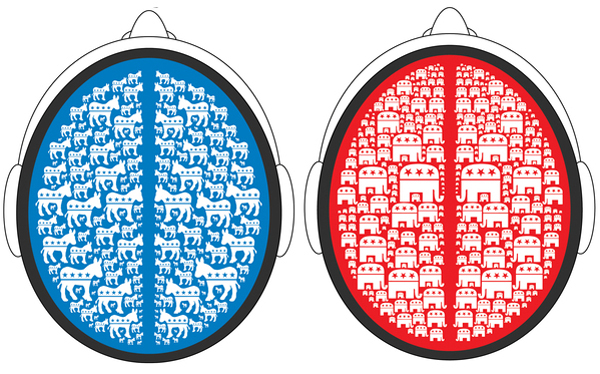
Haidt isn’t just scolding liberals, however. He sees the left and right as yin and yang, each contributing insights to which the other should listen. In his view, for instance, liberals can teach conservatives to recognize and constrain predation by entrenched interests. Haidt believes in the power of reason, but the reasoning has to be interactive. It has to be other people’s reason engaging yours. We’re lousy at challenging our own beliefs, but we’re good at challenging each other’s. Haidt compares us to neurons in a giant brain, capable of “producing good reasoning as an emergent property of the social system.”

Our task, then, is to organize society so that reason and intuition interact in healthy ways. Haidt’s research suggests several broad guidelines. First, we need to help citizens develop sympathetic relationships so that they seek to understand one another instead of using reason to parry opposing views. Second, we need to create time for contemplation. Research shows that two minutes of reflection on a good argument can change a person’s mind. Third, we need to break up our ideological segregation. From 1976 to 2008, the proportion of Americans living in highly partisan counties increased from 27 percent to 48 percent. The Internet exacerbates this problem by helping each user find evidence that supports his views.

How can we achieve these goals? Haidt offers a Web site, civilpolitics.org, on which he and his colleagues have listed steps that might help. One is holding open primaries so that people outside each party’s base can vote to nominate moderate candidates. Another is instant runoffs, so that candidates will benefit from broadening their appeal. A third idea is to alter redistricting so that parties are less able to gerrymander partisan congressional districts. Haidt also wants members of Congress to go back to the old practice of moving their families to Washington, so that they socialize with one another and build a friendly basis on which to cooperate.

Many of Haidt’s proposals are vague, insufficient or hard to implement. And that’s O.K. He just wants to start a conversation about integrating a better understanding of human nature — our sentiments, sociality and morality — into the ways we debate and govern ourselves. At this, he succeeds. It’s a landmark contribution to humanity’s understanding of itself.

But to whom is Haidt directing his advice? If intuitions are unreflective, and if reason is self-serving, then what part of us does he expect to regulate and orchestrate these faculties? This is the unspoken tension in Haidt’s book. As a scientist, he takes a passive, empirical view of human nature. He describes us as we have been, expecting no more. Based on evolution, he argues, universal love is implausible: “Parochial love . . . amplified by similarity” and a “sense of shared fate . . . may be the most we can accomplish.” But as an author and advocate, Haidt speaks to us rationally and universally, as though we’re capable of something greater. He seems unable to help himself, as though it’s in his nature to call on our capacity for reason and our sense of common humanity — and in our nature to understand it.

You don’t have to believe in God to see this higher capacity as part of our nature. You just have to believe in evolution. Evolution itself has evolved: as humans became increasingly social, the struggle for survival, mating and progeny depended less on physical abilities and more on social abilities. In this way, a faculty produced by evolution — sociality — became the new engine of evolution. Why can’t reason do the same thing? Why can’t it emerge from its evolutionary origins as a spin doctor to become the new medium in which humans compete, cooperate and advance the fitness of their communities? Isn’t that what we see all around us? Look at the global spread of media, debate and democracy.

Haidt is part of this process. He thinks he’s just articulating evolution. But in effect, he’s also trying to fix it. Traits we evolved in a dispersed world, like tribalism and righteousness, have become dangerously maladaptive in an era of rapid globalization. A pure scientist would let us purge these traits from the gene pool by fighting and killing one another. But Haidt wants to spare us this fate. He seeks a world in which “fewer people believe that righteous ends justify violent means.” To achieve this goal, he asks us to understand and overcome our instincts. He appeals to a power capable of circumspection, reflection and reform.

If we can harness that power — wisdom — our substantive project will be to reconcile our national and international differences. Is income inequality immoral? Should government favor religion? Can we tolerate cultures of female subjugation? And how far should we trust our instincts? Should people who find homosexuality repugnant overcome that reaction?

Haidt’s faith in moral taste receptors may not survive this scrutiny. Our taste for sanctity or authority, like our taste for sugar, could turn out to be a dangerous relic. But Haidt is right that we must learn what we have been, even if our nature is to transcend it.

Success is a real and subtle whore

I have read the play [Orpheus Descending] three times since yesterday and am going to read it again. I think that it is the best play that you have done so far. I have been afraid for you sometimes, because success sings a deadly lullaby to most people. Success is a real and subtle whore, who would like nothing better than to catch you sleeping and bite your cock off.

— Marlon Brando,
in a 1955 letter to Tennessee Williams

Dude!

Coop:    Dude, I’m not gonna cave in! End of story, Dude!
Remer:  Dude?
Coop:    Dude!
Remer:  Dude!
Coop:    Dude.
Remer:  Dude!
Coop:    DUDE!
Remer:  Dude!… (Coop opens his mouth but says
nothing. Remer continues, firmly) Dude.
Coop:    I guess you got a point there.

Baseketball

Anatomy of an 8-year-old Hater

“Look at old Horse-Face blushing!” called Partridge; and they all laughed — none more derisively than Anthony. For Anthony had had time to feel ashamed of his shame; time to refuse to think about that hole in Lollingdon churchyard; time, too, to find himself all of a sudden almost hating old Horse-Face. “For being so disgustingly pi,” he would have said, if somebody had asked him to explain his hatred. But the real reason was deeper, obscurer. If he hated Horse-Face, it was because Horse-Face was so extraordinarily decent; because Horse-Face had the courage of convictions which Anthony felt should also be his convictions — which, indeed, would be his convictions if only he could bring himself to have the courage of them. It was just because he liked Horse-Face so much, that he now hated him. Or, rather, because there were so many reasons why he should like him — so few reasons, on the contrary, why Horse-Face should return the liking. Horse-Face was rich with all sorts of fine qualities that he himself either lacked completely, or else, which was worse, possessed, but somehow was incapable of manifesting. That sudden derisive burst of laughter was the expression of a kind of envious resentment against a superiority which he loved and admired. Indeed, the love and the admiration in some sort produced the resentment and the envy — produced, but ordinarily kept them below the surface in an unconscious abeyance, from which, however, some crisis like the present would suddenly call them.

— Aldous Huxley, Eyeless in Gaza