Big Brother’s Younger Sibling Depository

I worry about exposing him to bands like Journey, the appreciation of which will surely bring him nothing but the opprobrium of his peers. Though he has often been resistant — children so seldom know what is good for them — I have taught him to appreciate all the groundbreaking musicmakers of our time — Big Country, Haircut 100, Loverboy — and he is lucky for it. His brain is my laboratory, my depository. Into it I can stuff the books I choose, the television shows, the movies, my opinion about elected officials, historical events, neighbors, passersby. He is my twenty-four-hour classroom, my captive audience, forced to ingest everything worthwhile. He is a lucky, lucky boy! And no one can stop me.

— Dave Eggers, A Heartbreaking Work of Staggering Genius

Lego Beatles :: You’re Mother Should Know (Innocent Scandinavian Social Values vs. Darth Hollywood and the Lego-Sean Connerys from Hell)

Lego Trooper

The most staggeringly important article in the Sunday, September 6, 2009 New York Times Bussiness section

They’re everywhere…

Simply because they change and hide their names, do not give their right age, and by their own admission go about without allowing themselves to be recognized, there is no logic that can deny that they necessarily must exit.

— Heinrich Neuhaus, Pia et ultimissima admonestatio de Fratribus Rosae-Crucis, nimirum: an sint? quales sint? unde nomen illud sibi asciverunt, Danzig, Schmidlin, 1618; French ed. 1623, p. 5

— Umberto Eco, Foucault’s Pendulum

Open-at-random sentence of the day :: Infinite Jest

And then it turned out, when a cat aggrieved Letz by scratching his wrist in a particularly hostile fashion on the way into the receptacle, that doubled Hefty SteelSaks were such quality-reinforced products that they could hold something razor-clawed and frantically in-motion and still survive a direct swung hit against a NO PARKING sign or telephone pole without splitting open, even when what was inside split nicely open; and so that technique got substituted around United Nations Day, because even though it was too quick and less meditative it allowed Randy Letz to take a more active role in the process, and the feeling of (temporary, nightly) issues-resolution was more definitive when Lenz could swing a twisting ten-kilo burden hard against a pole and go: ‘There,’ and here a sound.

(Infinite Jest by David Foster Wallace, pg. 544)

Dilbert nutshells

Change sounds good but it hurts like crazy.

The biggest obstacle to your productivity is your stubborn insistence on being happy. Once you release that, you can get a lot done.

Consultants try to avoid mentioning the root cause of the company’s problem, because that is invariably the people who hired them.

— Scott Adams

Beatles: Rock Band; Impressive Review

THERE may be no better way to bait a baby boomer than to be anything less than totally reverential about the Beatles. So the news that the lads from Liverpool were taking fresh form in a video game (a video game!) called The Beatles: Rock Band struck some of the band’s acolytes as nothing less than heresy.

Luckily, Paul McCartney and Ringo Starr, along with the widows of George Harrison and John Lennon, seem to understand that the Beatles are not a museum piece, that the band and its message ought never be encased in amber. The Beatles: Rock Band is nothing less than a cultural watershed, one that may prove only slightly less influential than the band’s famous appearance on “The Ed Sullivan Show” in 1964. By reinterpreting an essential symbol of one generation in the medium and technology of another, The Beatles: Rock Band provides a transformative entertainment experience.

In that sense it may be the most important video game yet made.

Never before has a video game had such intergenerational cultural resonance. The weakness of most games is that they are usually devoid of any connection to our actual life and times. There is usually no broader meaning, no greater message, in defeating aliens or zombies, or even in the cognitive gameplay of determining strategy or solving puzzles.

Previous titles in the Rock Band and Guitar Hero series have already done more in recent years to introduce young people to classic rock than all the radio stations in the country. But this new game is special because it so lovingly, meticulously, gloriously showcases the relatively brief career of the most important rock band of all time. The music and lyrics of the Beatles are no less relevant today than they were all those decades ago, and by reimagining the Beatles’ message in the unabashedly modern, interactive, digital form of now, the new game ties together almost 50 years of modern entertainment.

With all due respect to Wii Sports, no video game has ever brought more parents together with their teenage and adult children than The Beatles: Rock Band likely will in the months and years to come.

One Friday evening last month I invited a gaggle of 20-something hipsters (I’m 36) to my apartment in Williamsburg, Brooklyn, to try the game. After 15 minutes one 25-year-old said, “I’m going to have to buy this for my parents this Christmas, aren’t I?” After nine hours we had completed all of the game’s 45 songs in one marathon session. On Saturday afternoon, I woke up to watch a 20-year-old spend three hours mastering the rolling, syncopated drum sequences in “Tomorrow Never Knows.” Thirty-six hours later, near dawn Monday morning, there were still a few happy stragglers in my living room belting out “Back in the U.S.S.R.” Good thing my neighbors were away for the weekend.

I grew up in Woodstock, N.Y., steeped in classic rock, so I had a head start on my younger band mates. (I suspect many parents will enjoy having a similar leg up on their progeny.) Yet I watched the same transformation all weekend long. We would start a song like “Something” or “While My Guitar Gently Weeps,” and as it began, they would say, “Oh yeah, that one.” Then at the end there would literally be a stunned silence before someone would say something unprintable, or simply “Wow” as they fully absorbed the emotional intensity and almost divine melodies of the Beatles.

Not only was the game serving to reintroduce this music, but by leading the players through a schematic version of actually creating the songs, it was also doing so in a much more engaging way than merely listening to a recording. It is an imperfect analogy, but listening to a finished song is perhaps like being served a finished recipe: you know it tastes great even if you have no sense of how it was created.

By contrast, playing a music game like Rock Band is a bit closer to following a recipe yourself or watching a cooking show on television. Sure, the result won’t be of professional caliber (after all, you didn’t go to cooking school, the equivalent of music lessons), but you may have a greater appreciation for the genius who created the dish than the restaurantgoer, because you have attempted it yourself.

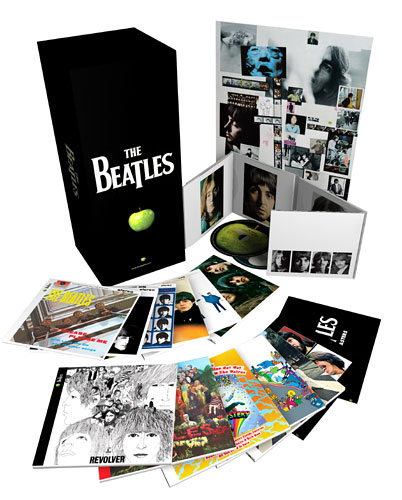
Previous music games have been about collections of songs. The Beatles: Rock Band is about representing and reoffering an entire worldview encapsulated in music. The developers at Harmonix Music Systems have translated the Beatles’ scores and tablature into a form that is accessible while also conveying the visceral rhythm of the music. In its melding of source material and presentation, The Beatles: Rock Band is sheer pleasure. The game is scheduled to be released by MTV Games for the PlayStation 3, Wii and Xbox 360 consoles on Wednesday, the same day the remastered Beatles catalog is slated to be released on CD.

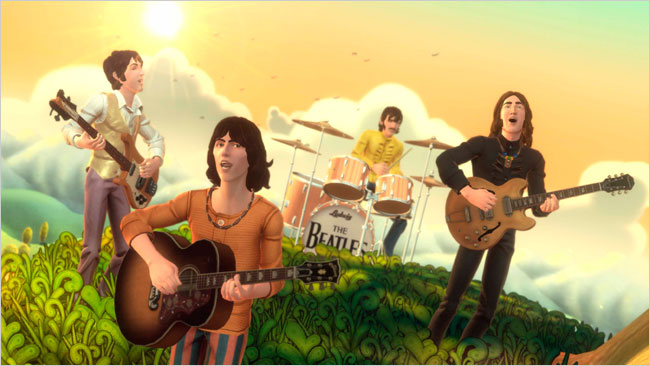
Mechanically it is almost identical to previous Rock Band games. One player sings into a microphone, replacing the original lead vocals, while another plays an electronic drum kit and two more play ersatz guitar and bass. (The new game supports up to two additional singers for a potential maximum of six players.)

In the game’s story line mode, players inhabit the various Beatles as they progress from the Cavern Club to Ed Sullivan’s stage; Shea Stadium; the Budokan in Japan; Abbey Road; and their final appearance on the Apple Corps roof in 1969. Unlike in previous Rock Band games, players are not booed off the virtual stage for a poor performance; rather the screen cuts to a declarative “Song failed” message. Previously unreleased studio chatter provides a soundtrack for some of the menu and credits screens, but there is no direct interaction with avatars of John, Paul, George or Ringo.

The colorful psychedelic dreamscapes used to represent the band’s in-studio explorations are particularly evocative, though they serve mostly to entertain onlookers rather than the players themselves (who will be concentrating on getting the music right rather than looking at the pretty pictures).

Of course almost nothing could be more prosaic than pointing out that playing a music game is not the same as playing a real instrument. Yet there is something about video games that seems to inspire true anger in some older people.

Why is that? Is there still really a fear that a stylized representation of reality detracts from reality itself? In recent centuries every new technology for creating and enjoying music — the phonograph, the electric guitar, the Walkman, MTV, karaoke, the iPod — has been condemned as the potential death of “real” music.

But music is eternal. Each new tool for creating it, and each new technology for experiencing it, only brings the joy of more music to more people. This new game is a fabulous entertainment that will not only introduce the Beatles’ music to a new audience but also will simultaneously bring millions of their less-hidebound parents into gaming. For that its makers are entitled to a deep simultaneous bow, Beatles style.

[From New York Times article “All Together Now: Play the Game, Mom“]

confidence in what we cannot help being

According to Frankfurt, self-preservation is the “protean mode of concern” – the basis from which we make decisions. This self-preservation is “not itself grounded in reason, but love.” When Frankfurt talks about love here, he’s not referring to romance or lust or any of those common definitions, but rather to a “mode of caring” that is involuntary and not rationally determined. The object can be, among other things, a person, an ideal, a group.

So, because an individual is invested in this love, and because this love is non-utilitarian, it necessarily provides a basis for deciding what to care about. Frankfurt sees this in an evolutionary schema-it requires a “confidence in what we cannot help being.”

“It’s important to you to understand what’s important to you,” said Frankfurt.

[From “On college, bullshit and love” by Naimh Wallace]

Hitched to a Star :: Harryette Mullen

Quantum mechanics fixed my karma wagon
Gypsies want to hold my hand
Dr. Duck recommends
……soap and ream therapies
With remedies like these
who needs friends?

[From Sleeping with the Dictionary]

In which Percival inspires poetry

“And now,” said Neville, “let Bernard begin. Let him burble on, telling us stories, while we lie recumbent. Let him describe what we have all seen so that it becomes a sequence. Bernard says there is always a story. I am a story. Louis is a story. There is the story of the boot-boy, the story of the man with one eye, the story of the woman who sells winkles. Let him burble on with his story while I lie back and regard the stiff-legged  figures of the padded batsmen through the trembling grasses. It seems as if the whole world were flowing and curving — on the earth the trees, in the sky the clouds. I look up, through the trees, into the sky. The match seems to be played up there. Faintly among the soft, white clouds I hear the cry ‘Run,’ I hear the cry ‘How’s that?’ The clouds lose tufts of whiteness as the breeze dishevels them. If that blue could stay forever; if that hole could remain forever; if this moment could stay forever —

“But Bernard goes on talking. Up they bubble — images. ‘Like a camel,’ . . . ‘a vulture.’ The camel is a vulture; the vulture a camel; for Bernard is a dangling wire, loose, but seductive. Yes, for when he talks, when he makes his foolish comparisons, a lightness comes over one. One floats, too, as if one were that bubble; one is freed; I have escaped, one feels. Even the chubby little boys (Dalton, Larpent and Baker) feel the same abandonment. They like this better than cricket. They catch the phrases as they bubble. They let the feathery grasses tickle their noses. And then we all feel Percival lying heavy among us. His curious guffaw seems to sanction our laughter. But now he has rolled himself over in the long grass. He is, I think, chewing a stalk between his teeth. He feels bored; I too feel bored. Bernard at once perceives that we are bored. I detect a certain effort, an extravagance in his phrase, as if he said ‘Look!’ but Percival says ‘No.’ For he is always the first to detect insincerity; and is brutal in the extreme. The sentence tails off feebly. Yes, the appalling moment has come when Bernard’s power fails him and there is no longer any sequence and he sags and twiddles a bit of string and falls silent, gaping as if about to burst into tears. Among the tortures and devastations of life is this then — our friends are not able to finish their stories.”

“Now let me try,” said Louis,” before we rise, before we go to tea, to fix the moment in one effort of supreme endeavour. This shall endure. We are parting; some to tea; some to the nets; I show my essay to Mr. Barker. This will endure. From discord, from hatred (I despise dabblers in imagery — I resent the power of Percival intensely) my shattered mind is pieced together by some sudden perception. I take the trees, the clouds, to be witnesses of my complete integration. I, Louis, I, who shall walk the earth these seventy years, am born entire, out of hatred, out of discord. Here on this ring of grass we have sat together, bound by the tremendous power of some inner compulsion. The trees wave, the clouds pass. The time approaches when these soliloquies shall be shared. We shall not always give out a sound like a beaten gong as one sensation strikes and then another. Children, our lives have been gongs striking; clamour and boasting; cries of despair; blows on the nape of the neck in the gardens.

“Now grass and trees, the travelling air blowing empty spaces in the blue which they then recover, shaking the leaves which then replace themselves, and our ring here, sitting, with our arms binding our knees, hint at some other order, and better, which makes a reason everlastingly. This I see for a second, and shall try tonight to fix in words, to forge in a ring of steel, though Percival destroys it, as he blunders off, crushing the grasses, with the small fry trotting subservient after him. Yet it is Percival I need; for it is Percival who inspires poetry.”

— Virginia Woolf, The Waves

The worm in the fruit

During his famous embassy to Rome in the second century B.C., Carneades took advantage of the occasion to speak the first day in favor of the idea of justice, and on the following day against it. From that moment, philosophy, hitherto nonexistent in that country of healthy conduct, began to perpetrate its ravages. What is philosophy, then? The worm in the fruit. . . .

Cato the Censor, who had been present at the Greek’s dialectical performances, was alarmed by them and asked the Senate to satisfy the Athenian delegation as soon as possible, so harmful and even dangerous did he consider their presence. Roman youth was not to frequent minds so destructive.

On the moral level, Carneades and his companions were as formidable as the Carthaginians on the military. Rising nations fear above all the absence of prejudices and prohibitions, the intellectual shamelessness which constitutes the allure of declining civilizations.

— E. M. Cioran, The Trouble With Being Born

your faces leap like butterflies

“I have won the game,” said Jinny. “Now it is your turn. I must throw myself on the ground and pant. I am out of breath with running, with triumph. Everything in my body seems thinned out with running and triumph. My blood must be bright red, whipped up, slapping against my ribs. My soles tingle, as if wire rings opened and shut in my feet. I see every blade of grass very clear. But the pulse drums so in my forehead, behind my eyes, that everything dances — the net, the grass; your faces leap like butterflies; the trees seem to jump up and down. There is nothing staid, nothing settled in this universe. All is rippling, all is dancing; all is quickness and triumph. Only, when I have lain alone on the hard ground, watching you play your game, I begin to feel the wish to be singled out; to be summoned, to be called away by one person who comes to find me, who is attracted towards me, who cannot keep himself from me, but comes to where I sit on my gilt chair, with my frock billowing round me like a flower. And withdrawing into an alcove, sitting alone on a balcony we talk together.

“Now the tide sinks. Now the trees come to earth; the brisk waves that slap my ribs rock more gently, and my heart rides at anchor, like a sailing-boat whose sails slide slowly down on to the white deck. The game is over. We must go to tea now.”

— Virginia Woolf, The Waves

Fugue :: Louise Glück

1.
I was the man because I was taller.
My sister decided
when we should eat.
From time to time, she’d have a baby.

2.
Then my soul appeared.
Who are you, I said.
And my soul said,
I am your soul, the winsome stranger.

3.
Our dead sister
waited, undiscovered in my mother’s head.
Our dead sister was neither
a man nor a woman. She was like a soul.

4.
My soul was taken in:
it attached itself to a man.
Not a real man, the man
I pretended to be, playing with my sister.

5.
It is coming back to me — lying on the couch
has refreshed my memory.
My memory is like a basement filled with old papers:
nothing ever changes.

6.
I had a dream: my mother fell out of a tree.
After she fell, the tree died:
it had outlived its function.
My mother was unharmed — her arrows disappeared, her wings
turned to arms. Fire creature: Sagittarius. She finds herself in —

a suburban garden. It is coming back to me.

7.
I put the book aside. What is a soul?
A flag flown
too high on the pole, if you know what I mean.

The body
cowers in the dreamlike underbrush.

8.
Well, we are here to do something about that.

(In a German accent.)

9.
I had a dream: were are at war.
My mother leaves her crossbow in the high grass.

(Sagittarius, the archer.)

My childhood, closed to me forever,
turned gold like an autumn garden,
mulched with a thick layer of salt marsh hay.

10.
A golden bow: a useful gift in wartime.

How heavy it was — no child could pick it up.

Except me: I could pick it up.

11.
Then I was wounded. The bow
was now a harp, its string cutting
deep into my palm. In the dream

it both makes the wound and seals the wound.

12.
My childhood: closed to me. Or is it
under the mulch — fertile.

But very dark. Very hidden.

13.
In the dark, my soul said
I am your soul.

No one can see me; only you —
only you can see me.

14.
And it said, you must trust me.

Meaning: if you move the harp,
you will bleed to death.

15.
Why can’t I cry out?

I should be writing my hand is bleeding,
feeling pain and terror — what
I felt in the dream, as a casualty of war.

16.
It is coming back to me.

Pear tree. Apple tree.

I used to sit there
pulling arrows out of my heart.

17.
Then my soul appeared. It said
just as no one can see me, no one
can see the blood.

Also: no one can see the harp.

Then it said
I can save you. Meaning
this is a test.

18.
Who is “you”? As in

“Are you tired of invisible pain?”

19.
Like a small bird sealed off from daylight:

that was my childhood.

20.
I was the man because I was taller.

But I wasn’t tall —
didn’t I ever look in a mirror?

21.
Silence in the nursery,
the consulting garden. Then:

What does the harp suggest?

22.
I know what you want —
you want Orpheus, you want death.

Orpheus who said “Help me find Eurydice.”

Then the music began, the lament of the soul
watching the body vanish.

[From Averno]

Why is there so much bullshit?

Why is there so much bullshit? Of course it is impossible to be sure that there is relatively more nowadays than at other times. There is more communication of all kinds in our time than ever before, but the proportion that is bullshit may not have increased. Without assuming that the incidence of bullshit is actually greater now, I will mention a few considerations that help to account for the fact that it is currently so great.

Bullshit is unavoidable whenever circumstances require someone to talk without knowing what he is talking about. Thus the production of bullshit is stimulated whenever a person’s obligations or opportunities to speak about some topic exceed his knowledge of the facts that are relevant to that topic. This discrepancy is common in public life, where people are frequently impelled — whether by their own propensities or by the demands of others — to speak extensively about matters of which they are to some degree ignorant. Closely related instances arise from the widespread conviction that it is the responsibility of a citizen in a democracy to have opinions about everything, or at least  everything  that pertains to the conduct of his country’s affairs. The lack of any significant connection between a person’s opinions and his apprehension of reality will be even more severe, needless to say, for someone who believes it is his responsibility, as a conscientious moral agent, to evaluate events and conditions in all parts of the world.

The contemporary proliferation of bullshit also has deeper sources, in various forms of skepticism which deny that we can have any reliable access to an objective reality, and which therefore reject the possibility of knowing how things truly are. These “antirealist” doctrines undermine confidence in the value of disinterested efforts to determine what is true and what is false, and even in the intelligibility of the notion of objective inquiry. One response to this loss of confidence has been a retreat from the discipline required by dedication to the ideal of correctness to a quite different sort of discipline, which is imposed by pursuit of an alternative ideal of sincerity. Rather than seeking primarily to arrive at accurate representations of a common world, the individual turns toward trying to provide honest representations of himself. Convinced that reality has no inherent nature, which he might hope to identify as the truth about things, he devotes himself to being true to his own nature. It is as though he decides that since it makes no sense to try to be true to the facts, he must therefore instead try to be true to himself.

But it is preposterous to imagine that we ourselves are determinate, and hence susceptible both to correct and to incorrect descriptions, while supposing that the ascription of determinacy to anything else has been exposed as a mistake. As conscious beings, we exist only in response to other things, and we cannot know ourselves at all without knowing them. Moreover, there is nothing in theory, and certainly nothing in experience, to support the extraordinary judgment that it is the truth about himself that is the easiest for a person to know. Facts about ourselves are not peculiarly solid and resistant to skeptical dissolution. Our natures are, indeed, elusively insubstantial — notoriously less stable and less inherent than the natures of other things. And insofar as this is the case, sincerity itself is bullshit.

— Harry G. Frankfurt, On Bullshit

I often die pierced with arrows to win their tears

“They have friends to sit by. They have things to say privately in corners. But I attach myself only to names and faces; and hoard them like amulets against disaster. I choose out across the hall some unknown face and can hardly drink my tea when she whose name I do not know sits opposite. I choke. I am rocked from side to side by the violence of my emotion. I imagine these nameless, these immaculate people, watching me from behind bushes. I leap high to excite their admiration. At night, in bed, I excite their complete wonder. I often die pierced with arrows to win their tears. If they should say that they were in Scarborough last holidays, the whole town runs gold, the whole pavement is illuminated. Therefore I hate looking-glasses which show me my real face. Alone, I often fall down into nothingness. I must push my foot stealthily lest I should fall off the edge of the world into nothingness. I have to bang my hand against some hard door to call myself back to my body.”

— Virginia Woolf, The Waves