The Truth

You can hide it like a signature
or birthmark but it’s always there
in the greasy light of your dreams,
the knots your body makes at night,
the sad innuendos of your eyes,
whispering insidious asides in every
room you cannot remain inside. It’s
there in the unquiet ideas that drag and
plead one lonely argument at a time,
and those who own a little are contrite
and fearful of those who own too much,
but owning none takes up your life.
It cannot be replaced with a house or a car,
a husband or wife, but can be ignored,
denied, and betrayed, until the last day,
when you pass yourself on the street
and recognize the agreeable life you
were afraid to lead, and turn away.

— Philip Schultz, Failure
It’s Sunday Morning in Early November

and there are a lot of leaves already.
I could rake and get a head start.
The boys’ summer toys need to be put
in the basement. I could clean it out
or fix the broken storm window.
When Eli gets home from Sunday school,
I could take him fishing. I don’t fish
but I could learn to. I could show him
how fun it is. We don’t do as much
as we used to do. And my wife, there’s
so much I haven’t told her lately,
about how quickly my soul is aging,
how it feels like a basement I keep filling
with everything I’m tired of surviving.
I could take a walk with my wife and try
to explain the ghosts I can’t stop speaking to.
Or I could read all those books piling up
about the beginning of the end of understanding…
Meanwhile, it’s such a beautiful morning,
the changing colors, the hypnotic light.
I could sit by the window watching the leaves,
which seem to know exactly how to fall
from one moment to the next. Or I could lose
everything and have to begin over again.

— Philip Schultz, Failure

If Something of the Ancestors Lives On

Even the next era has no right to judge anything if it lacks the ability to contemplate the past without hatred or envy. But even that judgment would be one-sided, for every subsequent era is the fruit of previous periods and carries much of the past with it. It is fortunate if something of the ancestors lives on in it and continues to be loved and protected; only then does the past become fruitful and effective.

— Rilke, Early Journals

Optimism was observed among happy pigs

FINDINGS

Harper’s Magazine / October 2010
Rafil Kroll-Zaidi

Researchers found that suicide rates drop after U.S. presidential elections in states that support the winning candidate, and that suicides drop even further in states that support the loser. It was determined that stock-market returns in predominantly Muslim countries are nine times higher during the holy month of Ramadan than they are the rest of the year. Girls with younger brothers lose their virginity later, and girls with older brothers experience menarche later. Women who drink regular beer are at increased risk for psoriasis, but women who drink light beer are not. A man’s likelihood of picking up a female hitchhiker was correlated with her breast size, and a man’s likelihood of infidelity to a female partner was correlated with his financial dependence on her. A new species of titi monkey, which has a bushy red beard and mates for life, was discovered in Colombia. American students exhibit an inferior understanding of the “equals” sign. At Stonehenge, archeologists discovered a second henge; in the Sistine Chapel, a brain stem and spinal cord were discovered in God’s neck; and on Bulgaria’s Sveti Ivan island, the bones of John the Baptist were unearthed. It was revealed that the human buttocks tan poorly.

Three liger cubs were born in a Taiwanese zoo whose keepers had allowed an African lion and a Bengal tigress to cohabitate. Previous attempts to separate the couple, said the zoo’s owner, had made the lion “very angry.” Beavers reintroduced to Scotland through the Scottish Beaver Trial had produced offspring, the first beavers to be born in the country in 400 years. Polar bears were eating the eggs of barnacle geese, and both Greenlandic polar bears and Svalbardian glaucous gulls were suffering from industrial contamination. Moose malnourished in childhood are at greater risk of developing arthritis in old age. Female mongooses were found to coordinate their litters in order to keep other mongoose mothers too busy to kill rivals’ pups. Adult moongooses were seen teaching their children how to open plastic Easter eggs filled with rice and fish. Neurologists identified the regions of the brain responsible for baby talk. Scientists concluded that the female ancestor of all human beings lived 200,000 years ago and that frogs learned to leap before they learned to land.

In Nevada, Christians prayed for the relocation of Bubba, a 700-pound black bear with a bulletproof skull who steals peanut butter from the poor. Ethnoprimatologists recommended ways for villagers in Guinea to avoid or defuse chimpanzee attacks. “Keep calm,” advised Kimberley Hockings of the New University of Lisbon. “Try not to scream.” Five hundred people were attacked and four children were killed by Peruvian vampire bats. The brains of gregarious locusts are 30 percent larger than those of solitarious locusts of the same species, according to neuroscientists who bred the insects over three generations. Aphids living on plants that produce the same pheromone whereby the insects announce that ladybugs are eating them become inured to the smell and are themselves likelier to be eaten by ladybugs. Pea aphids will drop to the ground in the presence of a lamb’s breath. Optimism was observed among happy pigs.

With the great unconscious gravity of a girl

The philosopher may sometimes love the infinite; the poet always loves the finite. For him the great moment is not the creation of light, but the creation of the sun and moon.

— G. K. Chesterton, The Man Who Was Thursday

Fratres Minores

With minds still hovering above their testicles
Certain poets here and in France
Still sigh over established and natural fact
Long since fully discussed by Ovid.
They howl. They complain in delicate and exhausted metres
That the twitching of three abdominal nerves
Is incapable of producing a lasting Nirvana.

— Ezra Pound, Poems from Blast

Thar she blows!

October 13.  “There she blows,” was sung out from the mast-head.
“Where away?” demanded the captain.
“Three points off the lee bow, sir.”
“Raise up your wheel. Steady!”
“Steady, sir.”
“Mast-head ahoy! Do you see that whale now?”
“Ay ay, sir! A shoal of Sperm Whales! There she blows! There she breaches!”
“Sing out! sing out every time!”
“Ay ay, sir! There she blows! there — there — thar she blows — bowes — bo-o-o-s!”
“How far off?”
“Two miles and a half.”
“Thunder and lightning! so near! Call all hands!”

J. Ross Browne’s Etchings of a Whale Cruize. 1846
“Extracts,” Moby-Dick

You Said “Live”

You said live out loud, and die you said lightly,
and over and over again you said be.

But before the first death came murder.
A fracture broke across the rings you’d ripened.
A screaming shattered the voices

that had just come together to speak to you,
to make of you a bridge
over the chasm of everything.

And what they have stammered ever since
are fragments
of your ancient name.

— Rilke, The Book of Hours I, 9

For the Sake of the Whole

Are there relations of the heart that embrace what is most cruel for the sake of wholeness? For the world is only world when everything is included.

— Rilke, Letter to Marianne von Goldschmidt-Rothschild
December 5, 1914

Gentlest of Ways

I love you, gentlest of Ways,
who ripened us as we wrestled with you.

You, the great homesickness we could never shake off,
you, the forest that always surrounded us,

you, the song we sang in every silence,
you dark net threading through us.

You began yourself so greatly
on that day when you began us.

— Rilke, From The Book of Hours I, 25

Oh, I made myself sad

Shadows are falling and I’m running out of breath
Keep me in your heart for awhile

If I leave you it doesn’t mean I love you any less
Keep me in your heart for awhile

When you get up in the morning and you see that crazy sun
Keep me in your heart for awhile

There’s a train leaving nightly called when all is said and done
Keep me in your heart for awhile

Sha-la-la-la-la-la-la-li-li-lo
Keep me in your heart for awhile

Sha-la-la-la-la-la-la-li-li-lo
Keep me in your heart for awhile

Sometimes when you’re doing simple things
around the house
Maybe you’ll think of me and smile

You know I’m tied to you like the buttons on
your blouse
Keep me in your heart for awhile

Hold me in your thoughts, take me to your dreams
Touch me as I fall into view
When the winter comes keep the fires lit
And I will be right next to you

Engine driver’s headed north to Pleasant Stream
Keep me in your heart for awhile

These wheels keep turning but they’re running out
of steam
Keep me in your heart for awhile

Sha-la-la-la-la-la-la-li-li-lo
Keep me in your heart for awhile

Sha-la-la-la-la-la-la-li-li-lo
Keep me in your heart for awhile

Keep me in your heart for awhile

— Warren Zevon

Mmmm

I was sitting in the Hollywood Hawaiian Hotel
I was listening to the air conditioner hum
It went
Mmmm mmmm mmm mmm mmm mmm mmm
mmm mmm mmmm mm mm mmmm mmmm mmm mmm mmm mmm mmm
mmm mmm mmmm mmmm mmm mmm mmm mmm mmm
mmm mmm mmmm mm mm mmmm mmmm mmm mmm mmm mmm mmm
mmm mmm mmmm mmmm mmm mmm mmm mmm mmm
mmm mmm mmmm mm mm mmmm mmmm mmm mmm mmm mmm mmm
mmm mmm mmmm mmmm mmm mmm mmm mmm mmm
mmm mmm mmmm mm mm mmmm mmmm mmm mmm mmm mmm mmm
Look away down Gower Avenue
Look away . . .

— Warren Zevon

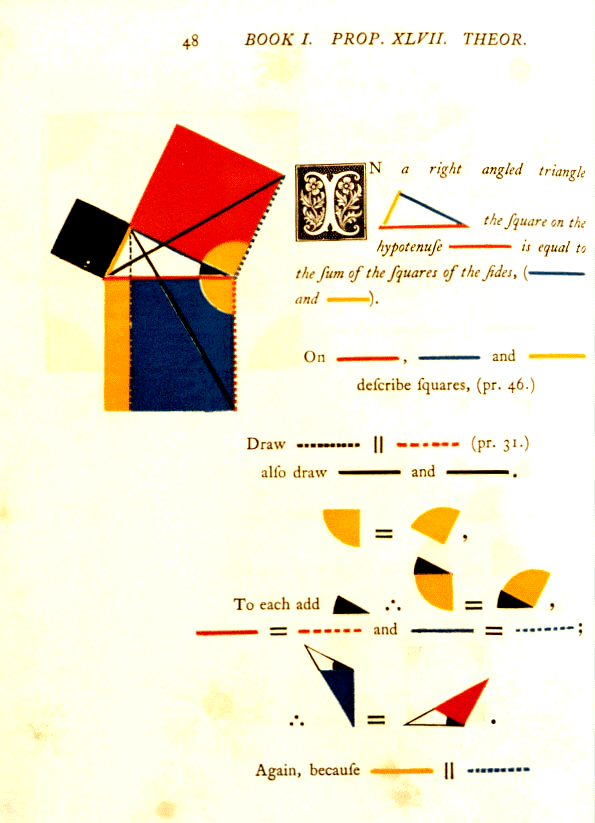
Just the first VI

THE ELEMENTS OF EUCLID

BOOK I.

DEFINITIONS.

I.

A point is that which has no parts.

II.

A line is length without breadth.

III.

The extremities of a line are points.

IV.

A straight or right line is that which lies evenly between its extremities.

V.

A surface is that which has length and breadth only.

VI.

The extremities of a surface are lines.

Byrne's 1847 Euclid

Mount Fuji

Thirty-six times and a hundred times
the artist portrayed the mountain.
Now pulled away, now compelled
(thirty-six times and a hundred times)

to return with glad impatience
to that ungraspable one.
To see it rise there, bold in outline,
withholding nothing of its majesty.

Out of each day emerging over and over,
letting the unrepeatable nights
fall away as though too small.
Each glimpse exhausted in an instant,

form ascending into form,
far off, impassive, wordless —
then suddenly the revelation
of an awareness lifting in the sky.

— Rilke, New Poems