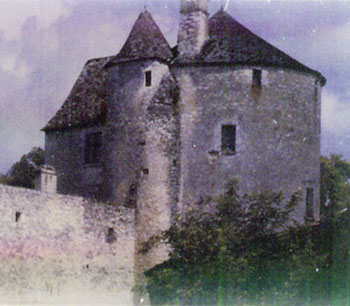
In the year of Christ 1571, at the age of thirty-eight, on the last day of February, anniversary of his birth, Michel de Montaigne, long weary of the servitude of the court and of public employments, while still entire, retired to the bosom of the learned Virgins, where in calm and freedom from all cares he will spend what little remains of his life now more than half run out. If the fates permit, he will complete this abode, this sweet ancestral retreat; and he has consecrated it to his freedom, tranquility, and leisure.
Quotes
Sonnet: Between Two Seas
Between two seas the sea-bird’s wing makes halt
…Wind-weary; while with lifting head he waits
…For what may come of glory thro’ the gates
That open still toward sunrise on the vault
High-domed of morning, & in flight’s default
…With spreading sense of spirit anticipates
…What new sea now may lure beyond the straits
His wings exulting that her winds exult
And fill them full as sails to seaward spread
…Fulfilled with fair speed’s promise. Pass, my song,
Forth to the heaven of thy desire & dread,
…The presence of our lord, long loved & long
Far above beholden, who to thee
Was as light kindling all a windy sea.
— Algernon Charles Swinburne
The world was a cosmic wobble: a shimmy
If my mind could gain a firm footing, I would not make essays, I would make decisions; but it is always in apprenticeship and on trial.
— Montaigne
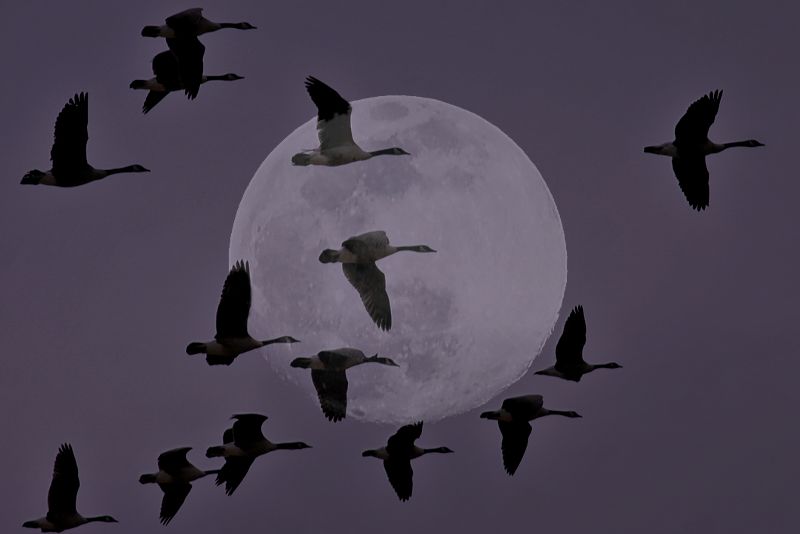
Lead, kindly fowl!
Montaigne’s philosophy — maybe
If others examined themselves attentively, as I do, they would find themselves, as I do, full of inanity and nonsense. Get rid of it I cannot without getting rid of myself. We are all steeped in it, one as much as another; but those who are aware of it are a little better off — though I don’t know.
— Montaigne
Import some of death’s delicacy and buoyancy into life
. . . slide over this world a bit lightly and on the surface . . .
— Montaigne
Keep calm, carry on
If at first you don’t succeed, try, try again. Then quit. There’s no point in being a damn fool about it.
— W. C. Fields
Supreme hallucinations
Human existence being an hallucination containing in itself the secondary hallucinations of day and night (the latter an insanitary condition of the atmosphere due to accretions of black air) it ill becomes any man of sense to be concerned at the illusory approach of the supreme hallucination known as death.
— de Selby (via Flann O’Brien)
Brothers and Sisters
Physical kinship together with a strong difference in temperament, incidentally, is disturbing; sometimes the mere idea of kinship is enough, the consciousness of self; siblings often cannot bear each other in a way that goes far beyond anything that might be justified; it derives merely from the existence of the other, from the slightly distorted mirror image they have of each other.
— Robert Musil, The Man Without Qualities
Taxpayers vs. Liberal Arts
The concept of a productivity spreadsheet came from the Texas Public Policy Foundation, a conservative think tank that Gov. Rick Perry invited to a state university summit in May 2008. The group suggested several reforms with a common theme: Let taxpayers see what’s going on at every public institution—and let them decide what’s worth subsidizing.
Bill Peacock, a vice president at the foundation, acknowledges that this approach could mean a radical reshaping of academia, with far more emphasis on filling students with practical information and less on intellectual pursuits, especially in the liberal arts.
That’s OK by him. “Taxpayers of the state of Texas,” Mr. Peacock says, should decide whether “they should be spending two years paying the salary of an English professor so he can write a book of poetry simply to add to the prestige of the university or the body of literature out there.”
When the choice is put that bluntly, Chester Dunning, a history professor at Texas A&M, wonders if he’d pass muster. Mr. Dunning teaches two classes a semester and has won several teaching awards. His salary of about $90,000 a year also covers the time he spends researching Russian literature and history. His most recent book argues that Alexander Pushkin’s drama “Boris Godunov” was a comedy, not a tragedy.
Mr. Dunning says his scholarly work animates his teaching and inspires his students. “But if you want me to explain why a grocery clerk in Texas should pay taxes for me to write those books, I can’t give you an answer,” he says.
His eyes sweep his cramped office, lined with books. Then Mr. Dunning finds his answer. “We’ve only got 5,000 years of recorded human history,” he says, “and I think we need every precious bit of it.”
— From “Putting a Price on Professors,” wsj
Get out of dodge
Logic is neither a science nor an art, but a dodge.
— Benjamin Jowett (via Jason)
American Essai
No prudent man dared to be too certain of exactly who he was or what he was about; everyone had to be prepared to become someone else. To be ready for such perilous transmigration was to become an American.
— Daniel Boorstin, describing the makeshift character of the colonial experience (Harpers)
Futility
Move him into the sun —
Gently its touch awoke him once,
At home, whispering of fields unsown.
Always it woke him, even in France,
Until this morning and this snow.
If anything might rouse him now
The kind old sun will know.
Think how it wakes the seeds, —
Woke, once, the clays of a cold star.
Are limbs, so dear-achieved, are sides,
Full-nerved — still warm — too hard to stir?
Was it for this the clay grew tall?
— O what made fatuous sunbeams toil
To break earth’s sleep at all?
— Wilfred Owen
To Dear Daniel
There is a loud noise of Death
Where I lay;
There is a loud noise of life
Far away.
From low and weary stride
Have I flown;
From low and weary pride
I have grown.
What does it matter now
To you or me?
What does it matter now
To whom it be?
Again the stain has come
To me;
Again the stain has come
for thee.
— Samuel Greenberg
This Living Hand
This living hand, now warm and capable
Of earnest grasping, would, if it were cold
And in the icy silence of the tomb,
So haunt thy days and chill thy dreaming nights
That thou wouldst wish thine own heart dry of blood
So in my veins red life might stream again,
And thou be conscience-calmed — see here it is —
I hold it towards you.
— John Keats’ last poem