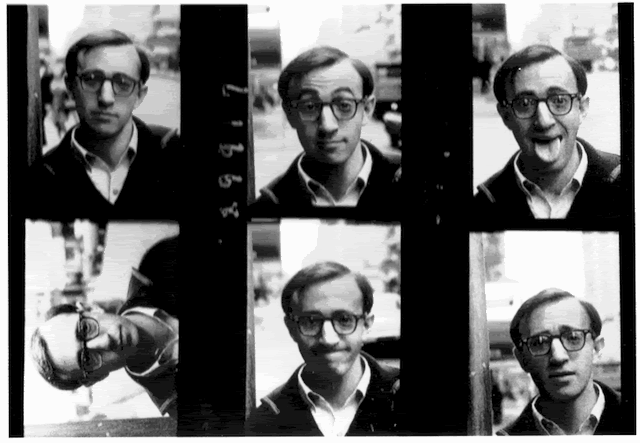
The two biggest myths about me are that I’m an intellectual, because I wear these glasses, and that I’m an artist because my films lose money. Those two myths have been prevalent for many years.
— Woody Allen

The two biggest myths about me are that I’m an intellectual, because I wear these glasses, and that I’m an artist because my films lose money. Those two myths have been prevalent for many years.
— Woody Allen

The composition of vast books is a laborious and impoverishing extravagance. To go on for five hundred pages developing an idea whose perfect oral exposition is possible in a few minutes! A better course of procedure is to pretend that these books already exist, and then to offer a resume, a commentary . . . More reasonable, more inept, more indolent, I have preferred to write notes upon imaginary books.


Ends are ape-chosen; only the means are man’s.
NARRATOR
Love casts out fear; but conversely fear casts out love. And not only love. Fear also casts out intelligence, casts out goodness, casts out all thought of beauty and truth. What remains is the dumb or studiedly jocular desperation of one who is aware of the obscene Presence in the corner of the room and knows that the door is locked, that there aren’t any windows. And now the thing bears down on him. He feels a hand on his sleeve, smells a stinking breath, as the executioner’s assistant leans almost amorously toward him. “Your turn next, brother. Kindly step this way.” And in an instant his quiet terror is transmuted into a frenzy as violent as it is futile. There is no longer a man among his fellow men, no longer a rational being speaking articulately to other rational beings; there is only a lacerated animal, screaming and struggling in the trap. For in the end fear casts out even a man’s humanity. And fear, my good friends, fear is the very basis and foundation of modern life. Fear of the much touted technology which, while it raises our standard of living, increases the probability of our violently dying. Fear of the science which takes away with one hand even more than what it so profusely gives with the other. Fear of the demonstrably fatal institutions for which, in our suicidal loyalty, we are ready to kill and die. Fear of the Great Men whom we have raised, by popular acclaim, to a power which they use, inevitably, to murder and enslave us. Fear of the War we don’t want and yet do everything we can to bring about.
As the Narrator speaks, we dissolve to the alfresco picnic of the baboons and their captive Einsteins. They eat and drink, with gusto, while the first two bars of “Onward Christian Soldiers” are repeated again and again, faster and faster, louder and louder. Suddenly the music is interrupted by the first of a succession of enormous explosions. Darkness. A long-drawn, deafening noise of crashing, rending, screaming, moaning. Then silence and increasing light, and once again it is the hour before sunrise, with the morning star and the delicate, pure music.
NARRATOR
Beauty inexpressible, peace beyond understanding . . .
Far off, from below the horizon, a column of rosy smoke pushes up into the sky, swells out into the likeness of an enormous toadstool and hangs there, eclipsing the solitary planet.
We dissolve again to the scene of the picnic. The baboons are all dead. Horribly disfigured by burns, the two Einsteins lie side by side under what remains of a flowering apple tree. Not far off a pressure tank is still oozing its Improved Glanders.
FIRST EINSTEIN
It’s unjust, it isn’t right . . .
SECOND EINSTEIN
We, who never did any harm to anybody;
FIRST EINSTEIN
We, who lived only for Truth.
NARRATOR
And that precisely is why you are dying in the murderous service of baboons. Pascal explained it all more than three hundred years ago. “We make an idol of truth; for truth without charity is not God, but his image and idol, which we must neither love nor worship.” You lived for the worship of an idol. But, in the last analysis, the name of every idol is Moloch. So here you are, my friends, here you are.
Stirred by a sudden gust, the stagnant plague-fog noiselessly advances, sends a wreath of pus-colored vapor swirling among the apple blossoms, then descends to engulf the two recumbent figures. A choking scream announces the death, by suicide, of twentieth-century science.
— Aldous Huxley, Ape and Essence (1948)

UNIBALL:
HI….
I AM WRITING TO THE MAKERS OF THE UNIBALL ‘GEL IMPACT’ PEN. UNFORTUNATELY I AM DOING SO WITH A PILOT P-500. AS OF THIS MOMENT, I HAVE YET TO LOCATE YOUR MAGNIFICENT PEN IN A STORE. AS SOON AS I FIND ONE I WILL PURCHASE ONE.
THIS IS THE DEAL….
I AM A STAND-UP COMEDIAN, MY NAME IS MITCH HEDBERG. I HAVE BEEN ON ‘THE LATE SHOW WITH DAVID LETTERMAN’ SIX TIMES. I HAVE A ½ HOUR COMEDY CENTRAL SPECIAL THAT IS PLAYED ON THE CHANNEL ALL THE TIME. I’VE MADE A GUEST APPEARANCE ON ‘THAT 70’S SHOW’ AND I HAVE A VERY VERY SMALL ROLE IN THE NEW CAMERON CROWE FILM, ‘ALMOST FAMOUS.’ I’VE DONE JUST ABOUT EVERY CABLE COMEDY SHOW AROUND.
RIGHT NOW I AM ON A TOUR IN AN RV WITH MY WIFE. OUR NEXT STOP IS RALEIGH, N.C.. ONE EVENING WE PULLED INTO A KOA TO SLEEP. I HAD TO FILL OUT A RESIGNATION SLIP AND THE SECURITY GUY HANDED ME ONE OF YOUR GEL IMPACT PENS TO DO THE JOB.
IT WAS A VERY SATISFYING WRITING EXPERIENCE TO SAY VERY LITTLE.
I WOULD LOVE TO ARRANGE A SPONSORSHIP DEAL WITH YOUR COMPANY SO I CAN PLUG THE THING. I’D BE SO HAPPY TO WEAR A UNIBALL T-SHIRT ON MY NEXT LETTERMAN SPOT. I’D PROMOTE THE PEN ANYWAY POSSIBLE.
I STILL HANDWRITE MOST OF MY JOKES. PERHAPS I WILL TYPE THEM MORE IF UNIBALL UNLEASHES A GEL IMPACT KEYBOARD. I USE PENS CONSTANTLY. YOUR PEN IS IT. I’VE TRIED BUYING EXPENSIVE PENS BUT NONE HAVE LIVED UP TO THE G.I.. SO SMOOTH AND EASY TO CONTROL.
IS THERE ANYTHING WE CAN DO TOGETHER? WOULD YOU BE INTERESTED IN CO-SPONSORING A TOUR? WE COULD PUT A LARGE BANNER ACROSS THE BACK OF THE STAGE: “GEL IMPACT IS RESPONSIBLE FOR THE WRITTEN VERSIONS OF THE JOKES THIS COMEDIAN IS SAYING.”
I’D BE SO PROUD.
LET ME KNOW WHAT YOU THINK AND THANKS A TON FOR READING THIS.
MY PILOT DAYS ARE CLOSING IN.
SINCERELY,
(Signed)
MITCH HEDBERG
(Address redacted)SORRY ABOUT ANY SPELLING MISHAPS!
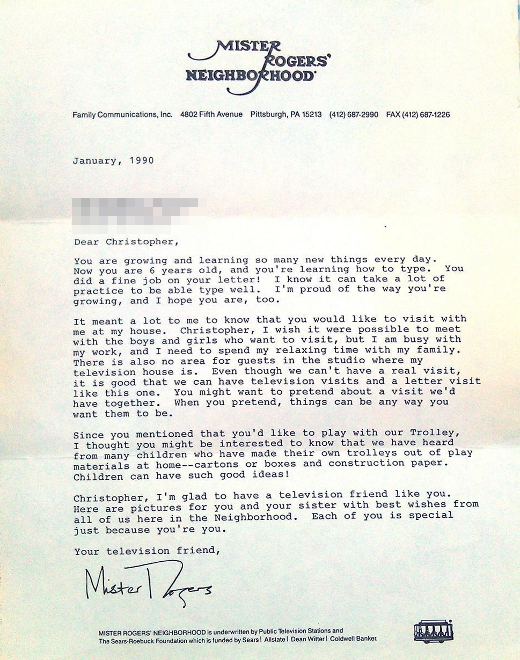 Transcript:
January, 1990
Dear Christopher,
You are growing and learning so many new things every day. Now you are 6 years old, and you’re learning how to type. You did a fine job on your letter! I know it can take a lot of practice to be able to type well. I’m proud of that way you’re growing, and I hope you are, too.
It meant a lot to me to know that you would like to visit with me at my house. Christopher, I wish it were possible to meet with the boys and girls who want to visit, but I am busy with my work, and I need to spend my relaxing time with my family. There is also no area for guests in the studio where my television house is. Even though we can’t have a real visit, it is good that we can have television visits and a letter visit like this one. You might want to pretend about a visit we’d have together. When you pretend, things can be any way you want them to be.
Since you mentioned that you’d like to play with our Trolley, I thought you might be interested to know that we have heard from many children who have made their own trolleys out of play materials at home–cartons or boxes and construction paper. Children can have such good ideas!
Christopher, I’m glad to have a television friend like you. Here are pictures for you and your sister with best wishes from all of us here in the Neighborhood. Each of you is special just because you’re you.
You television friend,
(Signed, ‘Mister Rogers’)
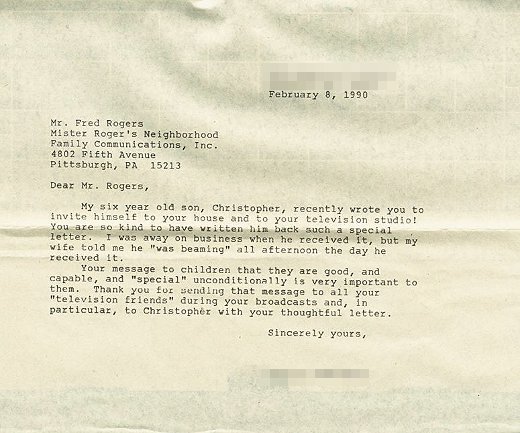
Transcript
February 8, 1990
Dear Mr. Rogers,
My six year old son, Christopher, recently wrote you to invite himself to your house and to your television studio! You are so kind to have written him back such a special letter. I was away on business when he received it, but my wife told me he “was beaming” all afternoon the day he received it.
Your message to children that they are good, and capable, and “special” unconditionally is very important to them. Thank you for sending that message to all your “television friends” during your broadcasts and, in particular, to Christopher with your thoughtful letter.
Sincerely yours,
[Redacted]
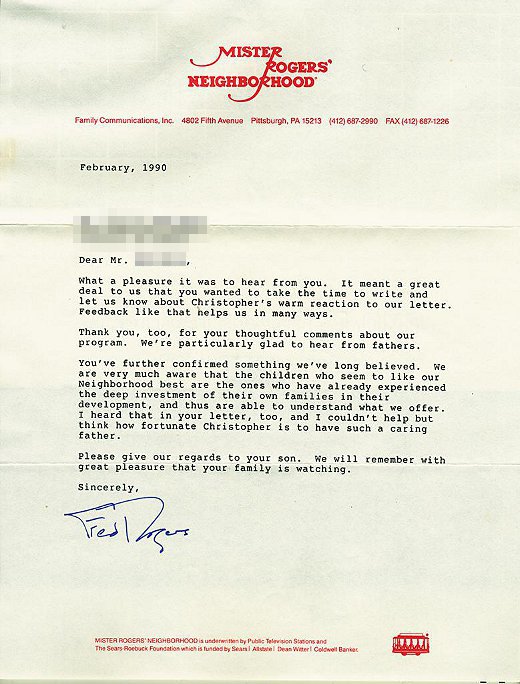
February, 1990
Dear Mr. [redacted],
What a pleasure it was to hear from you. It meant a great deal to us that you wanted to take the time to write and let us know about Christopher’s warm reaction to our letter. Feedback like that helps us in many ways.
Thank you, too, for your thoughtful comments about our program. We’re particularly glad to hear from fathers.
You’ve further confirmed something we’ve long believed. We are very much aware that the children who seem to like our Neighborhood best are the ones who have already experienced the deep investment of their own families in their development, and thus are able to understand what we offer. I heard that in your letter, too, and I couldn’t help but think how fortunate Christopher is to have such a caring father.
Please give our regards to your son. We will remember with great pleasure that your family is watching.
Sincerely,
(Signed, ‘Fred Rogers’)
Religion has done love a great service by making it a sin.
— Anatole France
Vertical stripes, horizontal stripes, noughts and crosses, eagles and hammers. Mere arbitrary signs. But every reality to which a sign has been attached is thereby made subject to its sign.
— Aldous Huxley, Ape and Essence

BLTC RESEARCH was founded in 1995 to promote paradise-engineering. We are dedicated to an ambitious global technology project. BLTC seek to abolish the biological substrates of suffering. Not just in humans, but in all sentient life.
Absurdly fanciful? No. The blueprint for a Post-Darwinian Transition to a cruelty-free world is conceptually simple, technically feasible and morally urgent.
At present, life on earth is controlled by self-replicating DNA. Selfish genes ensure that pain and malaise are endemic to the living world.
Yet all traditional religions, all social and economic ideologies, and all political parties, are alike in one respect. They ignore the biochemical roots of our ill-being. So the noisy trivia of party politics distract us from what needs to be done.
Fortunately, the old Darwinian order – driven by blind natural selection acting on random genetic mutations – is destined to pass into evolutionary history.
For third-millennium bioscience allows us to:
In the new reproductive era ahead, biotechnology will make us smarter, happier and just possibly nicer. Post-Darwinian superminds can abolish “physical” and “mental” pain altogether.
The ethical importance of the decisions we take can scarcely be exaggerated. For soon we’ll be forced to choose how much suffering in the living world we want to conserve and create. Or we can choose instead to abolish suffering completely.
Life on earth can be animated by gradients of ecstatic well-being beyond the bounds of normal human experience.
In the end, the greatest obstacles to lifelong superhealth and a cruelty-free world may prove ideological, not technical. BLTC RESEARCH campaign to promote paradise-engineering as a rigorous academic discipline and a mature applied science.
— BLTC
Cut open the dog head. Cup the pale green
brain. Its head is an avocado.
Take out its stone then the fork from your pocket.
Drag it over the muzzle. The blood runs out in ribbons
into the hair. Its dog-ribbon hair.
The dog-egg in the pan boils, barks through red
and endless dark, bubbles stars into light,
lies down inside my bitten ankles, ballerina tutus,
they dance away from me. Our sheets hang like lungs
on the washing line. Capillaries shoot blue, bark green
Dobermans through the streets
of Santiago. the size of small horses,
liquid lime, they run as zaps, snapping
the swinging tassels on my bag.
— Liz Adams

But there is something about this narrative hectoring about men not understanding manhood that seems particularly brutal in that it specifically attacks them for emotional ineptitude while simultaneously attacking them for having emotions.
— NPR
You made your great mistake when you abandoned the poetry business, and set up shop as a wizard in general practice. You wrote, in your day, some very good verse, and I had the pleasure, along with other literary buzzards, of calling attention to it at the time. But when you fell into the hands of those London logrollers, and began to wander through pink fogs with them, all your native common sense oozed out of you, and you set up a caterwauling for all sorts of brummagem Utopias, at first in the aesthetic region only but later in the regions of political and aesthetic baloney. Thus a competent poet was spoiled to make a tinhorn politician.
— H. L. Mencken, letter to Ezra Pound, Nov. 28, 1936
A deliberative figure: the amorous subject wonders, not whether he should declare his love to the loved being (this is not a figure of avowal), but to what degree he should conceal the turbulences of his passion: his desires, his distresses: in short, his excesses (in Racinian language: his fureur).
. . . A secondary anxiety seizes me, which is that I must determine the degree of publicity I shall give to my initial anxiety.
2. I am caught up in a double discourse, from which I cannot escape. On the one hand, I tell myself: suppose the other, by some arrangement of his own structure, needed my questioning? Then wouldn’t I be justified in abandoning myself to the literal expression, the lyrical utterance of my “passion”? Are not excess and madness my truth, my strength? And if this truth, this strength ultimately prevailed?
But on the other hand, I tell myself: the signs of this passion run the risk of smothering the other. Then should I not, precisely because of my love, hide from the other how much I love him? I see the other with a double vision: sometimes as object, sometimes as subject; I hesitate between tyranny and oblation. Thus I doom myself to blackmail: if I love the other, I am forced to seek his happiness; but then I can only do myself harm: a trap: I am condemned to be a saint or a monster: unable to be the one, unwilling to be the other: hence I tergiversate: I show my passion a little.
3. To impose upon my passion the mask of discretion (of impassivity): this is a strictly heroic value: “It is unworthy of great souls to expose to those around them the distress they feel” (Clotilde de Vaux); Captain Paz, one of Balzac’s heroes, invents a false mistress in order to be sure of keeping his best friend’s wife from knowing that he loves her passionately.
Yet to hide a passion totally (or even to hide, more simply, its excess) is inconceivable: not because the human subject is too weak, but because passion is in essence made to be seen: the hiding must be seen: I want you to know that I am hiding something from you, that is the active paradox I must resolve: at one and the same time it must be known and not known: I want you to know that I don’t want to show my feelings: that is the message I address to the other. Larvatus prodeo: I advance pointing to my mask: I set a mask upon my passion, but with a discreet (and wily) finger I designate this mask. Every passion, ultimately, has its spectator: at the moment of his death, Captain Paz cannot keep from writing to the woman he has loved in silence: no amorous oblation without a final theater: the sign is always victorious.
4. Let us suppose that I have wept, on account of some incident of which the other has not even become aware (to weep is part of the normal activity of the amorous body), and that, so this cannot be seen, I put on dark glasses to mask my swollen eyes (a fine example of denial: to darken the sight in order not to be seen). The intention of this gesture is a calculated one: I want to keep the moral advantage of stoicism, of “dignity” (I take myself for Clotilde de Vaux), and at the same time, contradictorily, I want to provoke the tender question (“But what’s the matter with you?”); I want to be both pathetic and admirable, I want to be at the same time a child and an adult. Thereby I gamble, I take a risk: for it is always possible that the other will simply ask no question whatever about these unaccustomed glasses; that the other will see, in fact, no sign.
5. In order to suggest, delicately, that I am suffering, in order to hide without lying, I shall make use of a cunning preterition: I shall divide the economy of my signs. The task of the verbal signs will be to silence, to mask, to deceive: I shall never account, verbally, for the excesses of my sentiment. Having said nothing of the ravages of this anxiety, I can always, once it has passed, reassure myself that no one has guessed anything. The power of language: with my language I can do everything: even and especially say nothing.
I can do everything with my language, but not with my body. What I hide by my language, my body utters. I can deliberately mold my message, not my voice. By my voice, whatever it says, the other will recognize “that something is wrong with me.” I am a liar (by preterition), not an actor. My body is a stubborn child, my language is a very civilized adult . . .
— Roland Barthes, A Lover’s Discourse
Another peal of childish laughter broke out in the kitchen. Lady Hamilton at sixteen sounded as though she were about eleven. And yet how mature, how technically perfect had been the look with which she greeted Bob! Obviously, the most disquieting fact about Rosie was that she was simultaneously innocent and knowing, a calculating adventuress and a pigtailed schoolgirl.
— Aldous Huxley, Ape and Essence

 The Floating Library